Safe following distance is the gap you leave between your car and the one ahead so that you can stop without hitting it. The law gives no metres: the Portuguese Highway Code requires a «sufficient distance». In practice, use the 2-second rule (4 seconds or more in bad conditions), which adapts to your speed.
This guide explains what article 18 says, how to count the seconds, how many metres that is at 50, 90 and 120 km/h, what changes in the rain and what can happen if you tailgate.
What the law says about following distance
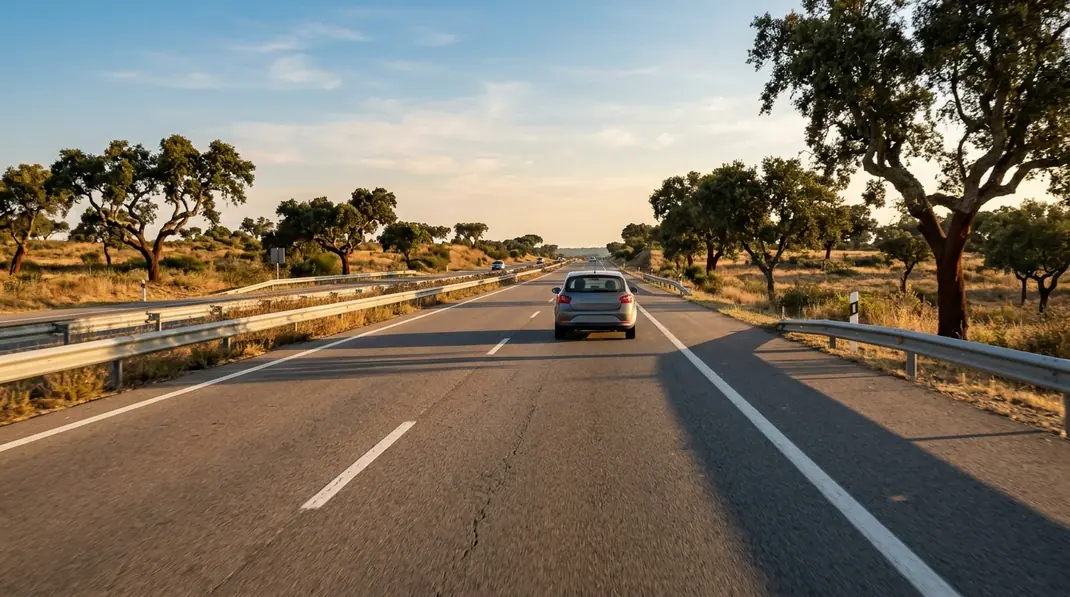
Article 18 of the Portuguese Código da Estrada (Highway Code) says that the driver of a moving vehicle must keep between their vehicle and the one in front «the sufficient distance to avoid accidents in case of sudden stopping or slowing» of that vehicle, with particular attention to vulnerable road users.
Note what is missing: there is no number of metres for cars. The law leaves the decision to the driver, who has to adjust it to speed, road condition, vehicle and weather. That is why a rule of thumb is taught instead of a table.
Article 24 points the same way: the driver must regulate speed so as to be able to stop in the free and visible space ahead, and, except in imminent danger, must not suddenly reduce speed without making sure that this does not endanger those behind.
The 2-second rule: how to count
It is the simplest way to measure the gap without calculating metres. It works like this:
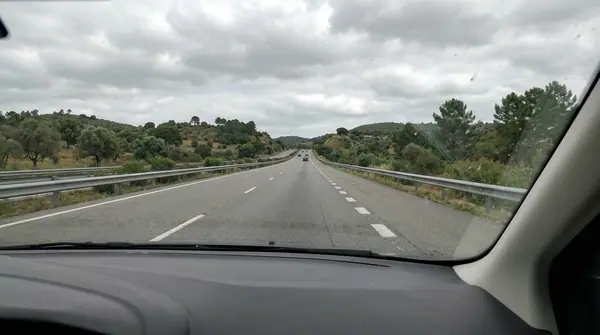
- Pick a fixed point at the roadside: a pole, a sign or a bridge.
- When the rear of the car ahead passes that point, start counting «one thousand one, one thousand two».
- If your car reaches the point before you finish counting, you are too close: lift off the accelerator and let the gap open.
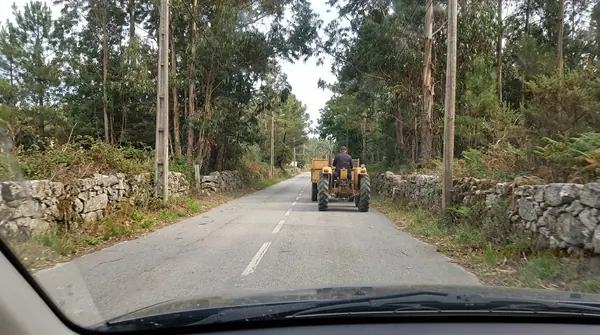
The usual recommendation is at least 2 seconds in good conditions (it is not a figure set by law). Speed is built into the count: the faster you go, the more metres fit in two seconds. If the weather is bad, it is dark, you carry a load or a trailer, or the vehicle ahead is a lorry that blocks your view, move to 4 seconds or more.
How many metres at 50, 90 and 120 km/h
The figures below are orders of magnitude for a dry road, tyres in good condition and an alert driver. They are not measurements or legal limits. The distance covered while reacting (about 1 second) is the speed in km/h divided by 3.6, in metres. Braking uses the rule of thumb usually taught in driving schools: (speed ÷ 10)².
- 50 km/h: about 14 m during the reaction and 25 m of braking, so close to 39 m to stop. Two seconds is about 28 m.
- 90 km/h: about 25 m in the reaction and 81 m of braking: close to 106 m to stop. Two seconds is 50 m.
- 120 km/h: about 33 m in the reaction and 144 m of braking: close to 177 m to stop. Two seconds is 67 m.
Note that 2 seconds on their own fall short of the total stopping distance at every speed in the list. The rule counts on the car ahead also needing room to brake. If it can stop suddenly (a crash, a stationary lorry), that room does not exist and you need more margin.
Rain, night and wet roads: leave more room
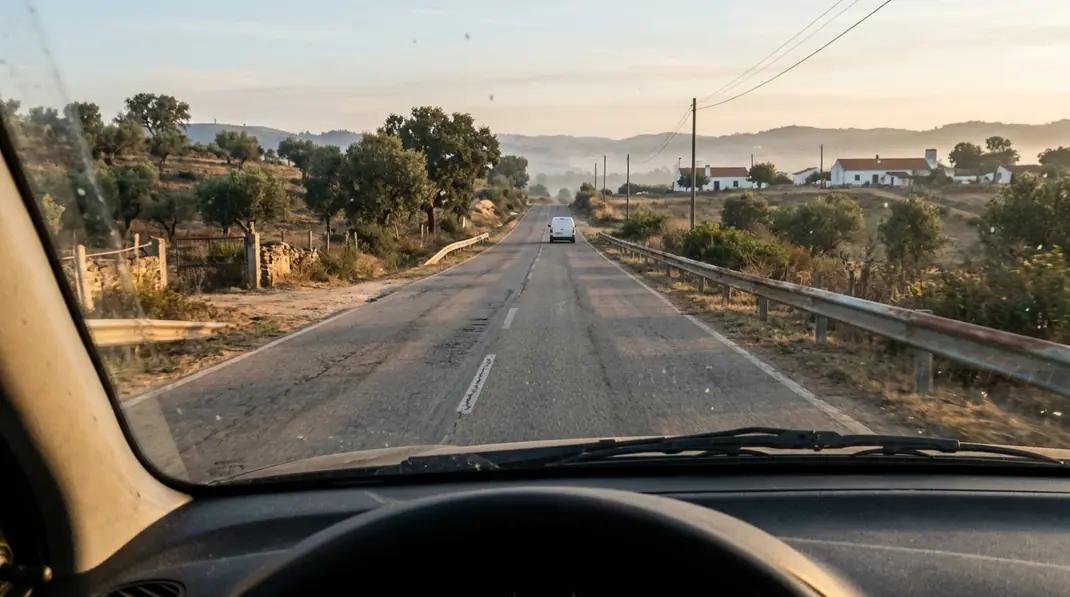
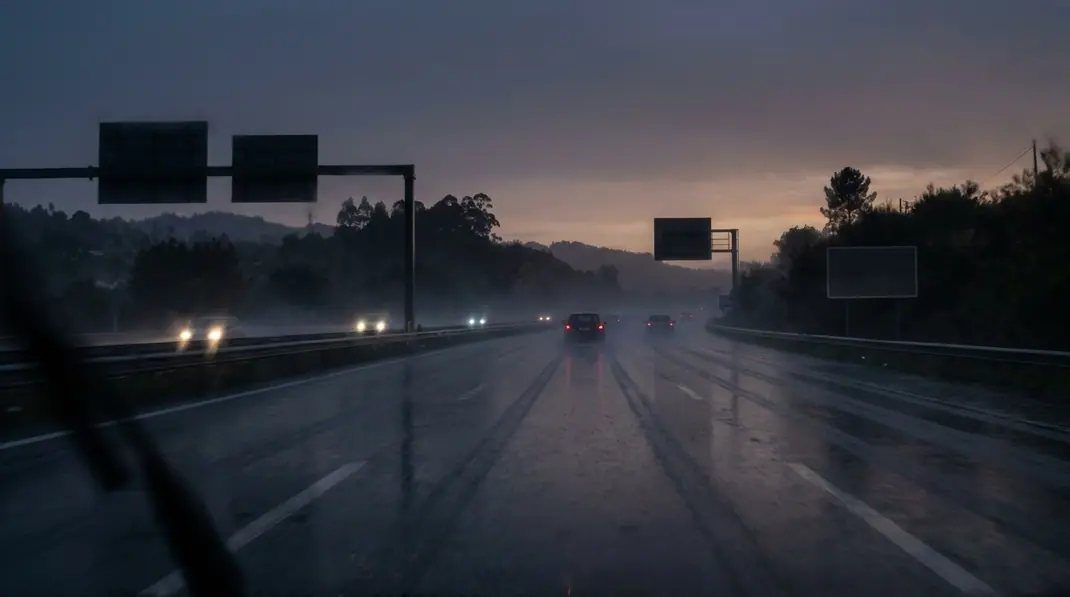
On a wet road braking gets considerably longer, and in heavy rain visibility also drops. As a safety margin, count on double the braking distance and move to 4 seconds or more. If in doubt, leave more room.
Tyres are what links the car to the ground: worn tyres lengthen braking. See the legal minimum in the guide to bald tyres and check the pressure in the guide to tyre pressure. With standing water on the tarmac there is also the risk of aquaplaning, where braking no longer helps.
Fine for tailgating
Article 18(4) provides a fine of €60 to €300. In addition, the Código da Estrada classifies disregard of the rules on distance between vehicles as a serious offence (article 145) and, on motorways and equivalent roads, as a very serious one (article 146). That classification opens the door to the accessory sanction of a driving ban.
The ANSR states that serious and very serious offences can also be punished with a driving ban: from 1 month to 1 year for serious ones and from 2 months to 2 years for very serious ones.
The fine and sanction actually applied depend on the offence notice and the authority’s decision, so always check the version of the Code in force. See also the amounts in the guide to speeding fines.
If a collision happens anyway, the guide to the amicable accident declaration explains how to fill in the form with the other driver.
Cyclists: the 1.5 metre side gap
Safe distance is not only about the front. Article 18 also requires the driver of a motor vehicle to keep at least 1.5 m of side distance from a cycle travelling in the same carriageway. If there is no room to keep that margin, wait before overtaking.
Cars with help: distance control and automatic braking
Many newer cars have assistants that help keep the distance, but they do not replace the driver. On 18 November 2026 there were 9,555 active cars on AUTO.MOTO.pt. Among the adverts that list equipment, 207 mention distance control and 171 emergency braking. See the used cars for sale and use the filters to compare.
These systems have limits: they may not detect a wet surface or a stopped car round a bend well. Keep counting your 2 seconds.
Figures according to the Highway Code and the ANSR at the date of publication; always check the version in force. For more driving advice, see Prevenção Rodoviária Portuguesa.
Frequently asked questions
What is the safe distance between cars?
The law requires a «sufficient distance» and sets no metres. In practice, use the 2-second rule, or 4 seconds or more in rain, at night or with a load.
How many metres is 2 seconds?
It depends on speed: about 28 m at 50 km/h, 50 m at 90 km/h and 67 m at 120 km/h.
What is the braking distance at 120 km/h?
On a dry road, with the rule of thumb (speed ÷ 10)², about 144 m of braking alone, and close to 177 m counting 1 second of reaction. It is an order of magnitude.
Can I be fined for not keeping a safe distance?
Yes. Article 18 provides a fine of €60 to €300, and the Code classifies disregard of the distance rules as a serious offence, or very serious on a motorway, with a possible driving ban.
Does the distance change in the rain?
Yes. A wet road lengthens braking, so count on double as a margin and move to 4 seconds or more.
How much room should I give a cyclist?
At least 1.5 m of side distance, according to article 18 of the Highway Code.