In Portugal, a passenger car tyre is bald, and illegal, when its main grooves are less than 1.6 mm deep. The fine is roughly €50 to €250, the police can seize the car's registration document and the car fails its inspection. For safety, replace it well before that, at around 3 mm.
This guide explains what the law says, how to check the tread at home (with the wear indicators or a €1 coin), what happens at a police check and when it is worth replacing your tyres, especially with autumn and winter rain.
What is the minimum tyre tread depth in Portugal?
The rule is in article 6 of Regulatory Decree 7/98. The limits are:
- passenger cars and trailers up to 3,500 kg: at least 1.6 mm in the main grooves;
- motorcycles, heavy vehicles and trailers over 3,500 kg: at least 1 mm;
- the depth applies all the way round the tyre, not just at the most worn point;
- it applies to every tyre, including the spare where one is mandatory.
The "main grooves" are those in the central part of the tread, which covers about three quarters of its width. A tyre with 3 mm in the centre and 1 mm on one shoulder is already a problem: it may point to wrong pressure or alignment.
It is not just the depth
The same decree bans tyres with cuts or damage that reach or expose the carcass, on the tread or the sidewalls. It also bans regrooving a worn tyre on passenger cars. Small punctures and minor marks do not count.
Fine for bald tyres: how much
Driving a passenger car whose tyres break these rules is an administrative offence under article 11 of the decree. The text still sets the fine in escudos, from 10,000$ to 50,000$. At the official conversion rate, that is about €49.88 to €249.40.
This offence is not on the Highway Code's list of serious or very serious offences, so as a rule it does not cost licence points. What follows the fine matters more.
Seized documents and an extra inspection
Under article 10 of the decree, when a car is driven with tread below the minimum or with regrooved tyres, the officer seizes the vehicle document and issues a guia (temporary travel document). That guia is only valid for the trip to your destination and to the nearest inspection centre, where the car is inspected.
- the route on the guia may not include motorways or roads with a limit above 90 km/h;
- the driver must keep to a moderate speed;
- breaking the guia's conditions is another offence, with a higher fine;
- if you replace the tyre on the spot, for example with the spare, these measures do not apply.
In practice, how the law is applied can depend on the situation and the officer. The Highway Code also allows, for easily repaired tyre faults, a guia to show the repaired car at a police station within eight days, with the minimum and maximum fine halved. If you are given a guia, read its deadline and conditions carefully.
Bald tyres fail the inspection
Tyres are checked at the periodic inspection. IMT, on its inspection types page, notes that the tread must be at least 1.6 mm deep. A tyre below the minimum, with bulges or with the carcass showing makes the car fail, and you pay for the re-inspection after replacing it.
The inspection price, deadlines and other common fails are in our guide to the car inspection in Portugal in 2026. Tyres are one of the easiest fails to avoid: just look at them a few days before.
How to tell if a tyre is bald
You do not need a workshop to get an idea. There are three simple ways to check the tread, from the quickest to the most accurate.
1. Tread wear indicators (TWI)
Every car tyre has small rubber bars inside the main grooves, 1.6 mm high. They are called tread wear indicators, or TWI. On the sidewall, their position is marked with the letters "TWI" or a small triangle.
If the tread is level with these bars anywhere around the wheel, the tyre has reached the legal limit and must be replaced. Check all four tyres and, if you can, turn the steering wheel fully to one side to see the front ones better.
2. The €1 coin test
Put a €1 coin into a main groove, silver centre down. The gold outer ring is about 3 mm wide. If the whole ring is visible, the tread is below 3 mm and it is time to think about new tyres.
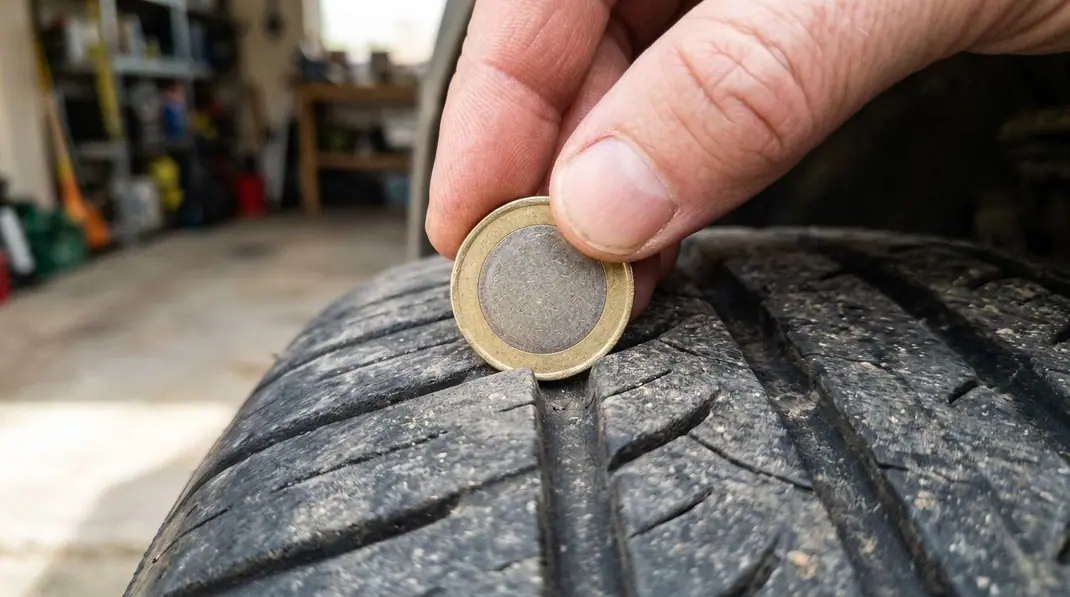
The coin does not prove you are within the law: between 3 mm and 1.6 mm the difference is hard to see this way. For that, use the TWI bars or a gauge.
3. Tread depth gauge
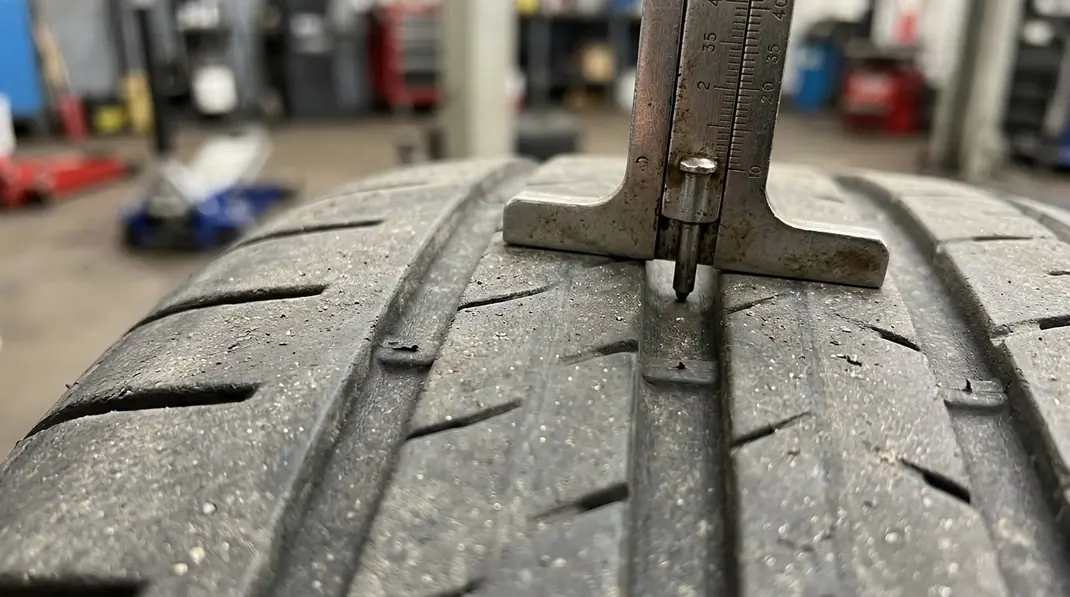
A tread depth gauge costs a few euros at any DIY or car parts shop. Measure at several points around each tyre, always in the central grooves. Keep the lowest reading: that is the one that counts.
When to replace tyres: do not wait for 1.6 mm
The legal minimum is a limit, not a recommendation. With less tread, the tyre clears less water and the braking distance on wet roads gets longer. Tyre makers usually advise replacing at around 3 mm for summer tyres and 4 mm for winter tyres.
Also replace a tyre, even with enough tread, when it has:
- cuts, bulges or deformation on the sidewall;
- cracks in the rubber, a sign of ageing;
- very uneven wear between the inside and outside edge, which calls for an alignment;
- many years on it: the DOT code on the sidewall gives the week and year of manufacture (for example, "2321" is week 23 of 2021).
As for age, many manufacturers recommend having tyres checked from five years old and not using them beyond ten, even with tread left. A dried-out tyre loses grip, especially in the cold and rain.
Replace two or four?
Ideally, always replace both tyres on the same axle, with the same size and model. If you only replace two, major tyre makers usually recommend fitting the new ones at the rear, so the back of the car does not slide in a wet bend. Ask your workshop.
Bald tyres, rain and winter
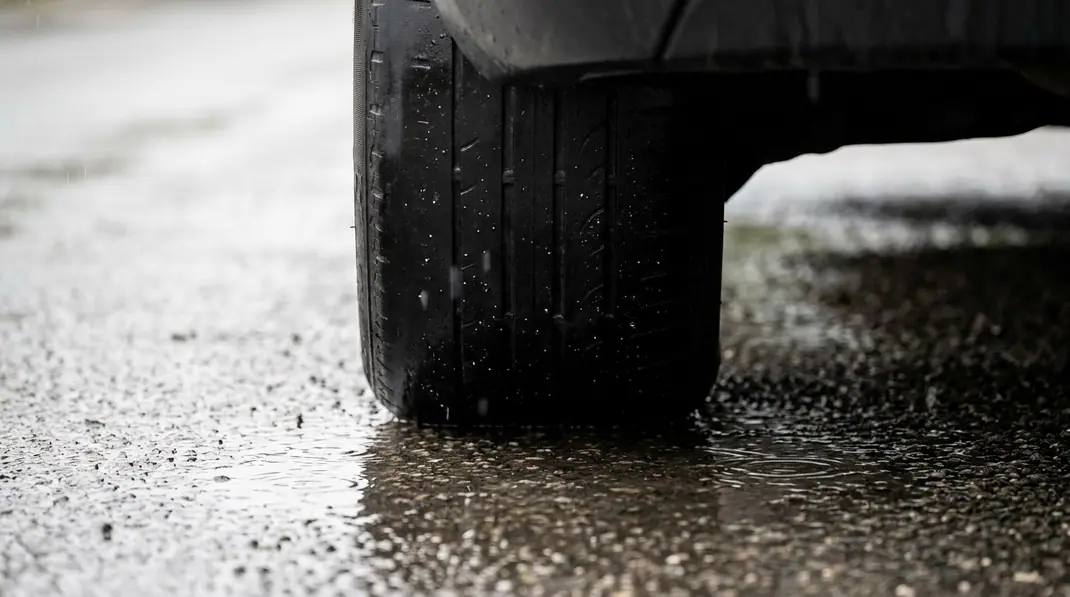
Autumn and winter are when worn tyres show most in Portugal. In heavy rain, a bald tyre can no longer push the water away and may aquaplane: the car loses contact with the road and stops responding to the steering and brakes.
Before winter, check the tread and the tyre pressure, which drops in the cold. Winter tyres are not mandatory in Portugal. In the mountains, on stretches with the mandatory sign, what counts are snow chains.
When buying, look at the EU tyre label. Regulation (EU) 2020/740 requires it to show wet grip, from A (best) to E. If you drive a lot in the rain, that is the figure that matters most.
How much new tyres cost
Our tyre search lists 32,708 tyres from online shops. In one of the most common sizes, 205/55 R16, a summer tyre starts at €54.95, and the median price is €90.20 per tyre, before fitting. In size 195/65 R15, the median price is €81.81.
Two new tyres for one axle, even at the median price and before fitting, cost less than the maximum fine for driving on bald ones. To choose between brands, ranges and types, read our guide on how to choose the right tyres for your car.
Buying a used car? Look at the tyres
Bald tyres on a car for sale are not a reason to walk away, but they are a cost to negotiate: a set of four can easily top €300. Uneven wear can also point to alignment or suspension problems. Take a gauge when you go to see the used cars for sale.
Frequently asked questions
What is the legal minimum tread depth?
1.6 mm in the main grooves for passenger cars and trailers up to 3,500 kg. For motorcycles and heavy vehicles, the minimum is 1 mm.
What is the fine for bald tyres?
Regulatory Decree 7/98 sets a fine of about €49.88 to €249.40 for passenger cars. On top of that, the car's document can be seized until it is inspected.
Do bald tyres cost licence points?
As a rule, no. The offence is not on the Highway Code's list of serious or very serious offences, which are the ones that cost points.
How do I know if a tyre is bald?
Check whether the tread is level with the wear indicators (TWI) inside the grooves. With a €1 coin, if the gold ring is fully visible, the tread is below 3 mm.
At how many millimetres should I replace tyres?
The law requires 1.6 mm, but for safety it is best to replace at around 3 mm for summer tyres and 4 mm for winter tyres.