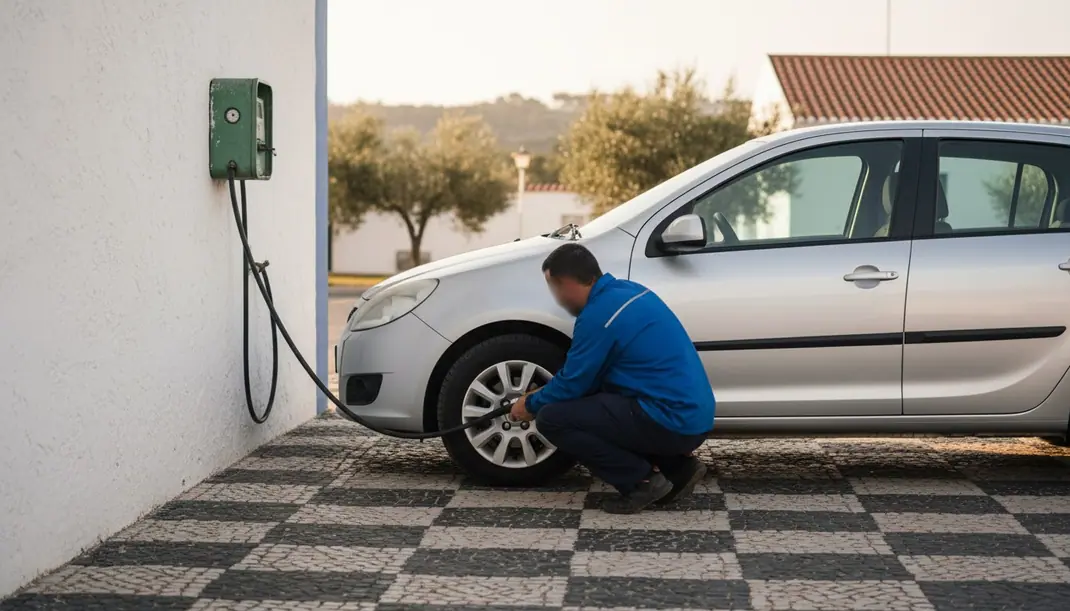
The right tyre pressure is the one the car manufacturer specifies, not the figure printed on the tyre. You will find it on a sticker on the driver's door pillar, inside the fuel flap or in the owner's manual. On average, for passenger cars, it is between 2.1 and 2.5 bar.
Tyre pressure is measured cold, once a month and before every long trip. It takes five minutes at a petrol station and saves fuel, tyres and trouble on the road.
This guide explains where to find your car's tyre pressure, gives a tyre pressure table in bar and PSI, shows how to check and inflate your tyres and what to do when the tyre pressure warning light comes on.
What tyre pressure does my car need?
There is no single ideal pressure for every car. It depends on the model, the tyre size and the load. According to Michelin's tyre pressure guide, the manufacturer's recommended pressure is usually:
- on a sticker on the driver's door pillar, visible when you open the door;
- inside the fuel filler flap;
- in the owner's manual, usually kept in the glovebox.
Note two details. Front and rear tyres may need different pressures. And many stickers show two values: the normal pressure for everyday driving and the loaded pressure for when the car is full of people or luggage.
Why shouldn't I use the pressure printed on the tyre?
The number on the tyre sidewall is the maximum pressure the tyre can take, not the pressure to drive on. Portugal's road safety association, Prevenção Rodoviária Portuguesa, is clear: always use the car manufacturer's figure. Inflating to the tyre's maximum makes it hard, reduces grip and wears the centre of the tread.
Tyre pressure table in bar and PSI
In Portugal air pumps almost always show bar, but some manuals and compressors use PSI or kPa. The conversion is fixed: 1 bar = 14.5 PSI = 100 kPa. These are the most common values, rounded to the nearest half PSI:
- 1.8 bar = 26 PSI = 180 kPa
- 2.0 bar = 29 PSI = 200 kPa
- 2.1 bar = 30.5 PSI = 210 kPa
- 2.2 bar = 32 PSI = 220 kPa
- 2.3 bar = 33.5 PSI = 230 kPa
- 2.4 bar = 35 PSI = 240 kPa
- 2.5 bar = 36.5 PSI = 250 kPa
- 2.6 bar = 37.5 PSI = 260 kPa
- 2.8 bar = 40.5 PSI = 280 kPa
- 3.0 bar = 43.5 PSI = 300 kPa
This table only converts units. Your car's pressure is still the one on the sticker. If you switched to a different tyre size from the original, ask the garage that fitted the tyres for the right pressure.
How to check your tyre pressure
The most important rule is to measure with cold tyres. Driving warms the tyres and raises the pressure, so a reading after a journey is misleading. The PRP considers a car cold when it has been parked for at least 2 hours or has not yet been driven. In practice:
- use the petrol station closest to home and measure as soon as you arrive, with only a few kilometres driven;
- remove the valve cap and press the pump nozzle or gauge firmly onto the valve;
- compare the reading with the sticker and add or release air until it matches;
- repeat on all four tyres and put the caps back on, as they protect the valve from dust and moisture;
- do not forget the spare tyre, if the car has one.
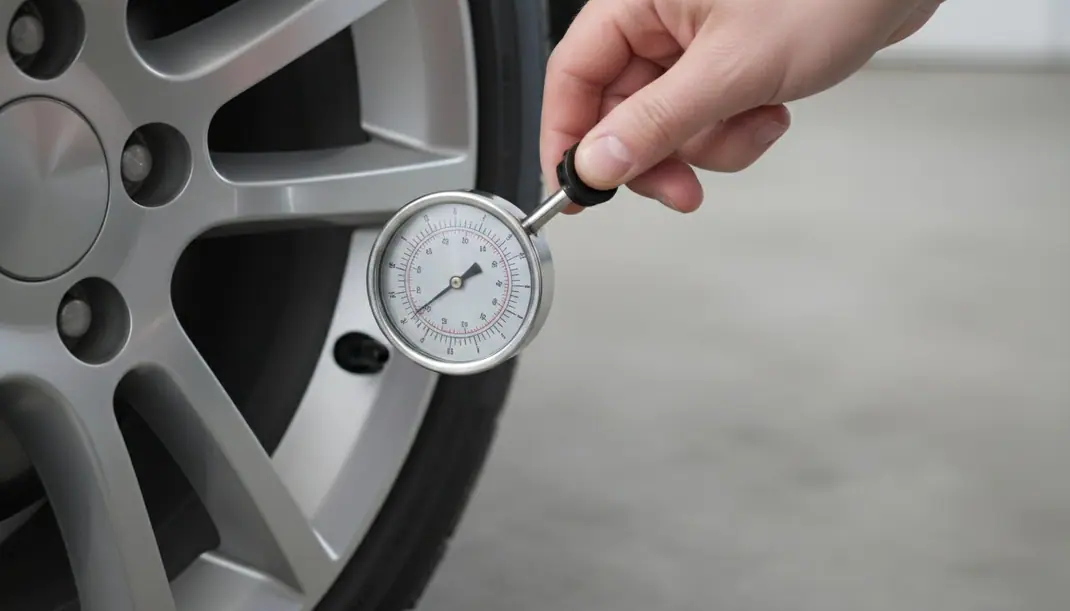
If you really have to measure with warm tyres, never let air out: the pressure will drop on its own as they cool. Petrol station gauges are not always calibrated, and a gauge of your own, digital or analogue, helps you double-check.
When should tyre pressure be checked?
It is a common question for anyone studying for the Portuguese theory test. The official sources give a simple answer: regularly, and with cold tyres. The Directorate-General for Energy and Geology, in its fuel-saving tips, recommends checking the pressure every month, with cold tyres and the manufacturer's values.
The PRP goes further and advises every two to four weeks and always before long trips or when carrying extra load. Even without a puncture, a tyre naturally loses about 0.07 to 0.1 bar a month, and more with the temperature swings of autumn and winter.
What happens when tyre pressure is wrong
Under- or over-inflated tyres are hard to spot by eye, but you feel them in your wallet and on the road:
- low pressure: the tyre flexes, wears on the shoulders, runs hotter and can burst on long, hot journeys. Steering feels heavier;
- high pressure: the tyre becomes stiff, wears in the centre, has less grip in bends and on wet roads, and the ride is harsher;
- braking: according to Michelin, 1 bar below the recommended pressure can add 11 metres to the braking distance on a wet road;
- fuel: the PRP estimates that 0.3 bar too little can raise fuel consumption by about 1.5%.
With fuel prices in Portugal where they are, 1.5% of a weekly tank is money thrown away. And the heat that builds up in an under-inflated tyre is one of the main causes we cover in our article on what can cause tyres to overheat.
Tyre pressure monitoring system (TPMS)
The tyre pressure monitoring system, known as TPMS, warns you on the dashboard when a tyre is low on air. According to Michelin, it has been compulsory in Europe on new cars since 1 November 2014. On AUTO.MOTO.PT, 74% of the cars for sale are from 2015 or newer: there are currently 5,667 used cars from 2015 onwards.
There are two types of sensor:
- direct: a sensor inside the tyre or on the valve measures the real pressure and shows it on the dashboard, sometimes tyre by tyre;
- indirect: the car works out the pressure from the wheel speed, using the ABS and ESP sensors. An under-inflated tyre is slightly smaller and turns faster.
The tyre pressure light is on: what should I do?
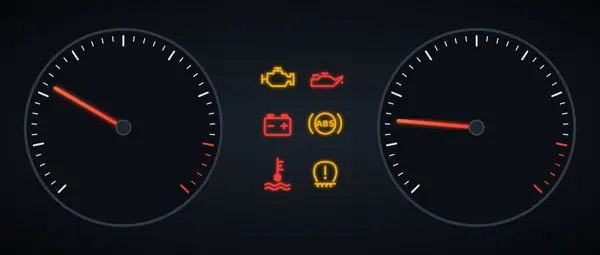
Depending on the car, the warning is a dashboard light or a picture of the car showing the pressure of each tyre. On many models the light shows a tyre in cross-section with an exclamation mark. When it comes on, slow down, stop somewhere safe and check whether any tyre is visibly flat. If none is, drive calmly to the nearest petrol station and set the pressure on all four tyres.
Do not wait for the light before inflating your tyres. Michelin explains that the warning only appears once the tyre has lost about 20% of its air, around 0.4 bar, and by then it is already wearing faster. After switching to a different tyre size, the system may need to be reconfigured at a garage.
Pressure with a full load, on trips and when changing tyres
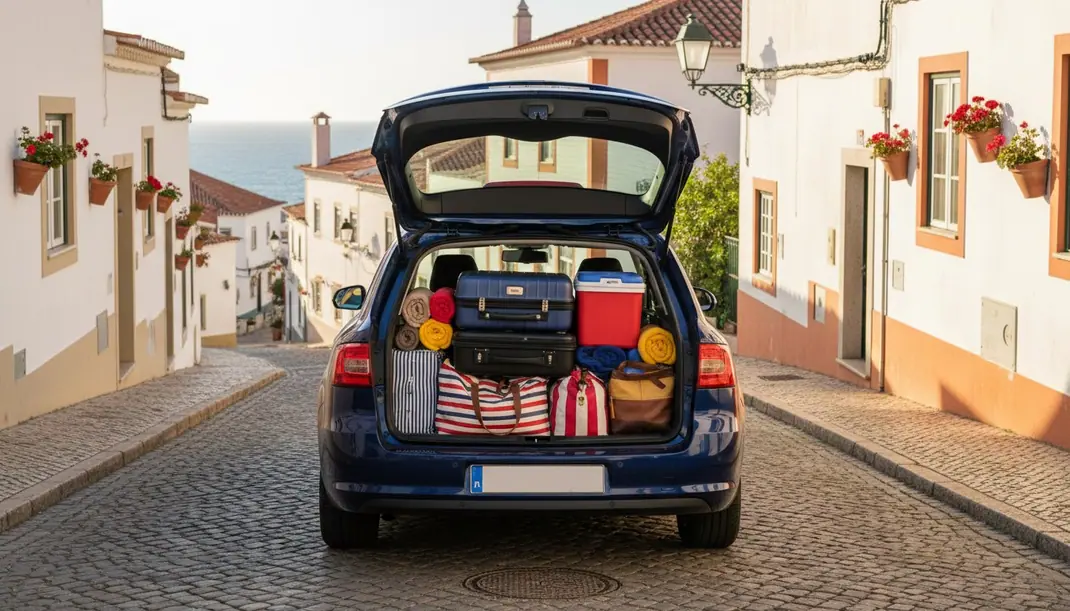
Before the holidays, with the car full and the family on board, use the loaded pressure on the sticker. Measure before you leave home, with cold tyres, not halfway down the motorway. When you get back, return to the normal pressure.
When it is time to replace the tyres, the DGEG points out that a tyre with efficiency class A can save between 5 and 7% of fuel compared with a class G tyre. We explain what to look for on the label and in the size in our guide on how to choose the right tyres for your car. To compare prices, you can search tyres by size.
Tyres and the vehicle inspection
At the periodic inspection, tyre condition counts. The IMT reminds drivers that before going to the test centre they can check that the tread is at least 1.6 mm deep. See also how often your car needs an inspection in Portugal.
Frequently asked questions about tyre pressure
What is the ideal tyre pressure for cars?
The one the manufacturer gives on the door sticker, inside the fuel flap or in the manual. On average, for passenger cars, it is between 2.1 and 2.5 bar, but some cars fall outside that range.
How many PSI is 2.2 bar?
About 32 PSI. To convert, multiply bar by 14.5: 2.5 bar is about 36.5 PSI.
How often should I check my tyre pressure?
At least once a month and always before a long trip or when the car is loaded. The spare tyre needs checking too.
Can I rely on the tyre pressure sensor alone?
No. The sensor only warns you once the tyre has lost about 20% of its air. A monthly check is still recommended, even on cars with TPMS.
Do the rear tyres need the same pressure as the front ones?
Not always. Many cars have different values front and rear, and another pressure for when they are loaded. Follow your car's sticker.