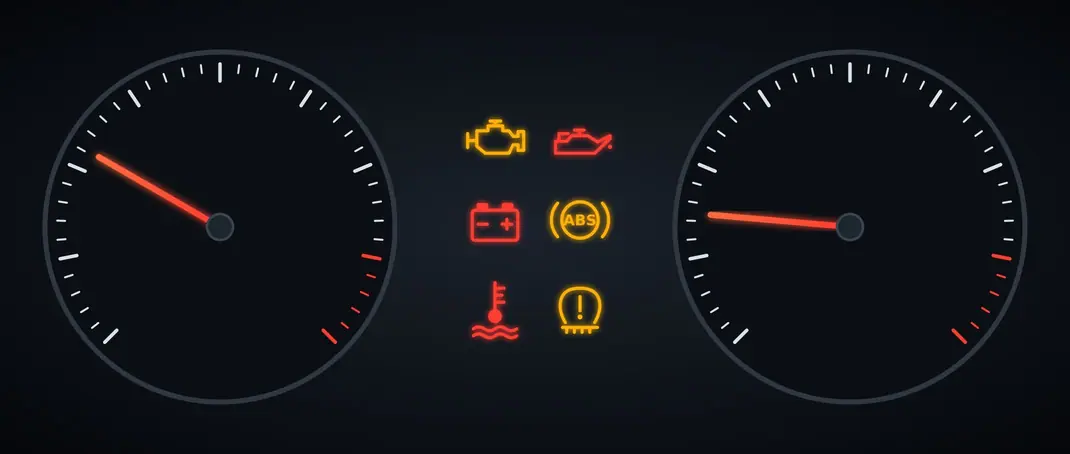
Car dashboard warning lights speak in colours: red means danger and, in most cases, stop as soon as it is safe, yellow or amber means a fault or warning to check soon, and green or blue only tell you that a system is switched on. A steady engine warning light means a trip to the workshop in the next few days; a flashing one means slow down and stop.
In this guide we show the most common symbols, what each one means and what to do, which lights fail the Portuguese MOT (the IPO inspection) and what to check on the dashboard before buying a used car.
What the colours of dashboard lights mean
Most carmakers follow the international standard ISO 2575, which sets out the symbols and the meaning of tell-tale colours:
- red: danger to people or risk of serious damage to the car, immediate or imminent;
- yellow or amber: caution, a system outside normal limits or faulty, with damage likely if ignored;
- green: a system switched on and working, such as dipped headlights or indicators;
- blue: kept for specific uses, mainly main beam.
The exact shape of a symbol can vary slightly between brands. If in doubt, your car's handbook has the full list of dashboard lights for your model.
The bulb check when you switch on the ignition
When you turn the key or press the start button, many lights come on together for a few seconds. It is a self-test: it confirms that the bulbs and systems respond. Once the engine starts, they should all go out, except those for systems that are switched on.
If a warning light stays on after starting, or never comes on during the self-test, something needs checking. The second case is the trickier one, as we explain in the used-car section.
Red dashboard lights: stop safely
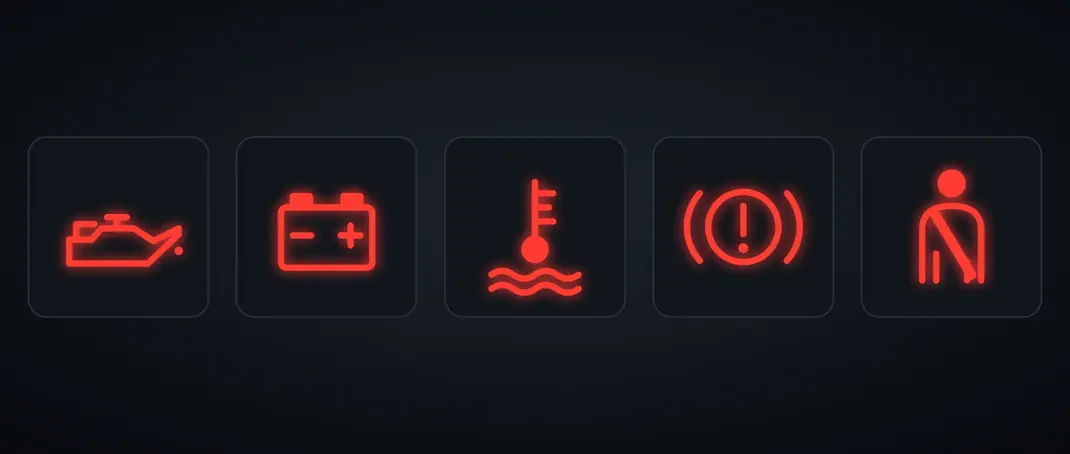
With a red light on, do not carry on as if nothing happened. Find a safe place to stop, switch off the engine when the warning calls for it, and only then decide whether to continue, call roadside assistance or have the car towed.
Oil light (oil can)
The red oil can means low oil pressure. Without pressure the engine is no longer lubricated and can be wrecked quickly. Stop and switch off the engine as soon as you can, wait a few minutes and check the level on the dipstick.
If the level is low, topping up the oil may fix it, but the light must not come back. If the level is fine and the light stays on, do not drive the car. We explain how to check and which oil to choose in our engine oil guide. Some cars also have a separate amber warning just for the oil level.
Battery light
Despite the drawing, a battery light rarely means a weak battery: it shows that the charging system is not charging, often because of a faulty alternator or belt. The car then runs on the battery until it is flat.
Switch off everything non-essential, such as the air conditioning, the rear demister and the radio, and drive straight to a nearby workshop. On many engines the same belt drives the water pump, so keep an eye on the temperature too. More advice in our car battery guide.
Engine temperature light
The thermometer over waves, in red, warns that the engine is overheating. Slow down, stop safely and switch off the engine. Do not open the coolant reservoir while the engine is hot: the coolant is under pressure and can scald you.
Once it has cooled, check the level. Driving on with an overheating engine can damage the head gasket and cost a lot. Some cars show the same symbol in blue while the engine is still cold: that is just a reminder not to work the engine hard.
Brake light
The circle with an exclamation mark between brackets, on many cars, comes on with the handbrake applied. If it stays on with the handbrake released, it may mean brake fluid below the minimum or a fault in the braking system. On cars with an electric parking brake, that has its own symbol, usually a P inside the circle.
With the handbrake off and this light on, stop and call for assistance. If it comes on together with the ABS light, it is even more serious.
Seat belt light and other red ones
The figure with a belt warns that someone has not buckled up, often with a chime. Other common red lights:
- door or boot open: the car seen from above with a door open;
- power steering: a steering wheel with an exclamation mark, red or amber depending on the brand; the steering gets heavy but still turns;
- general serious fault: a triangle with an exclamation mark, asking you to read the message on the screen.
Engine light on: what it means and whether you can drive
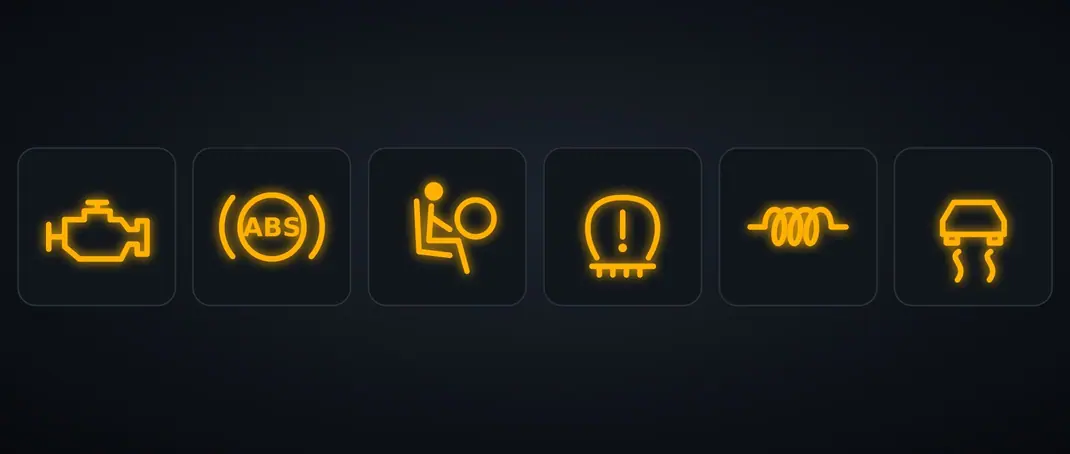
The engine warning light, amber and shaped like an engine seen from the side, is the malfunction indicator linked to the OBD diagnostic system. It comes on when the engine control unit detects a fault that can raise emissions or damage components. Steady or flashing, the meaning changes:
- steady: you can carry on carefully, but book the workshop in the next few days to read the fault code;
- flashing: usually means misfires that can damage the catalytic converter; slow down, avoid hard acceleration and stop as soon as you can;
- with loss of power: the car may go into limp mode; drive straight to the workshop, avoiding the motorway if you can.
Causes range from an oxygen sensor or a worn spark plug to a dirty EGR valve or a catalytic converter problem. Only an OBD reading tells you which. Clearing the code without a repair solves nothing: the fault is still there, the light comes back and an OBD reading shows the system's self-tests were reset.
Amber dashboard lights: what they mean
Amber dashboard lights do not force you to stop at once, but they should not stay on for weeks. They point to faults that get worse or safety systems that have stopped working.
ABS
With the ABS light on, the brakes still work, but without the anti-lock system: under hard braking the wheels can lock, especially on a wet road. Leave a bigger gap and take the car to a workshop. The most common cause is a wheel sensor.
Airbag
The seated figure with a circle in front shows a fault in the airbag and seat-belt pretensioner system. On many cars this light is red. While it is on, the airbags may not deploy in a crash, so do not put off the repair.
Tyre pressure
The horseshoe with an exclamation mark is the tyre pressure monitoring warning. Check and correct the pressure in all tyres when cold and, if the handbook says so, reset the system. If it flashes for about a minute at start-up and then stays on, the system itself is usually faulty. More on the system in our article on TPMS on the dashboard.
Glow plugs (diesel cars)
The amber coil comes on when you switch on the ignition of a cold diesel engine: wait for it to go out before cranking. If it flashes or comes on while driving, on several models it acts as an engine fault warning and should be checked.
Stability control (ESP)
The car with two wavy lines under it flashes while the system is working, for example on a wet bend: that is normal and a sign to ease off. Steady, it means a fault or that the system has been switched off, often with the word OFF.
Particulate filter, AdBlue and other amber lights
Diesel cars have more lights than others. On AUTO.MOTO.pt, 5,155 of the 10,164 cars for sale on 9 October 2026 were used diesel cars, so these are worth knowing:
- particulate filter: a box with dots; the filter needs to regenerate, which usually takes several minutes at a steady speed on the open road; the handbook gives the time and speed;
- AdBlue: warns well in advance that the tank is running low and, if it runs dry, the engine may not restart; see what to do if AdBlue runs out;
- low fuel: a fuel pump symbol; there are still a few litres left, but do not push it;
- worn brake pads: a circle with dashed arcs on each side, on cars with a wear sensor.
Green and blue lights: information only
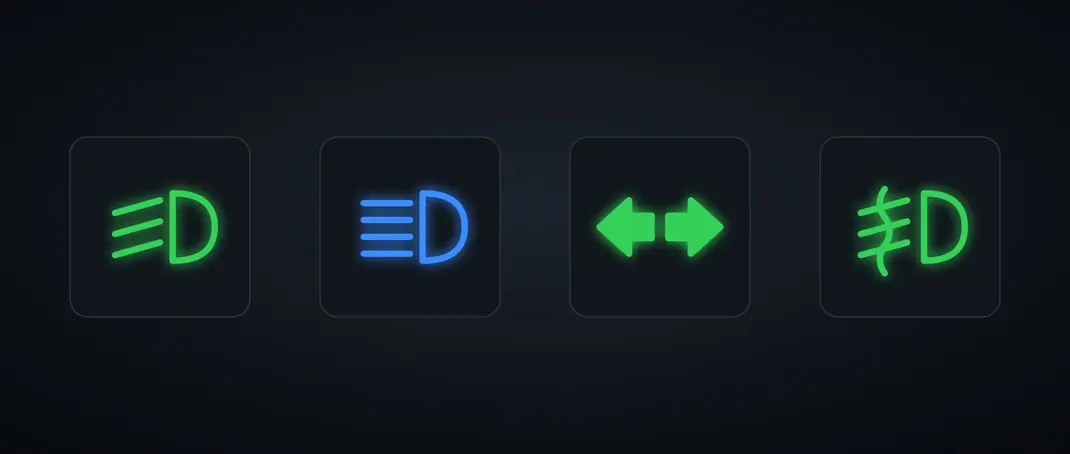
These lights confirm that you switched something on and do not signal a fault. The most common are dipped beam, main beam (usually the only blue one), indicators, front fog lights (the rear fog light shows in amber) and cruise control. One useful exception: if an indicator flashes faster than usual, a bulb on that side has often blown.
Electric and hybrid cars also show a green ready-to-drive light, often with the word READY. On many electric cars, an amber tortoise warns that power has been limited, for example when the battery is very low or very hot.
Dashboard lights and the periodic inspection
At the inspection, the inspector checks the warning lights on the dashboard and may read the OBD port. Deficiencies are graded type 1, 2 and 3, and a car fails with more than five type 1 deficiencies or a single type 2 or 3, under the vehicle inspection rules (Decree-Law 144/2012, as amended).
In that law's list of deficiencies, an ABS, airbag or stability control warning showing a fault counts as type 2, as does an OBD reading showing a significant emissions malfunction. A lit brake fluid warning is type 1.
So with an ABS, airbag or stability control fault showing, the car fails; the brake fluid light on its own is noted but is not enough to fail. Inspection types and deadlines are on the IMT website.
If you have to stop on the road
If a red light forces you to stop, Portugal's Highway Code sets out how to do it safely (articles 87 and 88):
- park the car or move it off the carriageway; if you cannot, keep it as far to the right as possible;
- switch on the hazard warning lights;
- put on the reflective vest before getting out to place the triangle;
- place the warning triangle at least 30 metres behind the car, so that it can be seen from 100 metres;
- passengers should not stay on the carriageway.
Not using the triangle or vest when required carries a fine of €120 to €600.
Before buying a used car: look at the dashboard
On a used car, the dashboard lights tell part of the story. Switch on the ignition with the engine cold and check that every warning light comes on during the self-test and goes out after starting.
Be wary of a light that never comes on, especially the airbag or engine light: it may have been disconnected to hide a fault. Ask a workshop you trust for an OBD reading and check the car's history with the VIN check.
Frequently asked questions
Can I drive with the engine light on?
If it is steady and the car drives normally, yes, carefully and only as far as the workshop in the following days. If it flashes, or the car loses power, slow down and stop: you may be damaging the catalytic converter.
What do amber dashboard lights mean?
They signal a fault or a safety system switched off: engine, ABS, airbag, tyre pressure, stability control, glow plugs, particulate filter or AdBlue. You do not have to stop at once, but they should be looked at soon.
Which dashboard light is the most serious?
The red oil, temperature and brake lights. With any of them, stop safely: carrying on can wreck the engine or compromise braking.
Can the engine light go out by itself?
It can, if the fault does not repeat over a few driving cycles. The code is still stored in the control unit's memory and should be read at a workshop.
Does a car fail the inspection with the engine light on?
It can. If the centre reads the OBD and it shows a significant emissions fault, that is a type 2 deficiency and the car fails. With an ABS, airbag or stability control warning showing a fault, it always fails.
How do I turn off the engine light?
Fix the cause. Clearing the code with an OBD reader without a repair only hides the problem: the light comes back on and the fault is still there.