
An engine problem rarely appears completely out of nowhere. In most cases, the car starts giving small signs first: it loses some power, makes a different noise, uses more oil or starts producing smoke from the exhaust.
This does not always mean that the engine is about to fail. Some problems are relatively simple to fix, but ignoring the first symptoms can turn a small repair into a much more expensive one.
So, how can you tell if your car has engine problems? There are several signs worth knowing.
How Can You Tell If the Engine Is in Good Condition?
A healthy engine should start without much effort, maintain a stable idle and respond smoothly when you press the accelerator. It should not produce persistent metallic noises, unusual smoke or excessive vibrations.
One of the best moments to observe an engine is during a cold start. When the engine has not yet reached its normal operating temperature, some problems become easier to notice.
The engine should start relatively quickly and settle into a stable idle within a few seconds. If it runs unevenly, shakes excessively or produces a strange noise that disappears only after warming up, it is worth investigating.
The same applies during a test drive. The engine should deliver power smoothly. Hesitation, irregular acceleration or an obvious loss of power can all indicate a problem.
This is particularly important when looking at used cars. Mileage alone does not tell you whether an engine is in good condition. A higher-mileage car with a documented maintenance history can be a better choice than a low-mileage car that has been poorly maintained.
What Are the Main Signs of Engine Problems?
There are several symptoms that can indicate engine problems. Some are easy to notice while driving, while others only become obvious when you pay close attention to how the car behaves.
The most common signs include:
- loss of power;
- difficulty starting;
- unusual engine noises;
- smoke from the exhaust;
- excessive oil consumption;
- vibrations;
- increased fuel consumption;
- overheating;
- an illuminated engine warning light;
- oil or coolant leaks.
One symptom alone does not necessarily mean that the engine has serious damage. The situation becomes more concerning when several signs appear at the same time.
For example, a car that has lost power, produces smoke and consumes a lot of oil deserves much more attention than one with a simple warning light caused by a faulty sensor.
For a closer look at some of the most common warning signs, the Haynes guide to common engine misfire symptoms explains how changes in idle quality, vibration, acceleration response and starting behaviour can point to a developing problem.
Why Is the Car Losing Power?
Loss of power is one of the easiest engine problems to notice. The car may start accelerating more slowly, struggle on hills or no longer respond as it used to when you press the accelerator.
There are many possible causes.
A dirty air filter can restrict the amount of air reaching the engine. Problems with the injectors, sensors, fuel system, turbocharger or exhaust system can also affect performance.
Modern diesel engines have additional components that can influence power delivery. Problems with the DPF, EGR system or turbocharger can sometimes cause the car to enter a protection mode and significantly reduce engine performance.
This is why randomly replacing parts is rarely a good idea. The car should be properly diagnosed first to find the actual source of the problem.
A sudden loss of power deserves particular attention, especially when it appears together with an engine warning light.
For more information about diesel powertrains, you can also read our guide to the best diesel engines available today.
Why Is the Engine Making a Strange Noise?
An engine is never completely silent, but any new or unusual noise deserves attention.
A light mechanical sound can be normal depending on the engine, while a metallic noise, strong knocking or a sound that clearly increases with engine speed can indicate a mechanical problem.
It is also important to notice when the noise appears.
A sound that only occurs during a cold start can have a different cause from one that remains after the engine reaches operating temperature. A high-pitched whistle can sometimes be connected with the intake or turbocharger, while a deep metallic knocking sound can point towards a more serious internal problem.
The safest approach is not to wait for the noise to disappear by itself.
The earlier a problem is diagnosed, the better the chances of preventing damage to other engine components.
What Does Smoke From the Exhaust Mean?
The colour of exhaust smoke can provide some useful clues about what is happening inside the engine.
Black smoke is usually associated with too much fuel or not enough air during combustion. On diesel engines, possible causes include problems with the air intake, injectors, turbocharger or emissions system.
Blue smoke is normally associated with the engine burning oil. It can be caused by worn internal components or turbocharger problems.
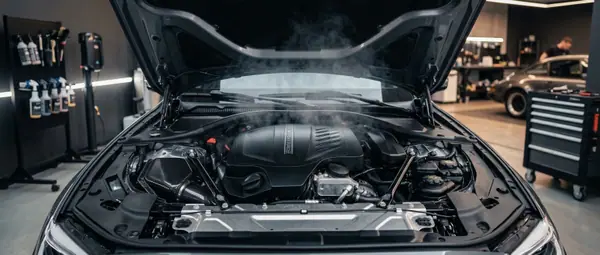
White smoke can simply be condensation, especially when the engine is cold. However, thick white smoke that continues after the engine reaches normal operating temperature can indicate that coolant is entering the combustion process.
The difference between a brief puff and continuous smoke is important.
Persistent smoke should not be ignored and is a good reason to have the engine inspected.
Why Is the Car Using Too Much Oil?
Some engines naturally use a small amount of oil between services. The problem starts when oil consumption suddenly increases or becomes clearly excessive.
The first thing to check is whether there is an external leak. Oil underneath the car or visible around the engine can indicate that oil is escaping rather than being burned.
If there is no obvious leak, the engine may be consuming oil internally.
Worn piston rings, valve seals and turbocharger problems are among the possible causes. Blue smoke from the exhaust can provide another indication that oil is being burned.
Checking the oil level regularly is particularly important on older cars and vehicles with higher mileage.
Using the correct oil specification also matters. Different engines require different viscosity grades and manufacturer specifications, so choosing an oil simply because it is cheap or familiar is not a good idea.
We have covered this subject in more detail in our guide to the best oil for a diesel engine.
Why Is the Engine Overheating?
Overheating is one of the engine problems that should always be taken seriously.
An engine can overheat because of low coolant levels, a coolant leak, a faulty thermostat, radiator problems, a water pump failure or a cooling fan that is not working correctly.
If the temperature gauge moves into the red zone or a temperature warning light appears, the safest option is to stop somewhere safe.
Continuing to drive an overheating engine can cause much more serious damage, including problems with the head gasket or cylinder head.
Never open the coolant reservoir while the engine is extremely hot. The cooling system can be pressurised and hot coolant can cause serious burns.
What Does the Engine Warning Light Mean?
The engine warning light, often called the Check Engine light, can appear for many different reasons.
A steady yellow light does not automatically mean that the engine is about to fail. It can be related to a sensor, emissions system, ignition problem or another component detected by the car's electronic control unit.
A flashing engine warning light is more concerning, particularly if the car is losing power, shaking or running unevenly.
In that situation, avoid hard acceleration and find a safe place to stop.
It is also important to remember that clearing a fault code does not repair the problem. If the underlying fault remains, the warning light can come back.
Why Is the Engine Vibrating or Shaking?
Excessive engine vibration is another symptom that should not be ignored.
If the car starts shaking while stationary, especially at idle, the cause could be related to ignition, fuel injection, air intake or even the engine mounts.
On petrol engines, worn spark plugs or ignition coils can cause misfires and uneven running. On diesel engines, injectors and other fuel-system components can play a similar role.
Try to notice when the vibration occurs. Does it happen only when the engine is cold? Does it continue after warming up? Does it become worse when accelerating?
These details can make diagnosis much easier.
Is It Safe to Drive With Engine Problems?
Not every engine problem means that you have to stop immediately.
A steady warning light without any noticeable change in engine behaviour may allow you to drive carefully to a workshop for diagnosis. Even then, the problem should not be ignored.
Other situations are much more serious.
If the car is overheating, losing oil rapidly, producing heavy smoke or making a strong metallic knocking noise, continuing to drive can cause severe engine damage.
The same applies to a red oil-pressure warning light. If it appears while the engine is running, stop the car as soon as it is safe to do so.
It is not worth risking a complete engine failure just to reach a workshop under your own power.
How Can You Prevent Engine Problems?
The best way to prevent serious engine problems is still regular maintenance.
Oil and filter changes should be carried out according to the manufacturer's maintenance schedule. The same applies to coolant, air filters, spark plugs and the timing belt or chain, depending on the engine.
It is also important not to ignore small symptoms.
A new noise, a slight loss of power or a recent increase in oil consumption may seem like minor issues. When diagnosed early, however, they are often easier and cheaper to fix.
Diesel engines deserve particular attention. Frequent short journeys can be demanding for modern diesel systems, especially vehicles equipped with a DPF.
Timing belt maintenance is another area where prevention is much cheaper than repairing an engine after a failure. The recommended replacement interval depends on the specific engine, so it is important to follow the manufacturer's schedule.
Our guide to when to change the timing belt on a Peugeot 208 explains why this maintenance can be particularly important on certain engines.
How to Check the Engine Before Buying a Car?
When buying used cars, it is worth spending a few extra minutes checking the engine before making a decision.
If possible, see the car when the engine is cold. Watch how it starts, listen to the idle and check the exhaust. Then take it for a proper test drive and pay attention to acceleration, vibrations, unusual noises and engine temperature.
You should also check the oil and coolant levels, look for signs of leaks and ask about the vehicle's maintenance history.
Service invoices and maintenance records can tell you much more about the condition of a car than the mileage displayed on the dashboard.
So, How Do You Know If Your Car Has Engine Problems?
There is no single test that can answer the question.
The best approach is to look at the whole picture: how the engine starts, how it idles, how it accelerates, what sounds it makes, whether it consumes oil, whether it overheats and whether warning lights appear on the dashboard.
One symptom can have a relatively simple explanation. Several symptoms appearing together deserve much more attention.
Most importantly, do not assume that a problem will disappear by itself. A diagnosis made at the right time can prevent a much more expensive repair later.
A healthy engine does not necessarily have to be new. It simply needs to be properly maintained, correctly diagnosed and used in the way it was designed to be.