In Portugal, as well as across the vast majority of the European continent, the undeniable passion and purely practical preference for diesel engines have incredibly deep historical and economic roots. Driven consistently by a demanding topography characterized by mountains and valleys, and the frequent economic necessity to undertake long-distance highway cruising to connect the country from north to south, the outstanding, unparalleled fuel economy and the robust, low-end pulling torque naturally offered by diesel powertrains have firmly established them as the undisputed, absolute number one choice. For the past three decades, thousands of families, high-mileage commercial fleets, and daily commuters have relied almost exclusively on this technology.
This overwhelming historical dominance is glaringly visible when analyzing the composition of the national automotive fleet. Whenever a prospective buyer initiates their thorough and careful search in the highly competitive and bustling market for used cars, diesel-powered models—such as the frugal and versatile Renault Megane 1.5 dCi, the ubiquitous and highly respected Volkswagen Golf 1.6 and 2.0 TDI, the dynamically engaging BMW 320d, or the reliable Peugeot 308 1.6 BlueHDi—invariably and aggressively dominate the top search engine results and the transaction volume charts. Buyers actively seek the inherent longevity of the diesel cycle, fully knowing that a well-engineered diesel block can easily and smoothly surpass the mythical 300,000 or even 400,000-kilometer milestone.
However, the legendary reliability and marathon-like endurance of these complex mechanical blocks are not guaranteed by pure magic, nor should they be taken for granted. They depend intrinsically, chemically, and exclusively on one highly critical, non-negotiable factor: perfectly correct lubrication. The common question "what is the best motor oil for a diesel engine?" simply cannot be answered by throwing out the name of a famous brand printed on a plastic bottle. It demands a comprehensive, deeply technical answer thoroughly grounded in mechanical engineering, applied thermodynamics, and complex fluid chemistry. In this exhaustive technical guide, we will dissect precisely what makes a specific diesel motor oil superior and how you must scientifically choose the lifeblood that flows through the intricate veins of your automobile.
The Complex Science of Oil: Why do Diesel engines demand entirely different chemical formulations?
A modern diesel engine operates on a fundamental thermodynamic principle that is significantly different from its petrol (gasoline/Otto cycle) counterpart. In a diesel power plant, the critical fuel ignition does not occur through an electrical spark generated by a spark plug. Instead, atmospheric air is violently compressed inside the cylinder barrel until it reaches extreme, searing temperatures. When the diesel fuel is atomized and injected at insanely high pressures (frequently exceeding a staggering 2,000 to 2,500 bar in modern, state-of-the-art Common Rail direct injection systems), the highly volatile air-fuel mixture immediately self-ignites.
This fundamental difference in thermodynamic principles dictates that the internal combustion cylinder pressures in a diesel engine are massively and brutally higher. This immense compression ratio has two critical, unavoidable side effects concerning the engine oil:
- Intense Blow-by Gases: The immense cylinder pressure physically forces the passage of hot combustion gases and unburnt fuel droplets past the microscopic gaps in the piston rings directly downward into the engine's oil sump (crankcase).
- Heavy Soot Production: The combustion of heavy diesel fuel, by its very chemical nature, produces a massive quantity of solid carbon particulate matter (microscopic soot).
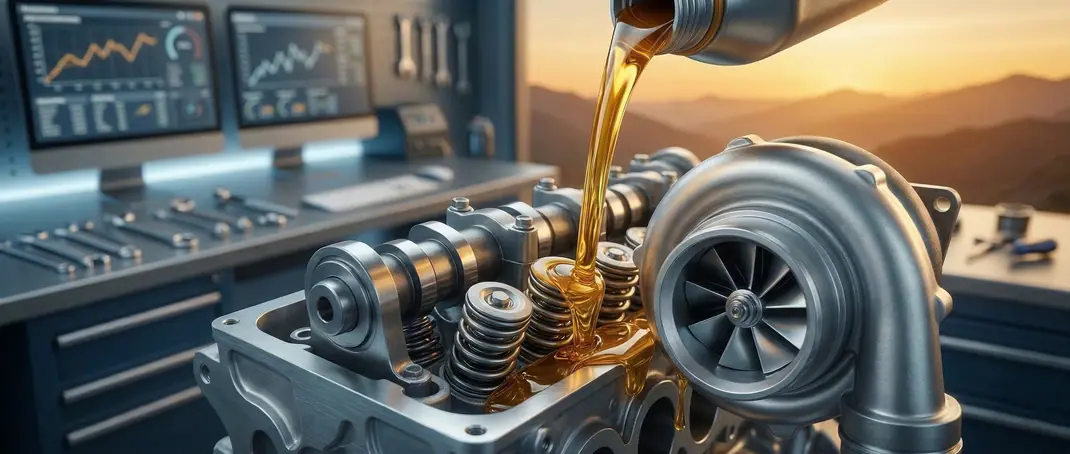
Consequently, the motor oil circulating within a diesel vehicle must inherently possess vastly superior chemical dispersant and detergent properties. It must actively behave as an advanced chemical sponge, specifically designed and engineered to grab these microscopic, abrasive soot particles and keep them safely and permanently suspended within the fluid matrix. If the motor oil fails to accomplish this daunting task, the suspended soot rapidly agglomerates, forming thick, highly abrasive, tar-like "sludge". This dangerous sludge blocks the narrow lubrication galleries, aggressively wears down the camshaft lobes, and completely destroys the sensitive hydrodynamic bearings supporting the high-speed turbocharger.
The Anatomy of a Premium Lubricant: Base Stocks and Additive Packages
A top-tier motor oil is not just "oil taken from the ground." It is a highly engineered, complex fluid mixture where approximately 75% to 80% consists of the underlying "base oil" and the remaining 20% to 25% constitutes a heavily researched chemical "additive package."
The Base Oil Groups (The Foundation):
- Groups I and II (Conventional/Mineral): These are extracted directly from crude oil through relatively simple, outdated refining processes. They possess molecules of highly irregular shapes and sizes, they oxidize (burn) rapidly under heat, and they are absolutely no longer adequate or safe for modern, high-stress turbodiesel engines.
- Group III (Hydrocracked Synthetics): These are technically highly refined mineral oils that have been subjected to such severe, intense chemical processing (hydrocracking) in a laboratory environment that their molecular structure is completely altered to closely resemble a pure synthetic. The vast, overwhelming majority of commercial oils proudly labeled as "100% Synthetic" or "Synthetic Technology" on supermarket shelves globally belong to this group. They offer excellent, highly reliable performance for the vast majority of passenger diesel engines.
- Group IV (PAO - Polyalphaolefins): These are true, 100% pure synthetic base oils, meticulously built molecule by molecule in a high-tech laboratory. They offer brutal, unmatched resistance to extreme thermal breakdown and provide unparalleled cold-flow fluidity at freezing temperatures.
- Group V (Esters): These are incredibly expensive, aerospace and hardcore motorsport-grade formulations. They feature a unique electromagnetic attraction to metal surfaces, guaranteeing that a protective film of oil remains stuck to the engine parts even after sitting for weeks, ensuring the engine never suffers a "dry" cold start.
The Additive Package (The Chemical Armor): For the diesel engine to survive its own immense internal pressures, the American Petroleum Institute (API) and European vehicle manufacturers demand the inclusion of highly specific chemical additives:
- Detergents and Dispersants: Generally formulated using calcium or magnesium bases, these powerful chemicals actively neutralize the highly corrosive sulfuric acids formed as a natural byproduct of burning diesel fuel, and they forcefully keep soot particles separated.
- Anti-wear Agents (ZDDP): Zinc dialkyldithiophosphate is the engine's final, desperate guardian. Under extreme mechanical pressure conditions, when the liquid oil film is physically squeezed out from between two moving parts, the ZDDP chemicals react to the heat and form a microscopic, sacrificial layer of glassy material directly over the metal, entirely preventing catastrophic steel-on-steel friction welding.
- Viscosity Modifiers and Pour Point Depressants: These complex polymers physically prevent the engine oil from thickening into the consistency of cold honey during freezing -10°C winter mornings, while simultaneously preventing the oil from thinning out and turning into the consistency of water when the engine block reaches a searing 120°C during a steep mountain climb.
Deeply Understanding Viscosity (The SAE J300 Standard)
The very first prominent code any vehicle owner looks at on a plastic bottle of oil is the viscosity index established by the internationally recognized Society of Automotive Engineers (SAE), such as the omnipresent, highly common "5W-30".
- The specific number immediately preceding the "W" (which officially stands for Winter) strictly indicates the fluid's dynamic flow capabilities at extremely low, freezing temperatures. During a cold engine start after a freezing night, up to 75% of the total mechanical wear of an engine's lifespan occurs in the very first few seconds because all the oil has drained down into the oil pan. A rating of "5W" or "0W" mathematically guarantees that the mechanical oil pump can push the thick, cold lubricant almost instantaneously up to the very top of the engine (the camshafts and the vital turbocharger bearings).
- The second number (e.g., 30, 40, or 50) strictly indicates the kinematic resistance (the actual physical thickness of the protective oil film) when the engine block reaches its standard, optimal operating temperature (which is globally tested at a standardized 100°C).
The Concept of HTHS (High Temperature High Shear): In modern automotive diesel engine design, global manufacturers are aggressively pursuing maximum fuel economy to meet strict governmental emissions targets. To achieve this, they utilize much thinner, lower-friction oils (such as modern 0W-20 or ultra-thin 5W-30 grades). However, the engine oil simply cannot be so incredibly thin that it physically tears apart under heavy towing loads. The complex HTHS measurement specifically tests the physical resistance of the oil film at an extreme 150°C while being subjected to incredibly severe mechanical shearing forces (exactly like the brutal forces occurring inside the spinning crankshaft journal bearings). A high HTHS rating (above 3.5 mPa.s) guarantees maximum, old-school mechanical protection for heavy loads, while a low HTHS rating (around 2.9 mPa.s) focuses heavily on reducing internal fluid friction and actively saving precious diesel fuel.
The Revolution and the Critical Factor: The Diesel Particulate Filter (DPF) and ACEA Standards
If you drive a modern diesel car that was manufactured anywhere after 2009 (complying with the strict Euro 5 emissions standard and onwards), your vehicle is legally and mechanically required to be equipped with a complex exhaust Diesel Particulate Filter (DPF). It is precisely at this highly technical juncture that the choice of engine oil physically transforms into a literal matter of life or death for your car's mechanics and your personal bank account.
An internal combustion engine naturally consumes a minuscule, highly regulated amount of oil during its normal, everyday operation. When that tiny amount of oil is inevitably burned inside the blistering combustion chamber, the heavy metallic additives (the zinc, calcium, and phosphorus) are instantly transformed into solid, unburnable ash. Unlike the soft, combustible soot generated from burning diesel fuel (which the advanced DPF system is designed to successfully burn off and transform into harmless gas during its "regeneration" cycle), these metallic oil ashes are completely and utterly incombustible. If you mistakenly use a traditional, old-school motor oil, these solid ashes will permanently and irreversibly accumulate deep inside the microscopic honeycomb structure of the particulate filter.
To strictly and totally prevent these metallic ashes from prematurely clogging and physically destroying the insanely expensive particulate filter, the European Automobile Manufacturers' Association (ACEA) created highly specific, incredibly restrictive chemical standards. Motor oils specifically engineered for modern, high-tech diesel engines equipped with a DPF must strictly and exclusively belong to the ACEA C chemical class (such as the highly specific C1, C2, C3, C4, C5, or ultra-modern C6 standards).
These advanced formulations are technically known in the global automotive industry as "Low SAPS" or "Mid SAPS" oils—meaning they feature a very strictly controlled, low content of Sulphated Ash, Phosphorus, and Sulphur.
- ACEA C3 and C4: These are the most robust, widely utilized standards in the European market. An oil proudly bearing the ACEA C3 standard guarantees an incredibly thick, strong protective film (a high HTHS rating) to rigorously protect the rapidly moving internal parts of the engine block, while simultaneously and severely limiting the amount of physical ash generated when burned. This chemical balance actively prolonges the expensive operational life of both the DPF and the preceding Diesel Oxidation Catalyst (DOC).
- Willingly pouring an older generation oil (like a classic, cheap ACEA A3/B4 standard) into a highly sensitive, modern DPF-equipped engine will result in the rapid, severe, and physically irreversible clogging of the filter's ceramic mesh. This is a massive, catastrophic mechanical failure that frequently exceeds a €1,500 to €2,000 repair bill—a nightmare financial scenario frequently documented and strongly warned against by leading global automotive electrical and exhaust engineering specialists like Hella Tech World.
Manufacturer Approvals (OEM Homologation): The ultimate, non-negotiable seal of absolute quality
Simply walking into an auto parts store and asking for "a generic jug of 5W-30 C3 oil" is no longer remotely sufficient given the extreme mechanical complexity of current engine designs. The absolute best, safest, and most highly recommended oil for your specific diesel engine is exclusively the one that proudly displays the exact OEM (Original Equipment Manufacturer) official approval stringently demanded by the specific creator of your automobile.
Global automotive brands invest tens of millions of euros into researching and developing their own unique internal metallurgies, incredibly tight assembly tolerances, specialized rubber seal materials, and complex exhaust gas aftertreatment systems. Consequently, they legally demand that major oil companies formulate highly exclusive chemical blends that can successfully pass their own rigorous, highly destructive, hundreds-of-hours-long laboratory wear tests. Global, multi-billion-dollar specialists in advanced chemical engineering and additive development for lubricants, such as the American multinational Lubrizol, frequently publish extensive engineering reports and complex radial charts (the famous engineering spider webs) that comprehensively demonstrate how cheap, generic "multi-brand" oils fail absolutely miserably when subjected to the highly demanding wear, oxidation, and piston cleanliness tests strictly required by premium European brands.
Some of the most highly critical, complex, and demanded European OEM approvals include:
- Renault RN0720 Standard: This is an absolutely mandatory, non-negotiable requirement for the millions of reliable 1.5 dCi engines equipped with a factory FAP (Filtre à Particules). It is a highly restrictive, customized formulation heavily based on the ACEA C4 standard, focused obsessively on severely reducing the long-term chemical degradation of the oil and maximizing the protection of the delicate French ceramic particulate filter.
- Volkswagen VW 507.00 Standard: The strict, vital, and absolutely mandatory engineering standard for the vast and world-famous range of TDI diesel engines produced by the VAG group (covering Volkswagen, Audi, Seat, and Škoda models). This is a highly robust formulation officially classified as a "LongLife III" oil, scientifically capable of withstanding extreme mechanical pressures and chemically resisting degradation over highly extended, flexible maintenance intervals that can incredibly reach the 30,000 km or 2-year mark.
- BMW Longlife-04 (LL-04) Standard: Exclusively designed and chemically tailored for BMW's modern European diesel engine market. This specific formulation utilizes customized additives engineered to deal perfectly with the specific quality of European diesel fuel, heavily focused on mitigating the severe mechanical wear of the complex timing chain mechanisms and actively neutralizing corrosive acids that cause internal metal corrosion over time.
- Mercedes-Benz MB 229.51 / 229.52 Standards: True standards of German engineering excellence, which stand out significantly for their incredibly rigorous control over the formation of thermal sludges (sludge control) and for actively promoting measurable fuel savings by maintaining a highly stable, unbreakable viscosity index even under prolonged, elevated thermal loads.
- Ford WSS-M2C950-A Standard: A relatively recent, highly advanced ultra-low viscosity specification (typically a 0W-30 grade) created entirely specifically for the latest generation of Ford TDCi engines. It is meticulously designed to offer the absolute maximum possible fuel economy and lowest CO2 emissions without compromising the shear strength of the protective oil film.
The Brutal Impact of the Turbocharger and Your Driving Profile on Oil Degradation
Absolutely every single modern passenger diesel engine deeply depends on the massive forced air induction provided by the exhaust-driven turbocharger to generate its characteristic, punchy low-end torque. The central shaft of the turbocharger spins at truly terrifying, almost incomprehensible speeds, frequently exceeding 200,000 revolutions per minute (RPM). At the exact same time, the exhaust side (turbine housing) of the turbocharger is continuously bombarded with searing hot exhaust gases at temperatures hovering around 800°C to 900°C. The single, solitary mechanical element that actively cools the shaft's floating bearings and totally prevents the high-grade metal from instantly melting together is the continuous, high-pressure flow of your engine oil.
When a hardworking diesel engine is suddenly shut off immediately after a long, high-speed highway journey or an intense towing session up a mountain, the extreme residual heat left in the cast iron housing literally "bakes" the stationary engine oil trapped inside the turbo core. True, 100% full synthetic oils of premium excellence resist this destructive thermal "coking" process; however, cheap, outdated mineral oils rapidly transform into tiny, hard crystals of abrasive carbon, rapidly destroying the most expensive peripheral component of the engine system in a matter of months.
Furthermore, aside from brutal heat, your personal driving profile is the absolute greatest enemy of oil longevity. Drivers of diesel vehicles who predominantly perform short urban commutes (e.g., 5 to 10 km trips across the city center) face the severe, silent engine killer known as "oil dilution." Because the exhaust system never reaches the high highway temperatures necessary for the passive regeneration of the Diesel Particulate Filter (DPF), the engine's ECU forces a desperate "active regeneration" cycle. It achieves this by injecting extra, raw diesel fuel late into the exhaust stroke (post-injection). Because the cylinder walls remain relatively cold during short trips, a portion of this raw diesel fuel utterly fails to burn; instead, it washes down past the piston rings directly into the oil pan. The liquid diesel heavily dilutes and mixes with the engine oil, utterly destroying its carefully engineered viscosity and reducing its hydrodynamic lubrication capacity to nearly zero. In such a terrible scenario, a top-tier premium oil will protect the metal parts from friction for slightly longer, but even the absolute best oils in the world will demand a vastly premature oil change to strictly avoid catastrophic total engine collapse.
The Invaluable Financial Value of Maintenance in the Automotive Market
The timely, periodic replacement of the engine oil and the respective high-filtration oil filter every 10,000 to 15,000 km (or, at the absolute maximum, every 12 months, aggressively ignoring highly unrealistic "LongLife" interval promises if the car frequently circulates in heavy stop-and-go urban traffic), utilizing with religious exactitude the precise specifications and approvals demanded by the manufacturer, is not at all a boring, annoying maintenance expense; it is, without a single shadow of a doubt, the greatest, most guaranteed high-return financial investment you can possibly make in your vehicle.
The current global and national automotive market is highly mature, incredibly demanding, and utterly unforgiving towards mechanical negligence. Today, both highly educated private buyers and professional dealership appraisers know perfectly well what they must look for under the hood and deep within the paperwork. A motor vehicle that proudly presents a completely immaculate, unbroken service history, strongly backed by a thick dossier of physical garage invoices that unequivocally prove the continuous, unfailing use of premium synthetic oils bearing the strictly correct OEM standards, benefits immediately from a tremendous, automatic financial appreciation.
This crucial factor of absolute mechanical transparency and ownership zeal becomes even more critical, decisive, and profitable when we operate within the vast, highly dynamic, and extremely competitive sector of used cars. A smart, well-informed, and thoughtful buyer will always be highly willing to pay a substantial, fair financial premium for a vehicle whose mechanical heart has been protected with extreme rigor and top-tier fluid chemistry from the very first day and the very first kilometer on the odometer. The savvy buyer completely understands that paying slightly more upfront at the exact moment of purchasing the used vehicle means, in practical reality, an ironclad guarantee that they will successfully avoid massively expensive, nightmare surprises in the short and medium term. They are actively paying to escape the ruinous scenarios of seized, blown turbochargers, camshafts severely worn flat by a total lack of a hydrodynamic oil film, completely ruined fuel injectors, or highly sensitive diesel particulate filters (DPF) completely strangled and choked to death by irreversible deposits of metallic ash caused by the wrong engine oil. Total clarity, absolute documentary honesty, and unyielding excellence and regularity in preventative chemical maintenance are the ultimate master keys to achieving full, highly profitable success in any modern automotive transaction.
Your next great step in the exciting world of mobility
Protecting your highly complex and wonderful mechanical machine with the perfect, scientifically matched lubricant chemistry is merely the first, albeit crucial and non-negotiable, step toward enjoying thousands of kilometers of entirely stress-free driving, devoid of flashing warning lights on your dashboard and completely free from terrifying financial worries at the repair shop. But if your true and current goal completely transcends the simple routine maintenance service of your existing automobile, and what you are really, actively searching for is to discover the absolutely ideal vehicle for the growth of your family, the track-focused dynamic performance car of your wildest dreams, or if you simply wish to sell your current automobile while guaranteeing maximum procedural transparency, total security, and the highest fair profitability available in the entire market, we possess the absolute perfect, highly technological platform and destination tailor-made for you.
We invite you to explore in meticulous detail the very best and safest financial and mechanical opportunities available in the entire national automotive market. Calmly analyze dozens of rigorously verified, highly detailed deals, and immerse yourself deeply into the most interactive, transparent, and dynamic mobility ecosystem existing in Portugal. We strongly invite you to visit the premier portal AUTO.MOTO.pt today. AUTO.MOTO.pt stands out brightly as the absolute leading, most highly trusted portal and the true destination of premium excellence across the entire national territory for ensuring the safe, secure, and highly transparent buying and selling of light passenger automobiles, heavy-duty commercial vans, and thrilling motorcycles of all categories and displacements. Find the exact keys to your next dream car, complete with a rigorously perfect, highly documented maintenance history, right now at AUTO.MOTO.pt, and fire up the engine to pull away and confidently start your very next great adventure on the open road!