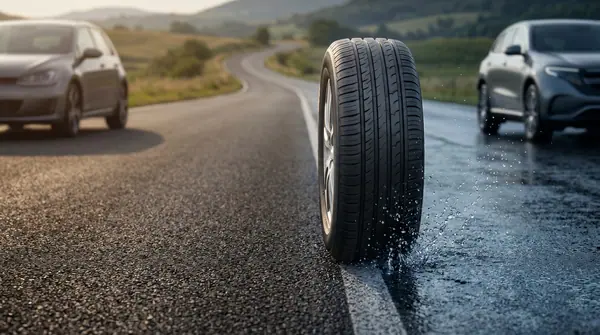
Tires are, without a shadow of a doubt, the single most critical active safety element of any motor vehicle. Being the sole point of physical contact between a two-ton machine and the road surface—through a contact patch footprint that is realistically no larger than a standard postcard—the structural integrity of the rubber dictates your vehicle's fundamental ability to accelerate, corner, and, most importantly, brake safely. However, there is a silent, highly lethal, and frequently ignored enemy lurking on the roads that constantly threatens this integrity: severe overheating.
Extreme heat is the absolute Achilles' heel of any modern tire. When the internal temperature of the tire casing surpasses its engineered thermal limits (typically starting around 80°C to 90°C for standard passenger tires), an irreversible chemical and structural degradation process instantly begins. But what exactly can cause this dangerous, life-threatening overheating? To answer this question comprehensively, it is absolutely necessary to dive deeply into the physics of polymers, the dynamics of automotive driving, and essential mechanical maintenance practices.
The Physics of Rubber: The Phenomenon of Hysteresis
To fully comprehend the mechanics of overheating, it is vital to understand exactly how a tire physically generates heat. Contrary to popular intuition, the vast majority of the heat within a running tire does not come exclusively from the direct surface friction of the rubber tread aggressively scraping against the asphalt. The primary, internal source of massive heat generation is a complex physical and thermodynamic phenomenon scientifically known as hysteresis.
As the tire rolls continuously under the heavy weight of the vehicle, its internal structure (specifically the flexible sidewalls) constantly deforms and flattens out as it enters the road contact patch, and then snaps back to its original circular shape as it exits that contact. The rubber compounds and synthetic inner materials, being viscoelastic in nature, actively absorb kinetic energy during this rapid deformation. Crucially, not all of this absorbed energy is efficiently returned when the tire recovers its shape; a highly significant percentage is trapped inside and converted directly into thermal energy (heat) deep within the tire casing. The greater the physical deformation of the tire, the higher the rate of hysteresis, and consequently, the greater the massive amount of internal heat generated from the inside out.
1. Underinflation (Low Tire Pressure): The Silent Killer Of all the various causes of severe tire overheating, underinflation is, by a massive margin, the most common, the most destructive, and the most dangerous. According to extensive, peer-reviewed engineering studies published by global industry leaders such as Michelin, driving a vehicle with tires inflated significantly below the manufacturer's recommended cold pressure dramatically alters the tire's physical footprint and its entire structural dynamic.
When a tire lacks the proper air pressure volume, it fundamentally cannot adequately support the sheer weight of the vehicle. This causes a severe, excessive flattening of the heavy tread area and, most critically, an exaggerated, violent flexing and bending of the tire sidewalls during every single rotation of the wheel. This continuous, extreme over-flexing exponentially multiplies the dangerous hysteresis effect mentioned earlier. Scorching heat rapidly accumulates inside the internal steel belts, the nylon cap plies, and the rayon carcass cords. During high-speed highway journeys, a tire operating with a pressure just 20% below the recommended baseline can reach critical, melting temperatures in under thirty minutes. This intense heat actively softens the chemical adhesive resins that bond the synthetic rubber to the internal steel belts. The final, terrifying result, if the vehicle continues at speed, is the complete structural separation of the tread (delamination) or a catastrophic, explosive high-speed blowout, immediately resulting in a total loss of vehicle control. Maintaining the exact correct tire pressure is not merely a trivial matter of slightly improving fuel economy; it is the absolute central pillar of highway survival.
2. Vehicle Overloading (Exceeding the Load Capacity) Modern automotive engineering is strictly based on highly precise limits. Every single certified tire manufactured in the world possesses a clearly molded "Load Index" on its sidewall (a numerical code, for example, "91", which strictly corresponds to a maximum supported weight of 615 kg per individual tire). When a driver severely overloads their vehicle—whether by completely stuffing the trunk with heavy construction materials, legally towing a heavy caravan without aggressively adjusting the rear tire pressures, or transporting more heavy passengers than legally stipulated—the tire suffers a brutal, severe vertical crushing force. The physical and thermal consequences of extreme overloading are virtually identical to those of severe underinflation. The excessive weight brutally crushes the tire against the harsh asphalt, forcefully pushing the sidewalls to bend far beyond their engineered elastic design limits. Internal chemical friction skyrockets, and the tire becomes completely unable to safely dissipate the generated heat into the surrounding ambient air at the exact same high speed it is currently producing it. Overheating becomes a mathematical certainty. International road safety and crash-testing organizations, such as Euro NCAP, frequently and aggressively highlight in their detailed safety reports the absolute critical importance of strictly respecting the vehicle's gross payload limits to maintain dynamic cornering stability and actively prevent catastrophic structural tire failures.
3. High-Speed Driving and Sustained Velocity In physics, velocity is pure kinetic energy, and energy never disappears; it only transforms into other states. All road-legal tires proudly feature a designated "Speed Symbol" (an alphabetical letter, such as "V" certified for 240 km/h or "Y" certified for an incredible 300 km/h), which officially attests to the absolute maximum speed at which the tire can safely and efficiently dissipate internal heat under ideal laboratory conditions. When a driver sustains highly elevated speeds continuously on a highway, two massive heat-generating physical factors aggressively collide. First, brutal centrifugal forces attempt to physically rip the heavy tire outward and apart, while the sheer aerodynamic load of the vehicle continuously presses it firmly downward, creating immense, tearing structural tensions on the internal rayon and kevlar plies. Secondly, the frequency of physical deformation massively increases: a tire traveling at a rapid 120 km/h forcefully rolls and deforms significantly more times per second than one gently cruising at 50 km/h. If the tire was never engineered for those extreme speeds, or if the cold tire pressure was not properly elevated according to the owner's manual for high-speed highway touring, the tire will simply fail to radiate the intense heat fast enough. The internal temperature aggressively spikes, actively melting the rubber compounds and exponentially increasing the dire risk of an explosive failure.
4. Aggressive Driving Styles: Extreme Braking and Cornering The driver plays an incredibly active, undeniable role in the thermal management of their automobile's mechanical components. A highly sporty, aggressive driving style—typically characterized by violent, hard accelerations, standing on the brakes at the very last possible second, and aggressively tackling sharp corners at massive speeds—generates heat in a very direct, physical, and brutal manner. When you brake violently, the massive kinetic energy of the heavy moving vehicle is instantly converted into searing thermal heat, first in the metallic brake discs and, subsequently, directly in the tire's small contact patch with the ground through extreme physical friction (longitudinal slip). In tight, aggressive corners taken well above the tire's lateral grip limit, the tire aggressively slides sideways (slip angle). This continuous, brutal lateral friction microscopically tears the rubber molecules apart and aggressively raises the temperature of the tread to truly alarming levels. On closed racing circuits, professional drivers actively need this intense heat to gain sticky grip, but in a standard, everyday road tire, this continuous, abusive overheating physically melts the tread compounds and prematurely degrades the rubber tread blocks, rendering them dangerous.
5. Environmental Conditions and Road Surface Temperatures The dark asphalt is not merely a static, decorative carpet; it is a highly efficient, massive thermal accumulator. During the notoriously harsh, blistering summer months in southern Europe, the ambient air temperature can easily hit a stifling 40°C, but the temperature of the dark, heat-absorbing asphalt directly under the blazing sun can easily and routinely surpass a scorching 65°C to 70°C. The strict laws of thermodynamics dictate that heat naturally flows from the hotter body to the colder body. If the tire is continuously rolling over a boiling surface sitting at 70°C, its natural, engineered capacity to cool down and efficiently dissipate the internal heat generated from its own hysteresis into the surrounding environment is completely and utterly nullified. On the contrary, the tire aggressively absorbs even more heat directly from the boiling road. Additionally, certain highly abrasive, rough surfaces, badly degraded roads, or aggressively grooved concrete pavements significantly increase the mechanical friction (rolling resistance), forcing the tire to work much harder and, consequently, causing premature, massive heating. Global engineering experts from Continental Tires frequently and urgently recommend double-checking cold tire pressures specifically during extreme, prolonged heatwaves, warning drivers about the natural, dangerous increase in internal air pressure strictly due to the thermal expansion of the air (precisely in accordance with Gay-Lussac's Law for ideal gases: P/T = constant).
6. Steering Alignment and Suspension Issues The complex suspension geometry of your car absolutely determines precisely how, and how effectively, the tires physically sit on the road. The three primary geometric angles—Camber, Caster, and Toe—must be perfectly and microscopically adjusted strictly according to the manufacturer's exact laser specifications.
If the steering mechanism is badly misaligned—for example, with an excessive "Toe-in" setup—the heavy tires do not roll perfectly parallel to the forward direction of the car's movement. Instead, they are literally, aggressively dragged and scraped sideways against the harsh asphalt continuously while trying to roll forward. This highly destructive physical phenomenon is universally known in mechanics as scrubbing. The intense, continuous friction generated by this brutal scrubbing transforms the inner or outer edge of the rubber tread into a literal miniature oven. Besides causing highly rapid, severely asymmetrical tread wear, this uninterrupted, scraping friction focuses an immense amount of heat into a single, narrow strip of rubber, aggressively precipitating a localized structural failure and deeply weakening the underlying internal steel belt structure. Furthermore, completely worn-out shock absorbers cause the heavy wheel to uncontrollably bounce (wheel hop), generating violent, intermittent impacts and severe friction spikes that also massively contribute to abnormal, dangerous temperature peaks.
7. Material Degradation and Tire Age Synthetic rubber is absolutely not eternal. Over a long period of time, the complex chemical polymers and essential lubricating oils that grant flexibility and elasticity to the tire's compound slowly dry out and evaporate heavily due to continuous, prolonged exposure to harsh ultraviolet (UV) radiation from the sun, atmospheric ozone, and constant, daily thermal variations. This natural, unstoppable chemical oxidation process forces the rubber to become significantly harder, dangerously brittle, and highly inflexible—a dangerous structural phenomenon widely known as "dry rot". A severely aged, dried-out tire completely loses its engineered capacity to manage and dissipate heat effectively. The massively increased stiffness of the old sidewalls actively causes microscopic internal cracks whenever the tire attempts to flex, creating massive, additional internal friction. This is exactly where used car buyers must exercise extreme, uncompromising caution. In the highly dynamic and incredibly popular market for used cars, many enthusiastic buyers heavily focus all their attention on checking the shiny paintwork or the mechanical sound of the engine, completely neglecting the terrifying fact that the tires mounted on the vehicle might be seven or even ten years old. When meticulously evaluating used cars, physically checking the DOT code (a 4-digit number indicating the exact week and year of manufacture) on the sidewall of the tire is absolutely imperative. A vehicle wearing tires that are over six years old, even if they proudly display a deep, healthy-looking tread pattern, presents an exponential, terrifying risk of severe overheating and catastrophic structural failure during a long, sustained highway journey under the blazing August sun. Global inspection and tire manufacturing entities, such as Bridgestone, aggressively and officially recommend the systematic, immediate replacement of absolutely any tire that reaches ten years from its exact date of manufacture, completely regardless of its seemingly pristine outward physical appearance.
Prevention: How to Guarantee Your Ultimate "Peace of Mind" on the Road
Actively avoiding the severe overheating and the consequent, terrifying explosive destruction of your tires requires unwavering diligence and the strict adoption of a relentless, uncompromising preventive maintenance routine:
- Bi-weekly pressure checks: Always utilize a highly calibrated, professional pressure gauge and strictly check the tire pressure only when the tires are completely cold (before driving more than 3 km). Aggressively adjust the pressure values upwards if you are planning to transport a maximum heavy payload.
- Meticulous visual inspections: Proactively and regularly look for deep cuts, dangerous bulging bubbles on the sidewalls, highly irregular tread wear patterns, or deep cracking (clear, undeniable indicators of advanced chemical aging and dry rot).
- Annual laser alignment: Rigorously verify the vehicle's complex suspension geometry at least once every single year, or absolutely every time you mount brand-new tires, guaranteeing that the mechanical rolling action is perfectly smooth and completely free from any destructive scrubbing friction.
- Strict attention to TPMS: Modern automotive technology actively saves lives. The Tire Pressure Monitoring System (TPMS) is a highly valuable, mandatory safety feature in most modern vehicles. Never, ever ignore an illuminated pressure warning light glowing on your dashboard; it is very frequently your final, desperate warning before a highly lethal, heat-induced tire blowout.
The Next Great Step in Your Automotive Journey
Absolute highway safety, precise vehicle control, and predictable dynamic handling depend entirely and exclusively on the four incredibly small, dark surfaces of rubber that physically connect your complex machine to the outside world. Deeply understanding the complex physics and mechanics behind tire overheating is not merely abstract technical knowledge; it is the absolute, ironclad guarantor of your family's safety in every single kilometer you travel. But if your current, primary goal transcends merely performing preventive maintenance on your existing automobile, and you are actively looking to significantly upgrade your garage, you absolutely demand the exact same high level of transparency, safety, and operational excellence. Whether you are actively exploring the vast, exciting market to purchase a highly reliable new vehicle or you intend to sell your current automobile with total security and maximum, fair profitability, choosing the absolute perfect digital platform makes all the difference in the world. Visit AUTO.MOTO.pt today. Standing proudly as the absolute premier, leading platform of excellence in Portugal for safely and securely buying and selling cars and motorcycles, AUTO.MOTO.pt confidently offers you the absolute best, highly vetted opportunities in the national automotive market within a completely secure, highly modern, and deeply trusted digital environment. Accelerate safely and securely towards your absolute best next great deal at AUTO.MOTO.pt!