For the dedicated professional who relies daily on logistics, urban distribution, passenger transport, or heavy technical services, a vehicle is never just a means of transportation. It is the mobile office, the primary work tool, and the most critical financial asset of the entire business operation. In this unforgiving landscape, where downtime directly equates to lost revenue, very few machines command as much respect and possess as profound an engineering legacy as this classic van. Our objective today is to get straight to the facts, without any fluff, deeply dissecting the engineering, the true costs, and the most frequently asked maintenance questions about this iconic workhorse.
1. What is the Sprinter?
To truly comprehend the massive impact of this vehicle, one must travel back to the pivotal year of 1995, when the historic, aging T1 series (often affectionately dubbed the "Bremen Transporter") was officially retired. Out of that transition, the Mercedes Sprinter was born. It did not merely replace its predecessor; it completely revolutionized the heavy and light utility vehicle segment. For the very first time, an automaker successfully introduced aerodynamic characteristics, cabin comfort, and engaging driving dynamics that were previously exclusive to the realm of passenger cars.
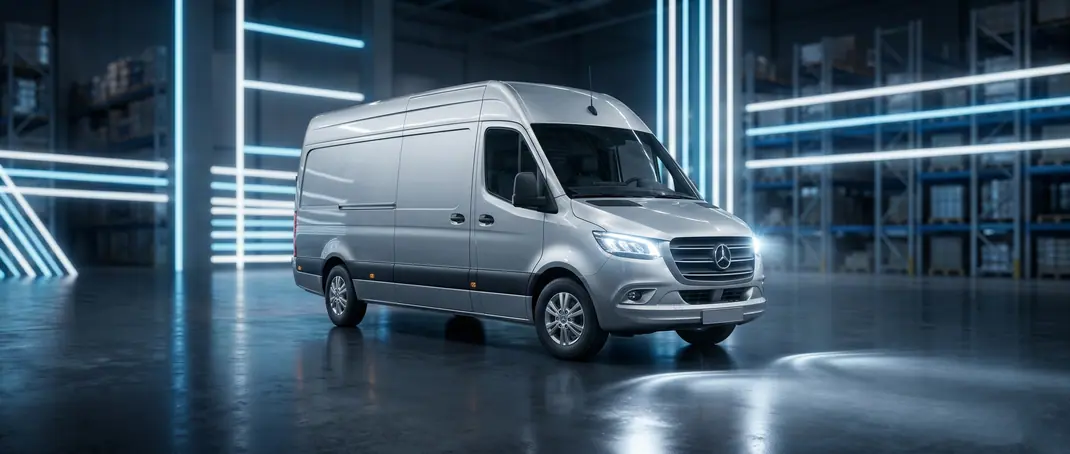
Today, well into its highly advanced third generation (internal codes W907/W910), the vehicle sets the gold standard so emphatically that the entire 3,500 kg category is informally known in many markets simply as the "Sprinter Class". It is a highly modular platform. It can be ordered with front-wheel drive (to maximize internal volume and significantly lower the loading floor), rear-wheel drive (the indestructible classic setup for heavy towing and dense loads), or 4x4 all-wheel drive (AWD) for demanding construction sites and low-grip winter terrain.
Its sheer versatility allows for bodywork configurations ranging from closed panel vans and chassis-cabs for flatbeds, refrigerated boxes, or ambulances, to the Tourer version, perfectly configured for executive-class passenger transport. Cutting-edge innovations like the MBUX (Mercedes-Benz User Experience) infotainment system and the highly efficient OM654 engines prove that Mercedes-Benz Vans keeps this model at the absolute pinnacle of global technological innovation.
2. How much does a Sprinter cost?
Answering this specific question requires understanding that there is no "single" model, but rather hundreds of possible custom configurations that alter the final price tag drastically. The extensive optional equipment list can easily double the base value.
New Vehicles (Zero Kilometers): In the current European market, the entry-level version in a front-wheel-drive Chassis-Cab configuration with the base engine (usually producing 114 hp) starts its pricing structure around €35,000 to €40,000, excluding Value Added Tax (VAT). If your business demands a High Roof Panel Van with a long wheelbase, the numbers quickly scale up to the €48,000 to €58,000 range. The variants heavily focused on VIP transport (Tourer), when fully equipped with electric sliding side doors, rear air suspension, and the potent 190 hp engine, can effortlessly break the €75,000 barrier. Furthermore, the newly introduced 100% electric eSprinter commands an initial acquisition cost in the neighborhood of €60,000, a value that is gradually amortized over the years by significantly lower maintenance and energy costs.
The Second-Hand Market: Thanks to the innate reliability of its diesel engines and its rugged chassis, this van maintains an enviable resale value. However, it is entirely possible to find excellent, smart deals in the market for used commercial vehicles, particularly within the highly respected W906 generation (manufactured between 2006 and 2018). A well-maintained 2016 or 2017 314 CDI panel van, with mileage ranging between 150,000 km and 200,000 km, typically changes hands for values between €16,000 and €24,000, depending strictly on a proven, stamped maintenance history and the physical integrity of the rear cargo compartment.
3. What driving license is required for a Sprinter?
The legal complexity of the driving license (or road permit) required stems from the fact that this specific model range covers vastly different Gross Vehicle Weight (GVW) categories and passenger seating capacities, all subject to strict local regulations and comprehensive European directives, such as those governed by the IMT in Portugal.
The brand's own nomenclature provides a helpful clue: the first digit dictates the approximate tonnage. A 314 model indicates roughly 3 tons (3.5t); a 415 indicates 4.6 tons; a 519 indicates 5 tons.
- Category B (Light Vehicles): If the specific model does not legally exceed 3,500 kg of Total Gross Weight (such as the 211 CDI, 313 CDI, or 319 CDI versions), it can be fully operated with a standard, everyday car driver's license. The strict passenger limit to remain in this category is 9 seats, which must obligatorily include the driver's seat.
- Category C1 or C (Heavy Goods Vehicles): When stepping up to the heavily reinforced dual-rear-wheel versions, explicitly designed to bear extreme payloads—like the 415 CDI (4,600 kg) or the massive 515 CDI (5,000 kg)—the law immediately reclassifies the vehicle as a Heavy Goods Vehicle. It becomes absolutely imperative to possess a Category C1 license (for heavy vehicles up to 7,500 kg) or a full Category C license. At this level, commercial operations also mandate the strict use of a digital tachograph to record driving and resting times, as well as specialized professional driver aptitude certificates.
- Category D1 or D (Heavy Passenger Vehicles): If the bodywork is a dedicated Minibus containing more than 9 seats (for example, 16 or 20-seat configurations for tourism and airport transfers), the physical weight loses its relevance regarding the required license. It is strictly required to hold a Category D1 license (up to 17 seats) or a Category D license (unlimited seating capacity).
4. Where is the fuse box on the Sprinter 415?
The 415 CDI model, and the vast majority of its generation, is an electronically complex machine. The vehicle is fundamentally based on an architecture structured by CAN (Controller Area Network) buses, allowing dozens of control units to communicate in milliseconds. To safely isolate electrical faults, the manufacturer intelligently divided the protection systems into several distinct physical locations.
In the Sprinter 415, there are two vital fuse boxes:
- Main Box and SAM Module: This is the fuse box for everyday access. It is housed inside the cabin, on the driver's side. At the very bottom of the dashboard (instrument panel), immediately above the hood release handle and right next to the steering column, there is a textured plastic cover. By firmly pulling and removing this cover, you gain access to the fuses protecting standard components like the windshield wipers, radio, central locking, interior lighting, and the OBD2 diagnostic port.
- High-Power Relay and Fuse Box: Located securely beneath the driver's seat. Accessing this box is slightly more complex, requiring the complete removal of the side plastic cover from the seat's heavy metal base structure. This is exactly where mechanics look for engine glow plug relays, engine control module (ECU) protection fuses, and the main fuel pump relays. Additionally, this base houses the terminal strip designed for bodybuilders to safely connect auxiliary equipment (such as hydraulic tail lifts, rotary warning lights, etc.).
5. Where is the oil sensor on the Sprinter 313 CDI?
The 313 CDI panel van is traditionally equipped with the highly reliable, almost indestructible OM651 engine block, a 2.1-liter biturbo that reaches brutal internal combustion pressures. Accurate, real-time reading of oil quality and oil level is absolutely fundamental to preventing catastrophic engine seizures.
The thermal and ultrasonic sensor responsible for this crucial measurement is bolted directly into the bottom of the engine's oil pan (sump), and is visible only from completely underneath the vehicle.
To physically access the component, it is strictly necessary to raise the van on a heavy-duty hydraulic lift or drive it over an inspection pit, and then carefully remove the aerodynamic lower plastic (or metal) skid plates. The sensor appears as a small, black plastic block with a 3-pin electrical connector inserted vertically straight into the metal of the oil pan.Important Note: The failure of this sensitive component causes constant, annoying "HI" or "LO" warnings on the instrument cluster display. Because it is located at the absolute lowest retention point of the engine, replacing it obligatorily requires draining the entirety of the engine oil. Therefore, this specific repair should ideally be scheduled during a routine, periodic oil change.
6. What is the largest Sprinter van?
In the highly competitive world of modern logistics, empty air space translates directly to money. Cargo volume is the primary defining metric in a closed panel van. Currently, the absolute largest model physically available straight from the factory is internally coded as L4H3 (Extra Long Length with Super High Roof).
To fully grasp the staggering scale of this highway colossus:
- The total length reaches an astonishing 7,367 mm (over seven and a half meters).
- The external height sits at 2,831 mm, forcing the driver to exercise extreme caution around low balconies, drive-thrus, and low bridges.
- The rear cargo compartment accommodates an amazing 17 cubic meters of highly usable volume.
The available interior load length in the L4H3 version comfortably exceeds 4.70 meters, allowing construction crews to insert long piping, massive rolled carpets, or easily line up six standard Euro pallets in a row. However, pay close attention to the scale: if this mega-van body is mounted on a standard 3,500 kg chassis (like the 314 CDI), the heavy tare weight of all that metal severely robs you of legal payload capacity. To legally carry 17m3 of dense, heavy material, it is absolutely mandatory to opt for the heavy-duty 400 or 500 series versions to avoid massive fines for exceeding axle weight limits.
7. Which is better, Iveco or Sprinter?
The eternal, fierce battle between the Italian Iveco Daily and the German Sprinter is the undisputed classic matchup of light heavy-duty vehicles. Stating outright which one is "better" is a grave technical error if we do not precisely know what purpose the vehicle will serve, as they are entirely based on opposing engineering philosophies.
Iveco Daily Engineering: The Daily is conceived, designed, and assembled exactly like a full-size truck. It features a robust ladder frame chassis (longitudinal beams) that is completely independent of the driver's cabin. Advantages: When it comes to withstanding continuous structural abuse, frequent (though illegal) overloading common in the civil construction sector, and the rigorous application of heavy hydraulic cranes and tipper bodies, the Iveco is absolutely unbeatable. It is a brutish vehicle that absorbs massive torsion without deforming the cabin. Disadvantages: It is significantly heavier, features a much bouncier, truck-like ride quality, posts higher fuel consumption figures, and suffers from a more industrial, less refined interior soundproofing.
German Engineering: In its closed box (panel van) versions, the German brand frequently opts for a unibody structure (where the chassis is seamlessly welded to the bodywork as a single piece). When we deeply analyze all Mercedes-Benz Commercial Vehicles, we quickly understand exactly why. Advantages: The high-speed aerodynamics and the sheer silence on board are irreproachable. When it comes to transporting passengers in VIP comfort, rapidly distributing urgent parcels, or comfortably covering massive long-distance European routes, the German van has absolutely no rival. The driver ergonomics, the passive safety systems rigorously tested by Euro NCAP (such as the highly effective Crosswind Assist), and the outstanding thermal efficiency of the OM654 engines ensure minimal driver fatigue. Furthermore, financial value retention upon resale is markedly higher. Disadvantages: The unibody panel van configuration is physically less suited to receiving super-heavy, concentrated payloads that drastically alter the vehicle's center of mass, especially when directly compared to the strong steel C-profiles of its Italian competitor.
8. Where is the battery located?
In a standard passenger car, popping the hood means immediately coming face-to-face with the battery. However, in a commercial van where the front end has been drastically shortened to absolutely maximize the usable space in the rear cargo area, housing a massive, heavy 95Ah or 100Ah battery right next to the hot engine block would severely hinder mechanical maintenance and ruin weight distribution.
The manufacturer cleverly solved this complex problem by completely hiding the main starter battery exactly beneath the floorboards, directly under the driver's feet.
To access it for replacement:
- Fully lift the thick, heavy-duty rubber floor mat located right next to the pedals on the driver's side.
- You will immediately see a heavy metal plate securely fastened by three or four Torx-head screws.
- Unscrew and completely remove this plate, and the underground compartment will reveal the battery, safely protected from water ingress and the degrading, excessive heat of the engine bay.
Emergency Jump Start Warning: If you find yourself stranded on the side of the road with a dead battery, you absolutely do not need to dismantle the floor. In the front engine compartment, on the left side, right near the black air filter box, there is a prominent cylindrical metal terminal securely protected by a red plastic cap. That is the Positive (+) terminal. For the Negative (-) connection, the vehicle's chassis features a dedicated brass pin bolted directly onto the metal bodywork, which safely prevents destructive voltage spikes from frying the highly sensitive electronic control units.
9. What is the correct tire pressure?
Completely ignoring the correct air pressure in a heavy commercial van is an open invitation for catastrophic, high-speed blowouts, highly accelerated rubber wear, and absurdly high diesel consumption. The physical weight transferred to the axles varies dramatically between an empty van and one loaded to the brim with two tons of cargo.
The correct pressure heavily depends on the specific tire size (with the 235/65 R16C being one of the most widely sold sizes) and whether the rear axle configuration is single or dual-wheel. Manufacturers and global entities like Michelinstrongly advise strictly consulting the official cold inflation table, which is permanently printed on a durable sticker located right on the B-pillar of the driver's door.
Common Reference Tolerances (Single Axle Models):
- Front Axle: Regardless of the heavy cargo loaded in the rear, the downward weight exerted by the heavy iron-block diesel engine up front remains constant. Front tire pressure generally oscillates strictly between 3.0 Bar (43 PSI) and 3.5 Bar (50 PSI).
- Rear Axle (Empty Vehicle): Running with zero cargo weight, excessive rear tire pressure will cause the van to bounce dangerously over bumps and severely wear out the exact center of the tire tread. It should be maintained between 3.3 Bar and 3.5 Bar.
- Rear Axle (Maximum Load): When the vehicle hits its maximum Gross Weight limit or is towing a heavy trailer, physics dictates the need for highly rigid sidewall support. The pressure must absolutely be increased to between 4.5 Bar (65 PSI) and 4.8 Bar (70 PSI), provided you are always utilizing legally homologated cargo tires (indicated by the letter "C" on the sidewall). Driving with dangerously under-inflated tires while under intense, heavy loads leads to severe overheating of the internal steel casing and highly probable blowouts at highway speeds.
The immense complexity of modern logistics absolutely demands not only vehicles that are fully prepared for any challenge, but also a profound mechanical knowledge on the part of fleet owners to optimize every single cent invested. Now that you intimately know all the deep technical details, the exact locations of vital components, and the crucial legal distinctions between tonnage classes, you are perfectly equipped to make the absolute best financial decision for your growing fleet.