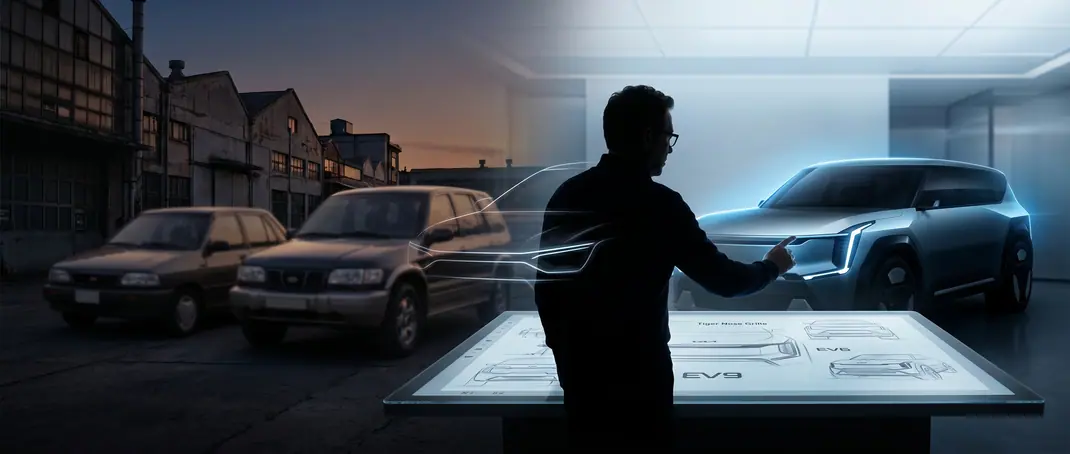
If we were somehow able to step into a time machine, rewind the clock a little over two decades to the turn of the new millennium, and genuinely ask any car enthusiast, local mechanic, or everyday driver what they honestly thought about the Kia brand, the response would likely be, at best, a highly condescending shrug. Back in those days, the South Korean automaker was strictly viewed by the European and American markets as an absolute last resort. It was the purely rational, cold, budget-dictated choice for someone who desperately needed four functional wheels and a steering wheel just to get from point A to point B, but who didn't care in the slightest about brand prestige, engaging driving dynamics, or exterior aesthetics. The interior cabin plastics were notoriously hard, brittle, and gray, the exterior design was painfully anonymous, and the overall driving experience was light-years behind the refined and engaging European and Japanese competition.
But, I urge you, take a very close look out at the road today. What exactly do we see cruising down our busy city streets and fast highways? We see the stunning, highly aggressive, and wonderfully retro-futuristic Kia EV6 violently sweeping up the highly coveted Car of the Year awards across Europe, turning heads at absolutely every intersection. We see the massive, imposing, and ultra-luxurious Kia EV9 actively redefining entirely what a full-size, all-electric, seven-seater family SUV can actually be, boldly and openly challenging established premium German luxury brands directly to their faces without an ounce of inferiority complex. We see the daring, angular Kia Sportage consistently dominating monthly global sales charts with a front-end lighting signature that looks like it was meticulously designed by artists for a high-budget sci-fi movie.
The massive transformation we have all witnessed over the last two decades has been so brutal, so absolute, and so incredibly rapid that it leaves many old-school drivers genuinely confused and deeply intrigued. Exactly how did a brand famous for making practically invisible, dirt-cheap utility cars miraculously transform into a global, award-winning giant of cutting-edge design and advanced electrified technology? Who exactly is financially backing them and pumping the necessary billions of dollars required to sustain this staggering, relentless level of research, global development, and marketing? In short, the burning question that many people still ask out loud is: which automotive group does Kia actually belong to?
In this we are going to plunge deep into the history of Kia. We will completely unveil the colossal Asian corporate empire that controls it with an iron fist, examine the intense and highly complex rivalry between corporate "siblings", and explicitly explain exactly how this Asian brand confidently conquered the profound respect of the entire automotive world.
1. The Direct, Unflinching Answer: The South Korean Empire
To not keep you waiting in suspense for a single paragraph longer, here is the clear, direct, and completely unequivocal answer: Kia completely and entirely belongs to the massive Hyundai Motor Group.
Yes, you read that perfectly right. Kia and Hyundai are corporate "sisters" firmly living under the exact same gigantic corporate umbrella. They actively and heavily share structural chassis platforms, efficient internal combustion engines, highly advanced electric battery tech, complex digital infotainment systems, and even the assembly lines of massive global manufacturing plants. However, the exact historical manner in which this massive union actually happened was absolutely not through a peaceful, friendly merger highly calculated and planned in a shiny corporate boardroom while drinking expensive champagne. It was a highly dramatic, tense, and absolutely vital emergency financial rescue mission that occurred during one of the absolute darkest, most terrifying economic moments in modern Asian history.
2. The Very Humble Beginnings: From Steel Tubing and Bicycles to Automobiles
The long, rich, and complex story of Kia did not start, contrary to what one might logically think, with the roaring sound of potent V6 engines or the careful assembly of high-density lithium-ion battery packs. Its humble beginning traces all the way back to December 1944, long before South Korea had transformed into the massive, wealthy technological, economic, and cultural powerhouse we recognize today. Originally and simply named Kyungsung Precision Industry, the modest small company operated on the outskirts of Seoul and was exclusively dedicated to the physical manufacturing of industrial steel tubing and the production of loose bicycle parts. Their very first major historical milestone happened in 1951, when they successfully designed, produced, and assembled the very first entirely South Korean domestic bicycle, affectionately named the Samchully.
In 1952, heavily reflecting a brand-new industrial ambition, the growing company officially changed its name to Kia Industries. The etymology behind the name "Kia" is highly fascinating and reveals a massive amount about its ultimate destiny. It is elegantly derived from ancient Sino-Korean characters: the distinct syllable "Ki" (起) strictly means to arise, awake, or forcefully ascend, while the single letter "A" (亞) refers directly to the continent of Asia. Translated completely literally, Kia means "To arise from Asia". It was an incredibly bold and highly prophetic name, especially when deeply considering the exact position of total global market dominance in which the company proudly stands today.
The difficult transition from two pedal-powered wheels to complex motorized vehicles was a very slow, highly methodical process that took decades of patience. They began by building small, rudimentary, noisy motorcycles under a strict commercial license from Honda in the late 1950s. Moving into the 1960s, they upgraded to manufacturing small, three-wheeled Mazda cargo trucks, providing the essential transport needed to help physically rebuild the war-torn nation. It was only in the pivotal year of 1974 that Kia finally managed to fully design and build its very first true, four-wheeled passenger car: the highly modest, boxy, yet reliable Kia Brisa.
Throughout the highly turbulent, changing decades of the 1980s and 1990s, Kia essentially survived and managed to slowly grow primarily through vital, life-saving corporate partnerships with massive global giants like America's Ford and Japan's Mazda. They produced incredibly popular, budget-friendly vehicles like the legendary Kia Pride (which was, underneath its simple sheet metal, essentially a joint project of the Ford Festiva and the Mazda 121), which literally flooded the tight streets of several developing countries and finally began to place the South Korean brand on the global export map.
3. The Dramatic Collapse and the Rescue: The 1997 Asian Financial Crisis
Despite the fact that Kia was aggressively growing its factory footprint and successfully managing to export highly affordable budget vehicles to incredibly competitive overseas markets like the United States and Europe in the 1990s (who could possibly forget the rugged, rudimentary first-generation Kia Sportage SUV or the cheap Sephia compact sedan?), the harsh, cold reality behind closed doors was that the entire company was built upon incredibly fragile, dangerous financial foundations. Its rapid global expansion was heavily financed by an ocean of excessive, highly toxic corporate debt—a deeply flawed business practice that was very common and heavily encouraged among the gigantic Korean business conglomerates (the famous Chaebols) of that specific, reckless era.
When the completely devastating 1997 Asian financial crisis violently struck the entire geographical region like a true economic tsunami, the financial results were absolutely catastrophic. National interest rates skyrocketed wildly out of control, essential commercial credit lines completely dried up overnight, and the South Korean national currency, the won, was brutally devalued against the US dollar in a matter of days. Kia simply could not generate enough liquid cash to pay the massive, mounting interest on its debts to angry international creditors and, in a shocking move that deeply shook the confidence of the entire Asian nation, the company officially declared total insolvency and bankruptcy.
The South Korean government knew perfectly well that it could not, under any political or economic circumstances, allow one of its largest, most historic heavy industries to simply vanish into thin air, dragging tens of thousands of factory jobs and smaller suppliers down into the abyss with it. A massive, global corporate auction was immediately initiated to sell off the broken Kia and all of its valuable physical assets. The American automotive giant Ford, which already had a deep, decades-long historical partnership with Kia and intimately knew its factory capabilities, aggressively tried to buy it on the cheap. However, to the great surprise of many Western industry observers, it was their fierce domestic compatriot and bitter rival, the Hyundai Motor Company, that ultimately won the highly bitter, high-stakes bidding war in 1998. Hyundai officially acquired a controlling 51% stake in the bankrupt company (today that financial participation has diluted slightly, and Hyundai holds roughly 33%, but absolutely maintains total, unquestioned directive and operational control over Kia).
Thus, rising from the smoking ashes of the financial crisis, the formidable Hyundai Motor Group was officially born. Hyundai literally saved Kia from the dark abyss of total liquidation, but what closely followed over the next two decades was an absolute, academic masterclass in global automotive management and brand strategy.
4. Sharing the Blood, But Never the Soul
Whenever one gigantic automotive conglomerate purchases another competing brand, the inherent corporate risk of sales "cannibalization" is enormously high. After all, if a brand-new Hyundai SUV and a brand-new Kia SUV are exactly the same in how they drive, with the exact same boring styling, and only have different plastic logos glued to the front grille, why on earth would a paying customer ever choose one over the other?
The top-tier, highly intelligent executives at the Hyundai Motor Group acutely realized this deadly commercial danger from day one. The winning corporate strategy that was carefully outlined and rigorously adopted over the last twenty years was based on a brilliant, unwavering core principle: exhaustively share absolutely everything the paying customer cannot physically see, and radically, completely differentiate everything the customer can see, touch, and feel on a daily basis.
Underneath the shiny exterior sheet metal and the glossy paint job, a modern Kia Sportage and a modern Hyundai Tucson are, for all practical engineering intents and purposes, identical twins. They boast the exact same millimeter-perfect wheelbase, they utilize the very same rigorous, high-strength steel structural chassis platforms, and they seamlessly share the exact same complex gearboxes and highly efficient gasoline, diesel, or hybrid engine powertrains. The group's current, monumental electric vehicle revolution, which is actively terrifying its European competitors, is heavily sustained by the widely acclaimed, dedicated E-GMP (Electric-Global Modular Platform). This shared, highly advanced 800-volt technological backbone is exactly what serves as the strong foundation for both the highly acclaimed retro-futuristic design of the Hyundai Ioniq 5 and the sleek, highly aerodynamic, sporty lines of the Kia EV6.
However, the specific mechanical tuning of the suspension (Kia models tend to be slightly firmer and sportier), the weight and feedback of the power steering, the aggressive exterior design language, and the physical interior architecture of the cabin are all components that are kept completely and utterly distinct from one another. The corporate group established incredibly clear, rigid marketing boundaries: Hyundai traditionally focuses heavily on fluid elegance, highly sophisticated ride comfort, and technology wrapped in a sleek, futuristic aesthetic. Kia, on the other hand, was deliberately and aggressively positioned in the global market as the rebellious, youthful, sporty, highly emotional brand with bold design language that makes absolutely no apologies for standing out in a crowded parking lot. The introduction of purely passionate "halo" models, such as the spectacular rear-wheel-drive sports sedan, the Kia Stinger GT (which loudly proved to the entire world that the Koreans could finally build a fast car to dynamically rival a BMW 3 Series or an Audi A5), heavily solidified this new image of irreverent performance.
5. The Peter Schreyer Effect and the Creation of the "Tiger Nose Grille"
If there was one specific, defining moment in time when Kia definitively stopped being the "ugly duckling" of the global automotive world and started to be deeply respected by harsh design purists, it was in the pivotal year of 2006. The board of directors at Hyundai-Kia made an incredibly bold, highly expensive decision that completely shook the stagnant European car industry to its core: they signed a multi-million dollar contract and successfully poached the highly acclaimed German designer Peter Schreyer, the creative genius who was primarily responsible for drawing the iconic, timeless, and totally original Audi TT.
The massive mission handed to Schreyer when he landed in Seoul was very simple to articulate, but absolutely titanic in its practical execution: he urgently had to give Kia, once and for all, a literal "face" and a cohesive visual soul. Until his highly publicized arrival, the Korean brand had absolutely zero design identity or coherent visual language; their cars simply looked like generic white household appliances, looking completely different with every single generation. Schreyer immediately got to work and brilliantly created the famous "Tiger Nose Grille", a deeply sculpted, wide, and unmistakable front grille that instantly became Kia's undeniable global trademark.
Suddenly, almost as if by Germanic magic, Kia cars completely stopped being boring, forgettable objects and began to proudly display a feline, wide, firmly planted, and highly aggressive posture with distinctly European proportions. The subsequent launch of the sleek Kia Optima midsize sedan and the muscular, revolutionary third-generation Kia Sportage SUV under Schreyer’s visionary leadership resulted in roaring, massive global sales successes that permanently changed the public perception and the prestige of the South Korean brand forever. Schreyer did such a phenomenal, game-changing job that he was eventually promoted to the position of President of the entire company, making him the very first non-Korean executive to ever achieve such an incredible feat in the long history of the group.
6. The 7-Year Warranty: Supreme Confidence or Marketing Masterstroke?
Alongside the massive, highly visible revolution in exterior design and the vastly improved quality of interior cabin materials, the Hyundai Motor Group intelligently used the Kia brand as the sharp spearhead to execute one of the absolute greatest, most effective marketing and customer loyalty coups in the entire history of the automotive industry in the old continent: the famous, unrivaled, and highly reassuring 7-year or 150,000-kilometer (roughly 93,000-mile) factory warranty.
Introduced strategically into the European market in 2006, directly in parallel with the grand opening of their brand new, gigantic, ultra-modern European manufacturing plant in Žilina, Slovakia (where the massive corporate investment easily crossed the one billion euro barrier), and accompanied by the launch of the Cee'd family hatchback (which was famously designed in Europe, specifically for European tastes), this massive warranty completely changed the paradigm of the game. At that specific time, the overwhelming majority of arrogant, established European brands offered their customers only the meager, legally required minimum of 2 years of warranty coverage. Kia's corporate message was loud and crystal clear to the consumer: "We fully know our past reputation for build quality was not the best. But today, we use high-strength steel, cutting-edge robotic assembly processes, and we trust the cars we build today so much that we are willingly handing you seven long years of total mechanical peace of mind."
This highly aggressive commercial strategy worked brilliantly. It instantly attracted millions of highly conservative drivers who were previously too afraid to risk their hard-earned money on an Asian brand, and it drastically, permanently altered the rules of vehicle depreciation and consumer confidence in the secondary car market.
7. The Unshakable Safe Bet: The Second-Hand Market
This extreme level of mechanical reliability, publicly attested to by the manufacturer itself and heavily sustained by solid legal warranty coverage, has had a massive, enduring secondary impact on exactly how the European consumer views the brand in today's current economic landscape. If in the past a Korean car suffered a dramatic, painful financial depreciation the exact second its tires left the shiny dealership lot, today the story and the financial mathematics are completely different.
The highly competitive market for used cars is unfortunately heavily flooded with premium European luxury brands that confidently promise high social status, but frequently deliver chronic, stressful electrical failures and incredibly expensive mechanic repair bills. However, when a young couple desperately looking for their first safe family car, or a busy professional, urgently needs a highly reliable alternative that won't leave them stranded on the side of the highway crying over a bill for thousands of euros, the Korean brand is, very frequently, the absolute number one choice highly recommended by independent, trusted mechanics.
Choosing nowadays to actively search for and buy used Kia cars has truly become synonymous with making a highly intelligent, financially rational, and fundamentally smart purchase. Because of the existence of that long, famous warranty, it is incredibly common to find high-quality vehicles from this brand on the second-hand market with three, four, or even five years of hard daily use that still perfectly maintain total, comprehensive factory protection. This is an absolutely devastating, unbeatable selling point that the overwhelming majority of proud, historic Western and European manufacturers simply cannot—or stubbornly will not—match without charging their customers absolute fortunes for extended warranty packages.
Today, when you make the thoughtful, deliberate decision to buy a Kia, you are no longer doing it based on the simple, outdated argument of it being the absolute cheapest option available (because, quite frankly, the overall quality has increased so drastically that they no longer offer the bargain-basement prices of the past). It is a highly deliberate, fully conscious decision deeply grounded in widely award-winning exterior design, an incredibly generous and highly technological level of standard equipment, passive and active safety ratings that consistently and easily achieve five stars in the highly rigorous crash tests conducted by Euro NCAP, and a long-term mechanical reliability that openly, actively embarrasses many of the traditional, legacy Western automakers that boast decades more history.
Conclusion: From Bankrupt Survivor to Global Leader of Electrification
The true story of Kia is the absolute, perfect definition of corporate resilience. The company miraculously survived the total humiliation of a crushing national bankruptcy, it eventually found a highly secure, extremely well-funded home under the massive, protective corporate umbrella of the Hyundai Motor Group, it was smart enough to ruthlessly poach and integrate top-tier European design talent, it completely and utterly reinvented its entire aesthetic and engineering philosophy, and it is now firmly and proudly positioned at the absolute forefront of the global electric vehicle revolution and sustainable mobility. That small company that once proudly adopted the bold name "To arise from Asia" has fulfilled its great historical destiny in a literal, poetic, and highly profitable manner.
By heavily sharing Hyundai's colossal capacity for technological and financial investment, Kia finally managed to break free from the heavy, restrictive chains of its humble past as a builder of basic, cheap transportation. Together, these two powerful brands currently form the third-largest automotive group on the entire planet Earth by annual sales volume, trailing only behind the unshakable Japanese juggernaut Toyota and the gigantic German Volkswagen Group.
Do you feel deeply and genuinely inspired by this incredible story of corporate overcoming, brilliant mechanical engineering, and market survival? Do you have a strong desire to sit comfortably behind the steering wheel of one of the global brands that has evolved, innovated, and surprised the entire market the most throughout the 21st century? Rest assured that you absolutely do not need to simply continue reading about it or dreaming about advanced Korean technology.