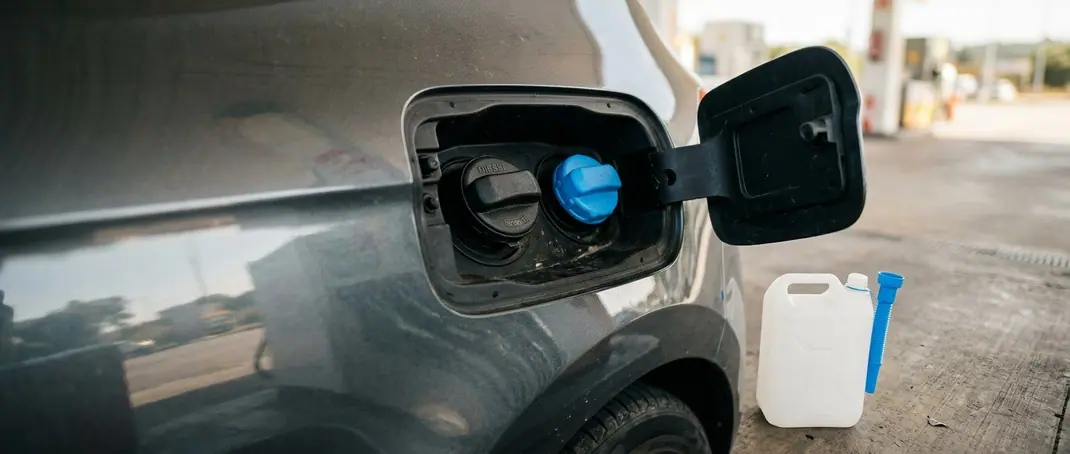
AdBlue is a fluid that many recent diesel cars use to cut their nitrogen oxide (NOx) emissions. It is neither fuel nor a diesel additive: it goes into its own tank, with a blue cap, and is injected into the exhaust.
A passenger car uses on average around 1.5 litres per 1,000 km. If it runs out, the car warns you well in advance and, in the end, will not start.
In this guide: what it is, which cars use it, how much it costs, where to fill up and what to do if the tank runs dry.
What AdBlue is and what it does
AdBlue is the trademark registered by the German automotive industry association (VDA) for the AUS 32 urea solution: according to the VDA specification, a colourless 32.5% solution of synthetic urea in demineralised water, made to the ISO 22241 standard. You may also see it called AUS 32 or DEF.
It works in a catalyst called SCR (selective catalytic reduction). The fluid is sprayed into the exhaust gas, releases ammonia, and this turns most of the NOx into nitrogen and water vapour. That is how many diesel engines meet the Euro 6 standard.
Which cars use AdBlue
Since 1 September 2015, every new passenger car registered in the European Union must meet Euro 6. According to the VDA, a considerable share of Euro 6 diesel cars has an SCR system and therefore uses AdBlue. Petrol cars, petrol hybrids and electric cars do not.
The easiest check is to look for the blue cap next to the diesel filler, or in the boot, and read the manual. On a used car, the chassis number helps: a VIN check confirms the exact engine version before you buy.
AdBlue price: how much it costs
The price varies a lot with the pack size and where you buy. On the day we wrote this (5 October 2026), 5 and 10-litre jerrycans in Portuguese hypermarkets cost between roughly €1.80 and €3.20 per litre. Many filling stations also have an AdBlue pump, sold by the litre.
Do the maths with the average use of 1.5 litres per 1,000 km:
- 10,000 km a year: about 15 litres, or €27 to €48
- 15,000 km a year: about 22.5 litres, €40 to €72
- 25,000 km a year: about 37.5 litres, €68 to €120
That is little next to the diesel itself. For fuel, see diesel prices by station near you, or the official figures on the DGEG portal. If you want to know why pump prices change on Mondays, we explained it in how fuel prices change from week to week.
Where to buy AdBlue
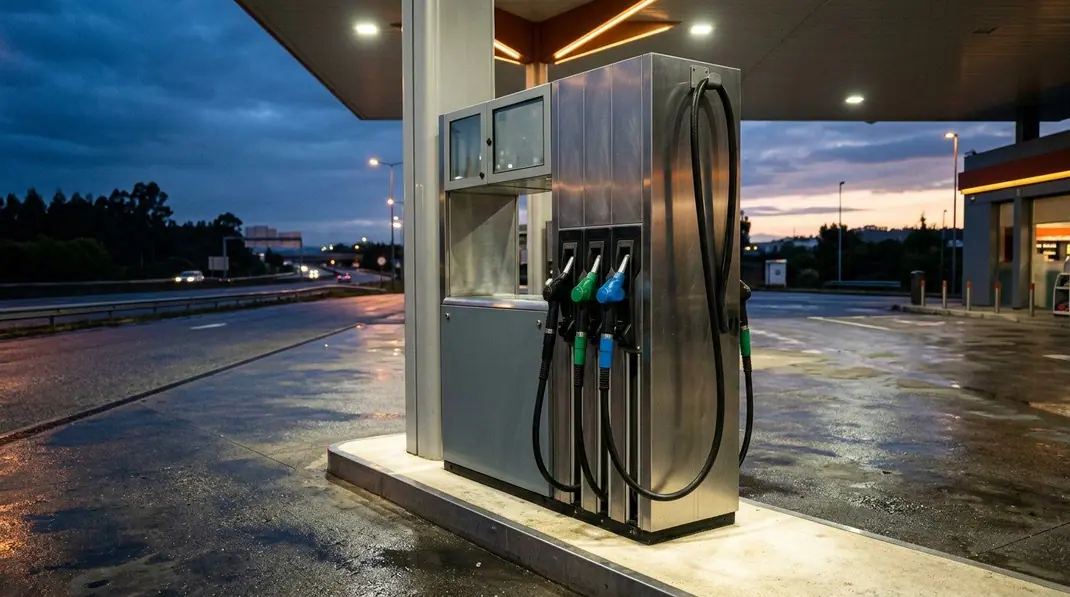
- At the pump: many stations, especially on motorways and in service areas, have a dedicated nozzle (usually blue). Check that it is for cars, as some are for lorries only.
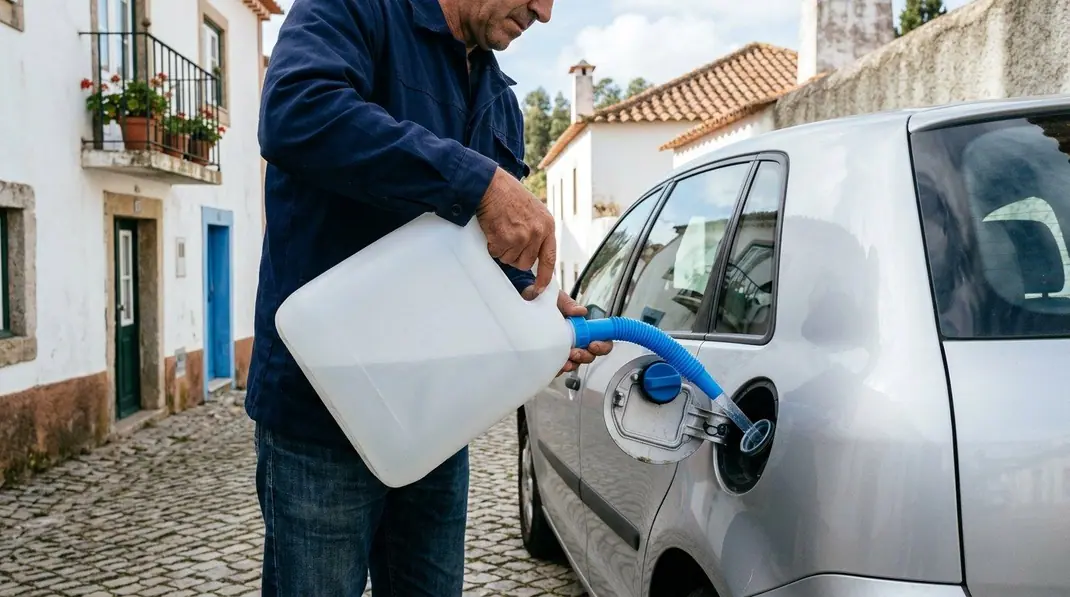
- In a jerrycan: hypermarkets, car parts shops and filling stations sell 5 and 10-litre packs, many with their own spout.
- At the garage: many garages top it up at the service, but the litre can cost more.
Always buy a product marked ISO 22241. Do not use water, any other fluid or "AdBlue" of doubtful origin: the system detects the wrong reagent, and the VDA warns that running without the right product risks damaging the SCR.
What happens if your car runs out of AdBlue
Nothing happens by surprise. The European emissions type-approval rules (Annex XVI of Regulation (EC) No 692/2008, now in Regulation (EU) 2017/1151) require the car to:
- warn at least 2,400 km in advance that the level is low, with a message such as "AdBlue level low" that becomes more insistent;
- prevent the car from running with an empty tank, through an "inducement" system chosen by the manufacturer;
- also react to the wrong reagent or to dosing faults: if the problem is not fixed within 50 km of the warning, the same system kicks in.
The inducement system varies by brand. One option is a countdown: once the tank is empty, the engine will not restart after you switch it off. Other options allowed by the rules are no start after refuelling, a locked diesel filler or a strong speed limit.
What to do if AdBlue runs out
- Do not ignore the warning. It comes at least 2,400 km before the tank is empty, but some brands start restricting the car before that. Top up within the first few days of the warning.
- If the tank is already empty and the engine is running, avoid switching it off until you reach a station, or home with a jerrycan.
- If the car no longer starts, add AdBlue. The rules only require the car to unlock once you add AdBlue equivalent to 2,400 km (about 4 litres at the VDA average). Some models also need a few minutes with the ignition on; the manual says how.
- If the warning stays on with a full tank, it may be a fault in the sensor, pump or injector of the system: that is a job for a garage.
Warning If you put AdBlue in the diesel tank (or the other way round), do not start the engine. Call your insurer's roadside assistance.
When to top up AdBlue
When the car warns you, or before. Many drivers have it topped up at the service, but high-mileage drivers may need to refill between services. At the VDA's average use, 10 litres last about 6,600 km. The tank size depends on the model and is in the manual.
In winter, AdBlue freezes below minus 11 °C. That does not happen in most of Portugal. It can in the mountains but, according to the VDA, freezing does not damage AdBlue, which can be used again once it thaws.
AdBlue on a used car: what to check
On 5 October 2026, AUTO.MOTO.pt had more than 3,700 used diesel cars for sale, with a median price of €14,990. About 1,400 of them were from 2018 or newer (median close to €19,800), the group where AdBlue is most likely.
- Ask whether it uses AdBlue and when it was last topped up.
- Start the car and look for AdBlue, SCR or emissions warnings on the dashboard.
- Ask for invoices for repairs to the system: sensors, pump and injector are the most talked-about faults.
- Be wary of "switched-off" systems: removing the SCR means the car no longer meets its emissions approval and can cause problems at the inspection and on resale.
If you are still choosing an engine, we compared options in the best diesel engine today.
Frequently asked questions
What is AdBlue and what is it for?
It is a 32.5% urea solution in demineralised water. It reduces nitrogen oxides (NOx) from diesel engines with an SCR catalyst.
What happens if a car runs out of AdBlue?
First, warnings that start at least 2,400 km before the tank is empty. Then, depending on the brand, the engine will not restart, will not start after refuelling, the filler locks or speed is limited, until you add AdBlue.
Which cars use AdBlue?
Many Euro 6 diesel cars, especially the more recent ones. Petrol and electric cars do not. Check the manual or look for the blue cap.
How much does AdBlue cost?
In 5 and 10-litre jerrycans we found between roughly €1.80 and €3.20 per litre. For 15,000 km a year, budget €40 to €72.
Can I put water in the AdBlue tank?
No. The system detects a reagent out of specification, triggers the warnings and, if it is not corrected, restricts the car. Use only ISO 22241 product.