Introduction: The Mechanical Reality of Lubrication
Friction destroys internal combustion engines with terrifying efficiency. Metal-on-metal contact between forged steel crankshaft journals and soft aluminum bearings generates catastrophic thermal loads within milliseconds of ignition. Manufacturers spend billions of Euros engineering microscopic tolerances—often measuring less than a thousandth of an inch—relying entirely on a microscopically thin hydrodynamic wedge of synthetic fluid to keep moving parts physically separated. Neglecting this chemical barrier guarantees rapid mechanical suicide, transforming precision-engineered powertrains into worthless scrap metal.
Evaluating the mechanical integrity of used cars requires looking far beyond polished paintwork and vacuumed carpets. Dealerships routinely accept heavily abused trade-ins, masking years of deferred maintenance with a quick wash and a fresh set of cheap tires. Buyers inheriting these neglected vehicles frequently encounter massive internal engine sludge—a thick, tar-like substance created when severely degraded car oil oxidizes and bakes onto the cylinder head under extreme heat. Sludge physically blocks the microscopic lubrication galleries feeding the camshafts and the variable valve timing (VVT) solenoids, triggering timing chain stretch and eventual catastrophic valvetrain collision.
Understanding the underlying chemistry of automotive lubrication separates informed buyers from impending financial disaster. Modern powertrains utilize forced induction, direct injection, and highly restrictive emissions control systems that subject lubricants to unprecedented chemical stress. Blow-by gases containing raw, unburnt fuel constantly slip past the piston rings during cold starts, heavily diluting the lubricant within the sump and physically shearing the chemical viscosity index improvers. Relying blindly on dashboard service indicators or the optimistic promises of a used car salesman virtually guarantees premature engine failure on the secondary market.
The Dipstick Protocol: Checking and Adding
Extracting diagnostic data directly from the engine sump remains the single most critical preventative maintenance procedure any driver can perform. Relying on modern ultrasonic fluid level sensors—which frequently fail due to internal carbon fouling [leaving the driver completely blind to massive internal consumption issues]—invites catastrophic bottom-end bearing failure. Manual verification utilizing the factory-provided physical dipstick guarantees absolute accuracy, provided the operator understands the specific thermal dynamics of fluid expansion.
Answering the fundamental mechanical query of how to check car oil requires a flat, perfectly level surface and a clean microfiber cloth. Engines must achieve full operating temperature [roughly 90 degrees Celsius for the coolant and 100 degrees Celsius for the sump fluid] before being shut down. Mechanics dictate waiting exactly five minutes after shutting the engine off—allowing the highly pressurized fluid trapped inside the upper cylinder head galleries to drain completely back down into the lower aluminum pan. Pull the dipstick, wipe it entirely clean of residual splash, reinsert it fully until the handle clicks against the guide tube, and pull it a second time to read the actual resting level against the crosshatched indicator marks.
Determining exactly when an oil level check should be done depends entirely on the specific engine architecture and the vehicle's mileage. High-performance turbocharged engines and modern direct-injected blocks natively consume small amounts of fluid through the Positive Crankcase Ventilation (PCV) system during aggressive deceleration. Drivers navigating the secondary market must manually inspect the dipstick level every 1,000 kilometers, or at least once a month, to establish a baseline consumption rate. Catching a rapidly dropping fluid level early prevents the catastrophic oil starvation that destroys delicate turbocharger journal bearings spinning at 150,000 RPM.
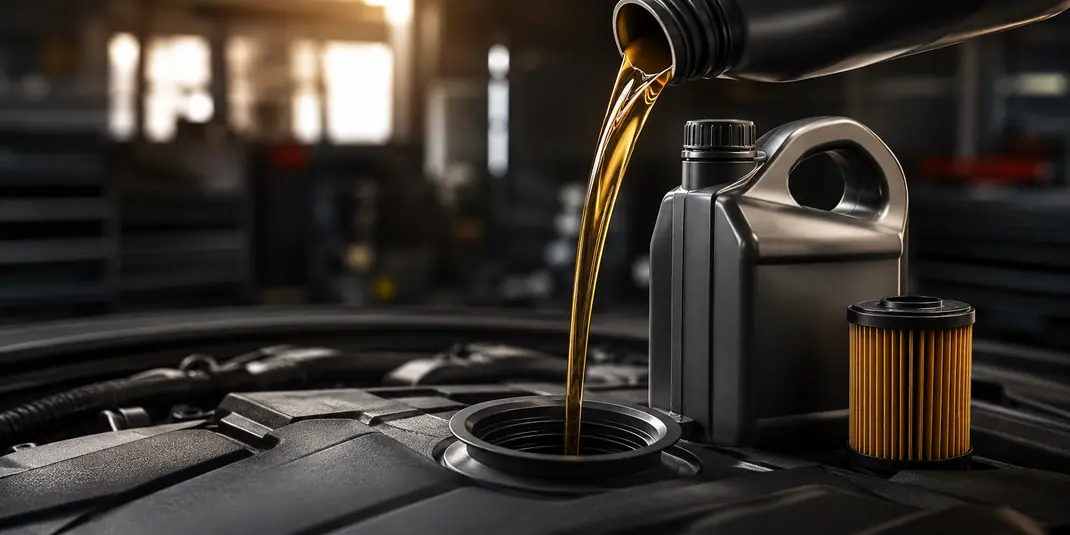
Locating precisely where to put oil in the car demands careful identification of the main filler neck, usually located prominently on the uppermost plastic or magnesium valve cover. Pouring fresh fluid into the wrong reservoir [such as the power steering pump or the transmission breather tube] guarantees immediate mechanical destruction requiring thousands of Euros in repairs. Remove the designated filler cap—often marked with a standardized SAE symbol resembling a vintage dripping can—and utilize a dedicated, clean plastic funnel to prevent spilling synthetic fluid directly onto the scorching hot exhaust manifold [which instantly creates a severe engine bay fire hazard].
Adding the correct volume of replacement oil for car applications requires absolute patience and a fundamental understanding of sump capacity. The physical distance between the "MIN" and "MAX" indicator lines on a standard European dipstick traditionally represents exactly 1.0 liter of fluid volume. Overfilling the sump past the maximum line causes the rapidly spinning crankshaft counterweights to physically slap the resting fluid pool, whipping the liquid into an aerated, frothy foam. Oil pumps cannot pressurize aerated foam, leading directly to a complete loss of hydrodynamic pressure, aggressively destroying the main bearings within seconds of high-RPM operation.
The Interval Math: Time vs. Mileage Reality
Dealership service schedules heavily prioritize artificially low maintenance costs on paper to attract massive corporate fleet buyers. Marketing departments famously invented the "LongLife" 30,000-kilometer service interval during the early 2000s, attempting to prove that advanced synthetic base stocks could survive multiple years of abuse without replacement. Independent mechanics universally reject these absurdly stretched intervals, pulling countless ruined, sludged-up engine blocks out of vehicles that strictly followed the manufacturer's suicidal recommendations.
Calculating exactly when to change car oil demands evaluating the vehicle's actual operating environment rather than staring blindly at the digital dashboard countdown. Severe duty cycles—defined by automotive engineers as frequent short trips under 10 kilometers, heavy stop-and-go urban traffic, and prolonged winter idling—never allow the sump to reach the necessary 100-degree Celsius threshold required to evaporate raw condensation and unburnt fuel. Moisture mixing continuously with sulfur combustion byproducts creates highly corrosive sulfuric acid inside the crankcase, which aggressively eats away at the soft copper and lead babbit materials coating the crankshaft bearings.
Addressing the exact metric of how many km to change car oil requires adopting a highly conservative, mechanically sympathetic approach. Turbocharged, direct-injected powertrains require strict replacement intervals every 8,000 to 10,000 kilometers, completely regardless of the premium synthetic branding on the plastic bottle. Naturally aspirated, multi-port injected engines can safely stretch to 15,000 kilometers under optimal, long-distance highway cruising conditions. Pushing any internal combustion engine past 15,000 kilometers on a single chemical fill actively accelerates timing chain wear, as the abrasive microscopic carbon soot suspended in the fluid physically grinds away the metal chain links like liquid sandpaper.
Determining how much time to change car oil proves equally critical for low-mileage vehicles driven infrequently on the weekends. Time degrades chemical additive packages just as aggressively as physical mileage. Anti-wear additives like Zinc Dialkyldithiophosphate (ZDDP), alkaline detergents, and complex friction modifiers chemically break down and separate from the synthetic base stock over months of sitting dormant in a cold aluminum pan. Mechanics mandate a strict 12-month maximum interval for all internal combustion engines, meaning a vehicle driven only 3,000 kilometers a year still absolutely requires a full preventative drain and refill annually.
Navigating the marketplace for used cars requires demanding concrete, physical paper invoices proving adherence to these strict, shortened intervals. Stamped dealership logbooks showing maintenance every 30,000 kilometers technically prove the previous owner followed the factory manual, but simultaneously guarantee the engine has suffered massive, invisible accelerated wear. Smart buyers specifically hunt for vehicles maintained by paranoid enthusiasts who proactively dumped their fluids every 10,000 kilometers at independent specialist garages.
Viscosity and Selection: Deciphering the Bottle
Decoding the cryptic alphanumeric codes plastered across aftermarket fluid packaging remains the most confusing aspect of routine automotive maintenance for average consumers. Viscosity—strictly defined as a fluid's physical resistance to flow at specific temperatures—dictates whether the hydraulic lifters will pump up silently on a freezing winter morning or clatter violently against the camshaft lobes. Operating a high-performance engine with an incorrect viscosity grade radically alters the internal hydraulic pressures, confusing the variable valve timing phasers and triggering immediate check engine lights.
Determining exactly what oil for my car requires completely ignoring generic auto parts store recommendations and consulting the specific manufacturer approval codes printed deep within the factory service manual. The large SAE viscosity numbers [such as 5W-30 or 0W-20] only tell half the physical story. The "W" stands for Winter, indicating the fluid's cold-cranking pumpability at -30 degrees Celsius, while the second number dictates the kinematic thickness operating at 100 degrees Celsius. Modern ultra-efficient engines utilize incredibly thin 0W-20 fluids to artificially reduce internal pumping losses and maximize fuel economy, sacrificing high-temperature shear protection in the pursuit of government-mandated carbon emission targets.
European powertrains demand strict adherence to ACEA (European Automobile Manufacturers' Association) chemical specifications, which differ wildly from American API standards. High-performance German engines require ACEA A3/B4 rated fluids boasting a High-Temperature High-Shear (HTHS) rating above 3.5 cP, ensuring the fluid film does not physically tear apart under the massive pressure of a turbocharger operating at full boost. Installing a standard, cheap API-rated oil for car applications into a highly strung European engine guarantees accelerated valvetrain wear and immediate turbocharger bearing fatigue.
Diesel applications demand entirely distinct chemical compositions to survive the massive soot loading generated by compression ignition. Navigating the complex requirements of modern exhaust after-treatment systems, specifically the Diesel Particulate Filter (DPF), requires specific Low-SAPS (Sulfated Ash, Phosphorus, and Sulfur) formulations carrying the ACEA C3 or C4 designation. Utilizing older, high-ash fluids in a modern diesel instantly clogs the microscopic ceramic honeycomb inside the DPF, triggering a restrictive "limp mode" and mandating a 2,000 Euro exhaust replacement. Drivers confused by these strict diesel requirements must comprehensively study the technical breakdown found in the best motor oil for a diesel engine guide to avoid catastrophic after-treatment failures.
Modern direct-injected petrol engines face a unique, highly destructive phenomenon known as Low-Speed Pre-Ignition (LSPI), which completely shatters forged pistons during heavy low-RPM acceleration. Automotive chemists discovered that excessive calcium-based detergents in older fluid formulations actively triggered these catastrophic premature explosions. Updating to the latest API SP or ILSAC GF-6 standards guarantees the fluid utilizes magnesium-based detergents instead, physically preventing LSPI events in modern, highly boosted, small-displacement powertrains.
The Financials: Dealerships vs. Independent Garages
Invoicing realities separate the actual cost of raw materials from the highly inflated labor rates charged by franchised service centers. Dealerships operate massive, multi-million Euro glass showrooms that require enormous monthly overhead capital, passing those massive real estate costs directly onto the consumer through inflated hourly diagnostic and maintenance rates. Average consumers frequently experience severe sticker shock when presented with a basic preventative maintenance bill exceeding 300 Euros for a simple fluid exchange.
Calculating accurately how much does it cost to change car oil requires breaking down the exact components of the garage invoice. Premium full-synthetic fluids (Group IV PAO or Group V Ester base stocks) purchased in bulk 208-liter drums cost the garage roughly 5 to 7 Euros per liter, yet dealerships frequently mark this exact fluid up to 25 or 30 Euros per liter on the final customer invoice. A standard four-cylinder engine requires roughly 4.5 liters of fluid, bringing the raw fluid cost to approximately 115 Euros before factoring in the physical filtration media.
Filter replacement remains absolutely mandatory during every single fluid exchange, trapping microscopic metal shavings, carbon soot, and degraded silicone sealant before they can circulate through the sensitive crankcase galleries. Modern European vehicles utilize environmentally friendly paper cartridge filters that drop into permanent aluminum housings (costing roughly 12 to 18 Euros from Tier-1 OEM suppliers like Mann, Mahle, or Hengst). Dealerships will aggressively inflate this cheap paper element to 45 Euros, adding a mandatory 5 Euro charge for the required rubber O-ring seal and the crush washer required for the drain plug.
Labor rates heavily dictate the final financial blow to the wallet. Independent garages specializing in European vehicles generally charge between 40 and 60 Euros per hour, completing a standard drain, filter swap, and fluid refill in roughly 0.6 hours. The total invoice at a reputable independent specialist for a premium synthetic service should land between 90 and 130 Euros, depending on sump capacity. Franchised dealerships charge upwards of 120 Euros per hour, instantly pushing the exact same mechanical procedure past the 250 Euro threshold.
Budgeting for these specific maintenance costs remains highly critical for buyers navigating the market for used cars. Purchasing a heavily depreciated luxury vehicle like an older BMW V8 or Porsche Cayenne might seem like a bargain, but those massive blocks require 8 to 9 liters of premium synthetic fluid and highly specific fleece oil filters. The routine annual maintenance costs on a depreciated luxury vehicle can easily exceed 400 Euros a year at an independent specialist, rapidly bankrupting buyers who only budgeted for the initial purchase price and standard insurance premiums.
Diagnostics and Disasters: Leaks and Dashboard Warnings
Dashboard illuminations trigger massive anxiety for average drivers, but understanding the specific color-coded warnings prevents total catastrophic engine failure. Modern instrument clusters utilize two entirely different warning systems to monitor the internal lubrication parameters. A yellow or amber illuminated symbol [frequently displaying a dripping can with a jagged wavy line underneath] indicates a strictly volumetric issue. The ultrasonic sensor in the oil pan detects that the physical fluid level has dropped below the minimum threshold, requesting the driver to manually add a liter of fluid at the next available fuel station.
Reacting rapidly when the car oil light comes on in bright, flashing red dictates immediate, aggressive evasive action. A red warning light (often accompanied by a loud, continuous acoustic chime) signifies a total, catastrophic loss of internal hydraulic oil pressure. Continuing to operate the engine for even five seconds with a red pressure warning guarantees spun main bearings, snapped camshafts, and a completely destroyed engine block. Drivers must immediately shift into neutral, safely coast to the shoulder of the road, and shut the ignition off instantly. Red pressure warnings occur when the mechanical oil pump fails, the internal pickup tube screen clogs completely with carbon sludge, or the physical fluid volume drops so low the pump sucks in pure air.
Locating the exact origin of a fluid leak requires stripping away the plastic acoustic engine covers and utilizing a high-powered inspection flashlight. Drivers asking oil leak in car what could it be must understand that internal combustion engines utilize dozens of rubber gaskets, silicone seals, and pressurized metal feed lines that degrade rapidly through constant thermal cycling. Gravity dictates that leaks originate high up on the block and track downwards, coating the entire lower chassis in a thick layer of sticky, black grime (making accurate diagnosis extremely difficult without first chemically degreasing the engine bay).
Valve cover gaskets represent the most frequent, inexpensive failure point across all manufacturers. The rubber perimeter seal separating the plastic valve cover from the aluminum cylinder head hardens and cracks over time, allowing pressurized fluid to weep directly down the sides of the block. If this fluid drips onto the scorching hot exhaust manifold, it instantly vaporizes, sending toxic, burning chemical smoke directly through the cabin HVAC vents. Replacing a valve cover gasket usually requires just one hour of labor and a 30 Euro replacement seal.
Rear main seal failures present a vastly more expensive financial nightmare. This massive circular rubber seal wraps around the output shaft of the crankshaft, physically keeping the pressurized engine fluid from leaking into the dry transmission bell housing. When the rear main seal ruptures (frequently caused by a failed PCV valve directly pressurizing the engine crankcase with trapped blow-by gas), fluid pours aggressively out of the bottom of the engine where it meets the gearbox. Replacing a 40 Euro rear main seal requires entirely removing the transmission, dropping the subframe, and extracting the clutch assembly—a massive, highly invasive mechanical procedure easily generating a 1,200 Euro labor invoice at an independent specialist garage.
Conclusion: The Final Maintenance Verdict
Documentation dictates secondary market value far more than aggressive exterior styling or premium leather interior packages. Engines survive strictly on the chemical viability of their lubrication, and deferring preventative maintenance schedules rapidly transforms reliable transportation into a rolling financial black hole. Drivers who obsessively monitor their fluid levels, utilize exact manufacturer-approved viscosity grades, and strictly reject extended 30,000-kilometer service intervals virtually guarantee their engine blocks will survive past the 250,000-kilometer mark without requiring catastrophic bottom-end rebuilds.
Evaluating used cars effectively demands viewing the vehicle exclusively through the harsh lens of mechanical provenance. A pristine interior means absolutely nothing if the cylinder head is packed tightly with thick, abrasive carbon sludge. Demand physical paper invoices proving premium synthetic fluid changes every 10,000 kilometers, manually check the dipstick for metallic glitter or the terrifying smell of raw fuel dilution before signing any paperwork, and immediately walk away from any vehicle exhibiting a flashing red pressure light on the instrument cluster.