In Portugal, overtaking is done on the left, only when the road is clear and the manoeuvre is safe, and ends with you returning to the right-hand lane as soon as possible. It is banned on crests, blind bends, crossroads, level crossings and zebra crossings, and you can never cross a solid line that separates the directions. Fines start at €120, and points and a driving ban are possible.
In this guide we explain what the Highway Code says: how to overtake, where it is banned, what the solid line means, when you can overtake on the right and how much mistakes cost.
How to overtake: the general rule
Overtaking must be done on the left (art. 36 of the Código da Estrada). You use the left-hand lane or the side of the road meant for opposing traffic and, when you finish, you must return to the right as soon as you can do so safely (art. 38). Overtaking on another side, outside the exceptions, carries a fine of €250 to €1,250.
Any overtaking manoeuvre may only be carried out in a place and in a way that creates no danger or obstruction for traffic (art. 35). You must also signal your intention to overtake in good time (art. 21, fine of €60 to €300).
What to check before you overtake
Art. 38 requires you to make sure you can overtake without risk of colliding with traffic going the same way or the opposite way. In practice, confirm that:
- the road is clear for the length and width the manoeuvre needs;
- you can return to the right without danger to those already there;
- nobody in your lane or the lane to your left has started to overtake you;
- the driver ahead has not signalled that they are overtaking another vehicle or going round an obstacle;
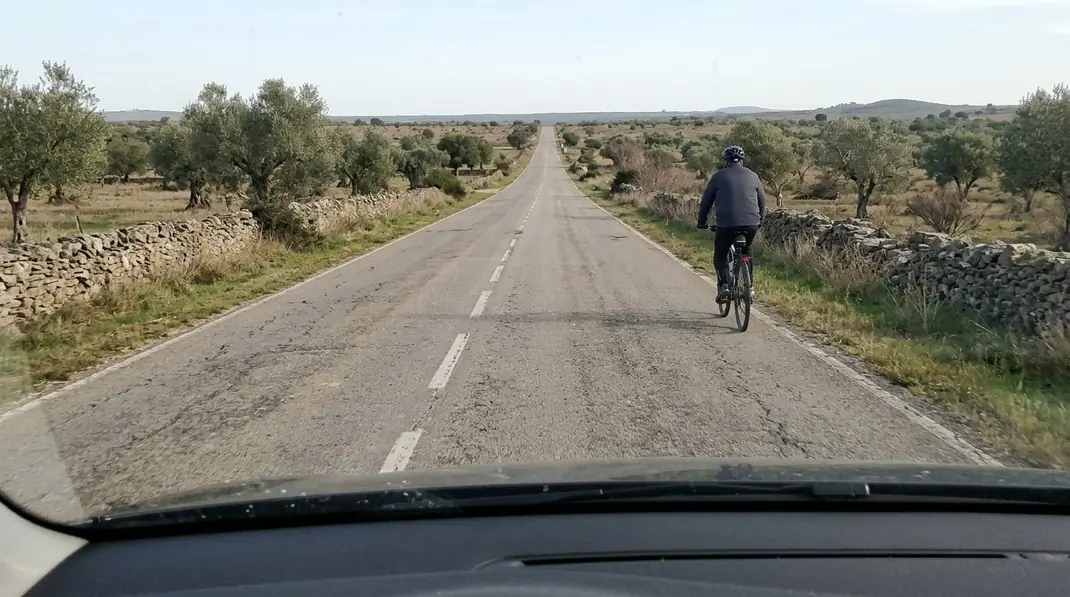
- when overtaking cyclists, or passing pedestrians on the verge, you keep at least 1.5 m of lateral distance and slow down.
Breaking these rules carries a fine of €120 to €600. Speed limits do not disappear either: art. 27 speaks of instantaneous speeds, so going over the limit to overtake is still speeding. For the amounts, see the speeding fines.
Where overtaking is banned
Art. 41 of the Código da Estrada bans overtaking:
- on crests;
- immediately before and at level crossings;
- immediately before and at crossroads and junctions;
- immediately before and at marked crossings for pedestrians and cyclists;
- on bends with limited visibility and anywhere visibility is insufficient;
- whenever the width of the carriageway is insufficient;
- of a vehicle that is itself overtaking a third one.
The fine is €120 to €600. There is also the no-overtaking sign (C14a), which bans overtaking other vehicles except cyclists, two-wheel mopeds and two-wheel motorcycles without a sidecar, according to the road signs regulation (RST).
If the carriageway has two or more lanes in the same direction, the bans on crests, level crossings, crossroads and bends with limited visibility, and the one on overtaking a vehicle that is overtaking, stop applying, as long as you do not use the side meant for opposing traffic (art. 41(3)). Overtaking remains banned before and at crossings, where visibility is insufficient and where the carriageway is too narrow.
Solid line: can you cross it to overtake?
No. Under the road signs regulation (art. 60), the solid line (M1) bans stepping on or crossing it and requires you to drive on its right when it separates the directions. The dashed line (M2) can only be crossed to carry out manoeuvres.
On a mixed line (M3), the line closest to your side applies: if it is solid you cannot cross; if it is dashed, you can, with care.
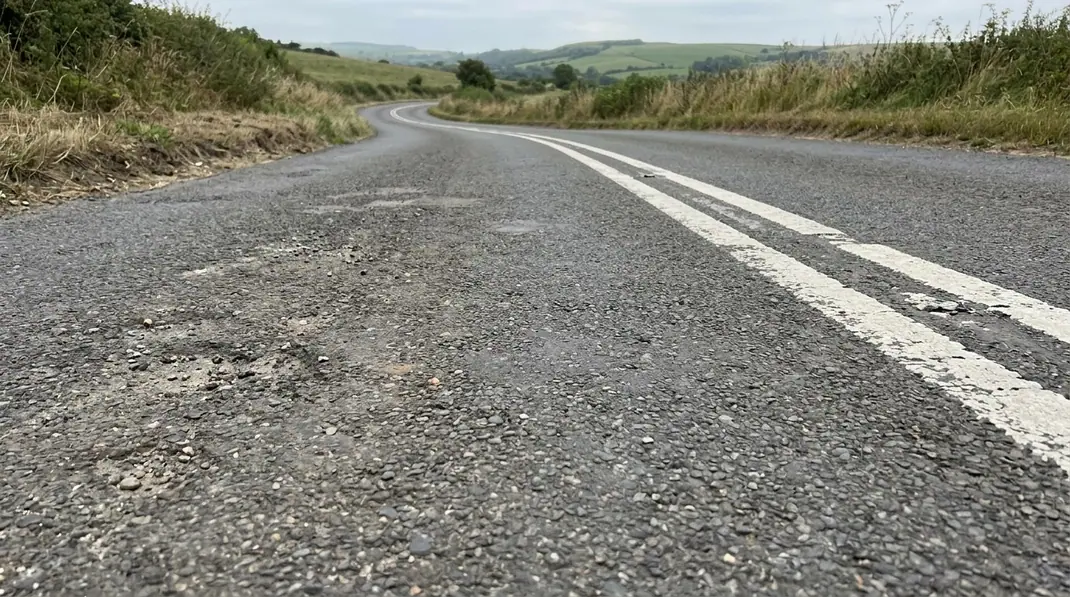
Crossing, or driving in breach of, a continuous longitudinal line that separates the directions of traffic (or a mixed line with the same meaning) is a very serious offence (art. 146). The accessory sanction is a driving ban of 2 months to 2 years, and 4 points are deducted from the licence.
The fine depends on the rule infringed; check it on the ANSR page on infringements of the Code.
Overtaking on the right: when it is allowed
The rule is the left, but art. 37 has exceptions. You must overtake on the right a driver who, signalling their intention, is about to turn left or, on a one-way road, to stop or park on the left, provided they have left the right-hand side of the carriageway clear. The fine for not complying is €120 to €600.
You may also overtake on the right vehicles that run on rails, such as a tram, if they are not stopped for passengers to get on or off or, if they are, there is a pedestrian refuge.
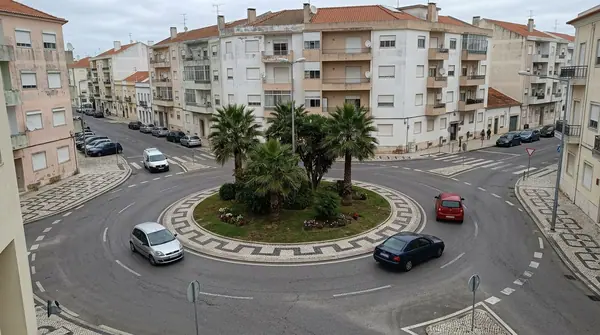
In built-up areas, on roundabouts and in parallel queues caused by heavy traffic, one queue moving faster than the one beside it is not overtaking under the Code (art. 42). Even so, in parallel queues you may not leave your queue for one further to the right, except to turn, stop or park (art. 15). On roundabouts, the lane and exit rules are different.
When you must let someone overtake
Being overtaken has rules too. Art. 39 requires every driver to make overtaking easy whenever nothing prevents it, moving as far to the right as possible and not increasing speed until overtaken. The fine is €120 to €600.
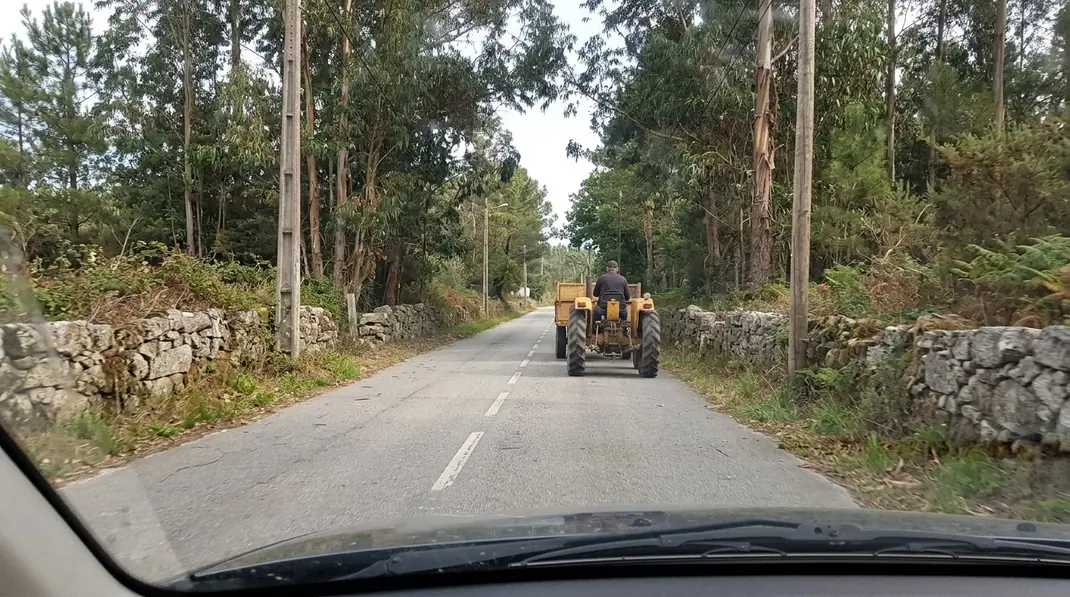
Outside built-up areas, on roads with one lane per direction, heavy vehicles, farm vehicles and other slow vehicles (except cycles) must keep 50 m from the vehicle ahead to allow safe overtaking and stop, if necessary, where the road is too narrow (art. 40, fine of €60 to €300).
Fines and points for overtaking mistakes
- Not overtaking on the left (art. 36): €250 to €1,250.
- Overtaking where it is banned (art. 41): €120 to €600.
- Overtaking unsafely or without checking traffic (arts. 35 and 38): €120 to €600.
- Not letting someone overtake (art. 39): €120 to €600.
- Not signalling the manoeuvre (art. 21): €60 to €300.
- Crossing a solid line (art. 146): very serious offence, 4 points and a ban of 2 months to 2 years.
Breaking the overtaking rules is a serious offence (art. 145), with an accessory driving ban of 1 month to 1 year and 2 points deducted.
If the overtaking happens immediately before or at crossings for pedestrians or cyclists, it is 3 points (art. 148). The final decision and the size of the penalty are for the authority; to understand the system, see our guide to licence points and the ANSR page on the points licence. If you received a notice, you can check your fines.
Tips for overtaking safely
- If in doubt, do not overtake: arriving a few minutes later costs less than a fine or a crash.
- Keep your eyes on the road: using a hand-held phone carries a fine of €250 to €1,250, as we explain in the phone-while-driving fine guide.
- Judge the distance of oncoming vehicles and how fast they approach, not only the free space ahead.
- Signal early, overtake without delay and return to the right as soon as you can do it safely.
- If you are being overtaken, keep your speed and move to the right.
If you are looking for a car for national roads, see the used cars for sale on AUTO.MOTO.pt.
The amounts in this article are those of the Código da Estrada as republished in 2020 and of the ANSR pages; always check the version in force before deciding anything.
Frequently asked questions
Can I overtake on the right in Portugal?
Only in the art. 37 exceptions: a driver about to turn left, or to stop or park on the left on a one-way road, and vehicles on rails, under the conditions of the law. Otherwise, overtaking is on the left.
Can I overtake at a zebra crossing?
No. Overtaking is banned immediately before and at marked crossings for pedestrians and cyclists, even on roads with several lanes in the same direction, and the offence can carry 3 points.
Can I cross a solid line to overtake?
No. Crossing a solid line that separates the directions is a very serious offence, with 4 points and a driving ban of 2 months to 2 years.
How much space must I leave when overtaking a bicycle?
At least 1.5 m of lateral distance, and you must slow down (art. 38).
How much is the fine for improper overtaking?
In most cases €120 to €600; overtaking on any side other than the left, outside the exceptions, costs €250 to €1,250. Points and a driving ban are possible.
Can I overtake a tractor or another slow vehicle?
Yes, if the road is clear, visibility is good, there is no solid line or other ban, and you follow the rules of art. 38.