
Paying IUC late in Portugal means a fine (coima). If you settle it on your own initiative, before the Tax Authority (Finanças) finds out, the reduced fine is generally €25. If the Tax Authority detects it first, the fine for negligence ranges from 15% to 50% of the unpaid tax, with a minimum of €50.
If you do not pay at all, the tax becomes a debt in enforcement proceedings, with late-payment interest, and can end in the seizure of your bank account or part of your salary, or in your income tax refund being used to pay the debt.
In this guide we explain how much the fine for late IUC costs, how to pay overdue IUC on the Portal das Finanças, how to check your tax debts and what happens if you leave the tax unpaid. The payment calendar, which changes in 2027, is covered in our article on the new IUC calendar from 2027.
When IUC becomes overdue
In 2026, IUC is paid in the month the vehicle was registered. A car registered in March pays in March every year. In the year of its first registration in Portugal, including imported cars, the deadline is 30 days after the end of the legal deadline for registration.
Once the deadline has passed (the last day of the registration month or, in the first year, the 30 days), your IUC is overdue. Even one day late counts as a late payment.
Some arrears appear without the owner noticing:
- a car sold but not registered to the buyer: IUC is owed by whoever appears in the ownership register, so the bill keeps going to the seller;
- a car that is off the road or broken down: the tax is due until the registration is cancelled by scrapping, even if the car is not driven;
- an out-of-date email address: not receiving the reminder from Finanças does not change the deadline.
If you sold the car and IUC still comes in your name, check that the buyer has completed the vehicle ownership registration. If the car is no longer used, scrapping the car is what ends the tax.
Fine for late IUC: how much it costs
The IUC Code refers non-payment to article 114 of the General Regime for Tax Offences (RGIT). For an individual, the amount depends on who spots the delay first.
If you pay on your own initiative: reduced fine
If you settle before Finanças issues an official report (auto de notícia) or starts an inspection, you are entitled to the reduction in article 30 of the RGIT. The fine drops to 12.5% of the legal minimum, which for an individual is 10% of the tax. In practice that is 1.25% of the IUC, but never less than €25.
Only an IUC above €2,000 makes the reduced fine higher than €25. Among the cars for sale on AUTO.MOTO.pt whose IUC we could calculate, none reaches that amount.
The reduction has two conditions: pay the fine within 30 days of the notice, and have the tax paid within the same period. If you miss them, offence proceedings are opened and the reduction is lost.
If Finanças detects it first: fine for negligence
When the Tax Authority detects the delay, the fine for negligence ranges from 15% to half of the unpaid tax. The minimum for any tax fine is €50, so for most cars the bill starts at €50.
We ran our IUC calculator on 3,561 cars for sale on AUTO.MOTO.pt on 13 October 2026. The median IUC is €148. For 95% of the cars, the annual tax is no more than €333, the point above which 15% of the tax exceeds €50.
If the Tax Authority considers that you deliberately did not pay, article 114 provides for higher fines.
Example with an IUC of €148
- you pay on your own initiative: €148 in tax, a reduced fine of €25 and late-payment interest for the days overdue;
- Finanças detects it first: €148 in tax, a fine of between €50 and €74 and late-payment interest;
- you do not pay: the debt goes to enforcement, with late-payment interest until it is paid.
In short, the sooner you settle, the less you pay.
How to pay overdue IUC
Overdue IUC is paid the same way as on-time IUC: with a single payment document (documento único de cobrança) carrying a reference you can pay at a Multibanco machine, through online banking or at a counter.
To get the document on the Portal das Finanças IUC area:
- log in with your tax number (NIF) and password, or with the Chave Móvel Digital;
- open Serviços › Veículos › IUC;
- under Pagamentos, choose Ano Corrente for this year's tax or Anos Anteriores for earlier years left unpaid;
- follow the steps to get the payment document;
- pay using the reference and keep the receipt.

Under the law, when the tax does not depend on an assessment made by the tax office, paying it counts as a request for a reduced fine. If the fine is not paid at the same time, Finanças will notify you to pay it within 30 days. Keep an eye on your notifications and your email.
If you do not use the Portal, you can ask for the payment document at any tax office (serviço de Finanças).
When an official assessment has already been issued
If you neither issue nor pay the tax, Finanças issues an official IUC assessment (liquidação oficiosa) and gives you 10 working days to pay. After that, a debt certificate is issued and the case moves to enforcement proceedings. From then on, the debt is paid within those proceedings.
How to check your tax debts on the Portal das Finanças
To find out whether you have overdue IUC or other debts, log in to the Portal das Finanças and look at:
- IUC › Consultar: shows the IUC assessments in your name and whether they are paid;
- Situação fiscal integrada: gives a summary of your standing with Finanças, including any outstanding debts;
- Notificações Eletrónicas and Mensagens: this is where notices from Finanças, such as fine notices, arrive.
It is worth checking once a year, especially if you own more than one car or have recently sold one.
What happens if you do not pay IUC
Leaving IUC unpaid does not make the debt go away. The path set out in law is:
- official assessment: Finanças calculates the tax and gives you 10 working days to pay;
- debt certificate and enforcement: without payment, enforcement proceedings are opened;
- late-payment interest: runs from the end of the deadline until payment (article 44 of the General Tax Law);
- fine: still due, now without the reduction.
Seizure (penhora) for unpaid IUC
In enforcement proceedings, Finanças can seize assets and income up to the amount of the debt and the charges. To collect the debt, the Code of Tax Procedure and Process provides, among others, for:
- bank balances: Finanças can ask banks for information on the debtor's accounts and balances;
- amounts owed to you, such as the salary paid by your employer, within the limits set by law;
- tax refunds: an income tax (IRS) refund can be used to pay the debt by offsetting.
Seizure of the car
The IUC Code also provides that, once an offence report for non-payment is drawn up, the vehicle and its documents may be seized or immobilised until the tax and the fine are paid. The law allows the tax and the fine to be paid on the spot when the offence is detected.
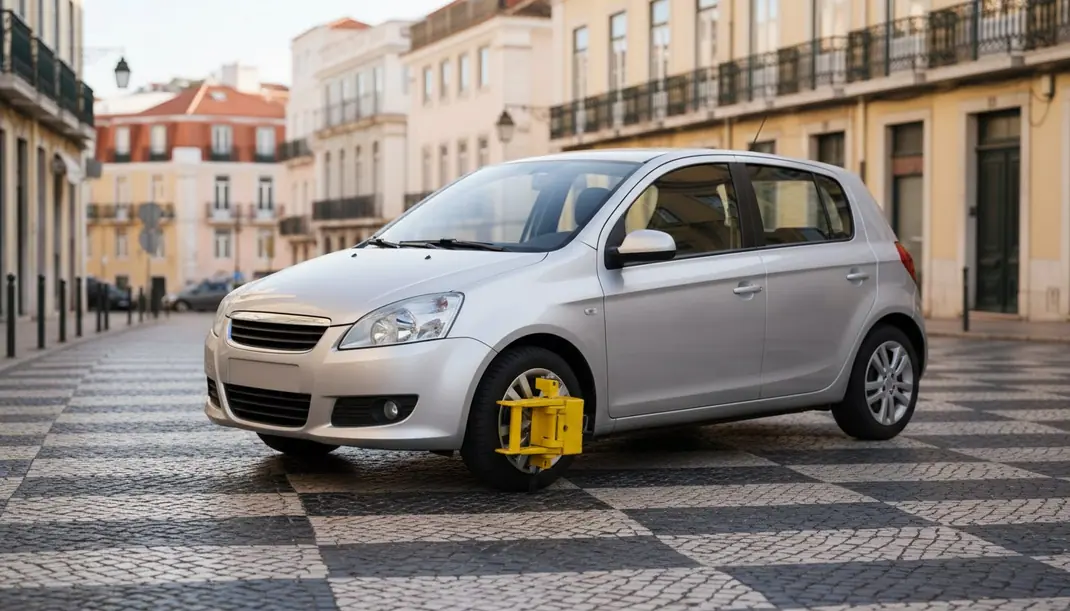
The GNR and the PSP are among the authorities the IUC Code names to enforce the tax. You do not need to carry proof of payment in the car: the payment is recorded by Finanças.
Can I pay overdue IUC in instalments?
While IUC is within its normal deadline, it is paid in one go. A debt in enforcement proceedings, however, can be paid in monthly instalments at the debtor's request, up to the point when a sale of the assets is scheduled.
Under article 196 of the Code of Tax Procedure and Process, the request may be granted to anyone whose financial situation does not allow them to pay everything at once. The limit is generally 36 instalments, and each has a minimum amount, so a small debt is split into only a few. Late-payment interest keeps running on the unpaid part.
Do IUC debts expire?
They do, but it is not a strategy. Under article 48 of the General Tax Law, tax debts expire after eight years. For periodic taxes such as IUC, the period runs from the end of the year in which the tax was due.
The law itself provides for events that interrupt or suspend that period, such as being served notice in enforcement proceedings. So relying on it is risky: steps such as being served notice in the proceedings can restart or suspend the clock.
Buying a used car with overdue IUC
IUC is owed by whoever was registered as the owner, so arrears generally belong to the previous owner. But the IUC Code gives the State a preferential claim over the vehicle itself to collect the tax and the fines.
Before you buy, ask the seller for the IUC payment receipts for recent years and check the vehicle register for any seizures. You can also check the car's history by VIN and compare prices among the used cars for sale.
If you are the seller, settle the IUC before you advertise: buyers are wary of a car with debts attached.
Frequently asked questions about overdue IUC
What is the fine for paying IUC late?
If you settle on your own initiative, before Finanças issues a report, the reduced fine is generally €25. If Finanças detects it first, the fine for negligence ranges from 15% to 50% of the tax, with a minimum of €50.
What happens if I pay IUC after the deadline?
You pay the tax and then a fine. As a rule, paying on your own initiative counts as a request for the reduction: Finanças notifies you of the reduced fine, which you must pay within 30 days.
How long do I have to pay IUC?
In 2026, until the last day of the month in which the car was registered. In the year of first registration, 30 days after the end of the legal deadline for registration. From 2027 the dates change.
Do I have to carry proof of IUC payment in the car?
There is no rule in the IUC Code requiring you to carry proof in the car. The old road tax disc ended when IUC was created in 2007. Even so, keep the receipt, which you can download from the Portal das Finanças.
What are the consequences of not paying IUC?
A fine, late-payment interest and enforcement proceedings, which can lead to the seizure of your bank account or part of your salary. Your IRS refund can be used to pay the debt, and the car can be seized or immobilised.
Can I pay IUC for previous years?
Yes. On the Portal das Finanças, under IUC › Pagamentos, choose Anos Anteriores and issue the payment document. If the debt is already in enforcement proceedings, it is paid within those proceedings.