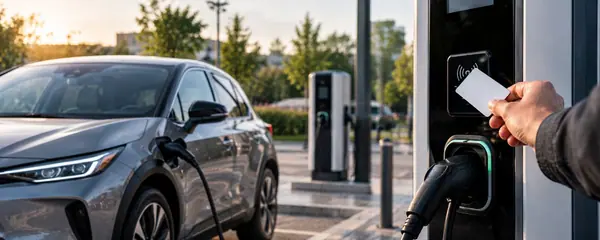
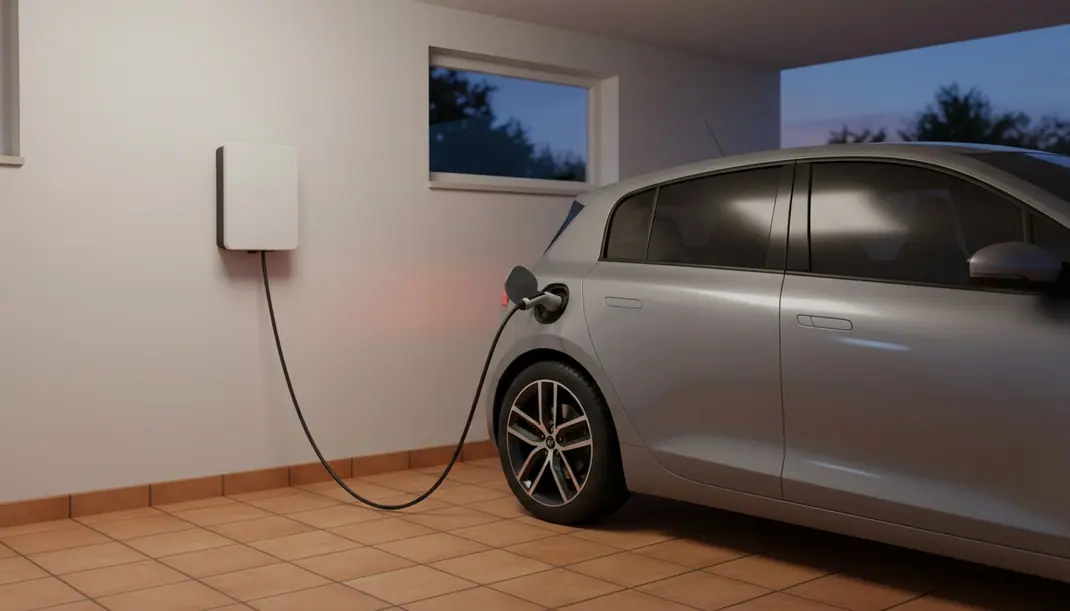
A wallbox is a wall-mounted charger for an electric car. At home, a 7.4 kW single-phase wallbox charges about three times faster than a household socket (2.3 kW): a 60 kWh battery goes from 10% to 80% in about six hours, in other words overnight.
As for the price, Portuguese shops and installers advertise between €300 and €900 for the unit and between €300 and €700 for installation in 2026. In a block of flats, you only need to notify the condominium administration in writing 30 days in advance.
This guide explains what it is, what it costs to buy and install, which power to choose, what the law says about a wallbox in a condominium, what support exists and when it is really worth it.
What a wallbox is and why the socket is not enough
It is a fixed charging point connected to its own circuit in the fuse board. It talks to the car, adjusts the current and cuts the power if it detects a fault. A household (Schuko) socket also charges, but slowly and for many hours at its limit.
- household socket: about 2.3 kW, roughly 15 km of range per hour of charging;
- single-phase wallbox: up to 7.4 kW (32 A), the most common choice in a Portuguese home;
- three-phase wallbox: 11 kW or 22 kW, only with a three-phase supply and if the car accepts that power.
How long each option takes for the best-selling models is covered in our article on how long it takes to charge an electric car.
Wallbox price: what it costs to buy and install in 2026
There is no single price: it depends on power, smart features and the distance between the fuse board and the parking space. Based on the prices Portuguese shops and installers publish in 2026 (indicative, VAT included):
- basic 7.4 kW wallbox: about €300 to €500;
- smart wallbox, 7.4 to 11 kW (app, scheduling, load management): about €500 to €900;
- electrical installation (cable, dedicated breaker, RCD and labour): about €300 to €700;
- usual total in a house or garage close to the fuse board: roughly €800 to €1,600.
The price goes up if the cable has to run a long way through a garage, if walls have to be chased or if you switch to three-phase. Always ask for a written quote with the materials itemised.
Which power to choose: 7.4 kW, 11 kW or 22 kW
More power on the wall does not mean faster charging. On alternating current, the car's on-board charger sets the limit: if your EV only accepts 7.4 kW, a 22 kW unit charges at exactly the same rate.
- 7.4 kW single-phase: enough for almost every driver who charges overnight;
- 11 kW three-phase: useful if the house already has three-phase and the car accepts 11 kW;
- 22 kW: rarely pays off at home, because few cars accept it on alternating current.
Contracted power: will you need to increase it?
A 7.4 kW charger running at full power, plus the oven and the washing machine, can trip a 6.9 kVA supply. There are two ways out: raise the contracted power with your electricity supplier or choose a wallbox with dynamic load management, which lowers the charge when the house uses more.
How to install a wallbox at home, step by step
- Check what the car accepts: maximum AC power and whether it is single- or three-phase;
- hire a qualified electrician: charging points follow the rules for private electrical installations and the technical rules of Portaria 128/2026/1, listed by the Directorate-General for Energy and Geology (DGEG);
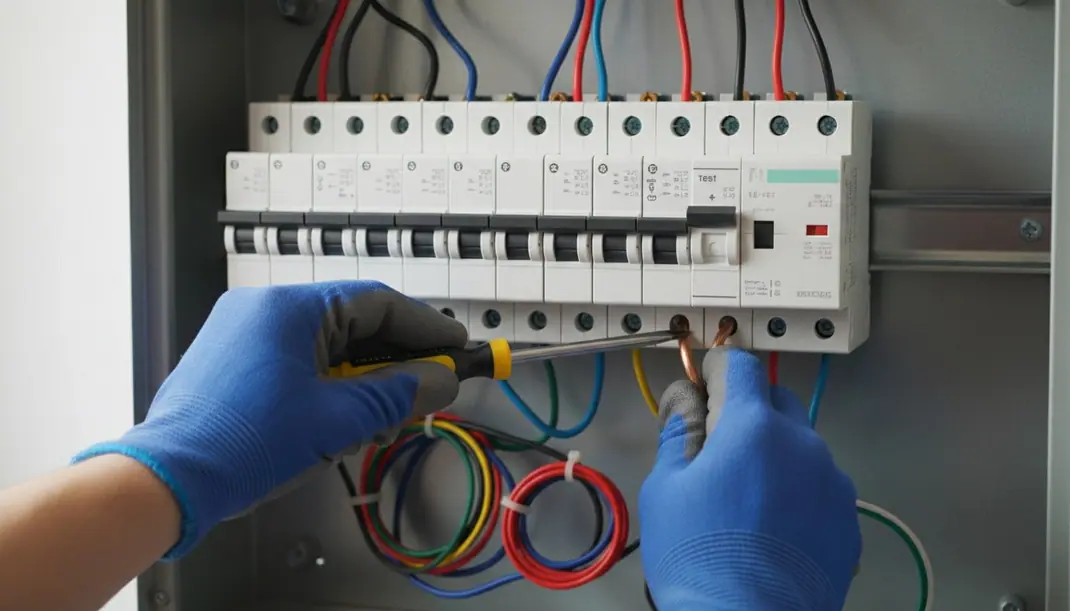
- a dedicated circuit: the charger connects to its own breaker and RCD in the fuse board, never to an existing socket;
- check your contracted power and, if needed, ask for the increase before the installation;
- keep the electrician's invoice with the certificate number: it is required for any Fundo Ambiental support.
If the car sleeps on the street and there is no garage, this is not an option. In that case you charge at public points, and our guide on which EV charging card to choose helps you avoid paying more than you need to.
A wallbox in a condominium: what the law says
The Legal Regime for Electric Mobility (Decree-Law 93/2025) gives any flat owner the right to install a charging point in their own parking space in an existing building, at their own expense, as long as the technical requirements are met.
- Written notice to the condominium administration at least 30 days in advance, when the installation runs through common areas;
- no approval needed from the owners' meeting, unlike other works in common areas;
- the owner pays for the unit and the installation: the simplest way is to connect the charger to your own flat's meter; the law also provides for separate metering points, on terms still to be set by the regulator ERSE.
The administration can only object in the cases the law sets out, within 30 days of the notice, by a simple majority of the building's total value, with a reasoned decision recorded in the minutes:
- the building already has a shared charging point serving everyone, or the condominium installs one within 90 days;
- the installation obstructs traffic on the garage's common lanes;
- it breaks the accessibility rules;
- there is a proven risk to people or property, backed by a technical opinion.
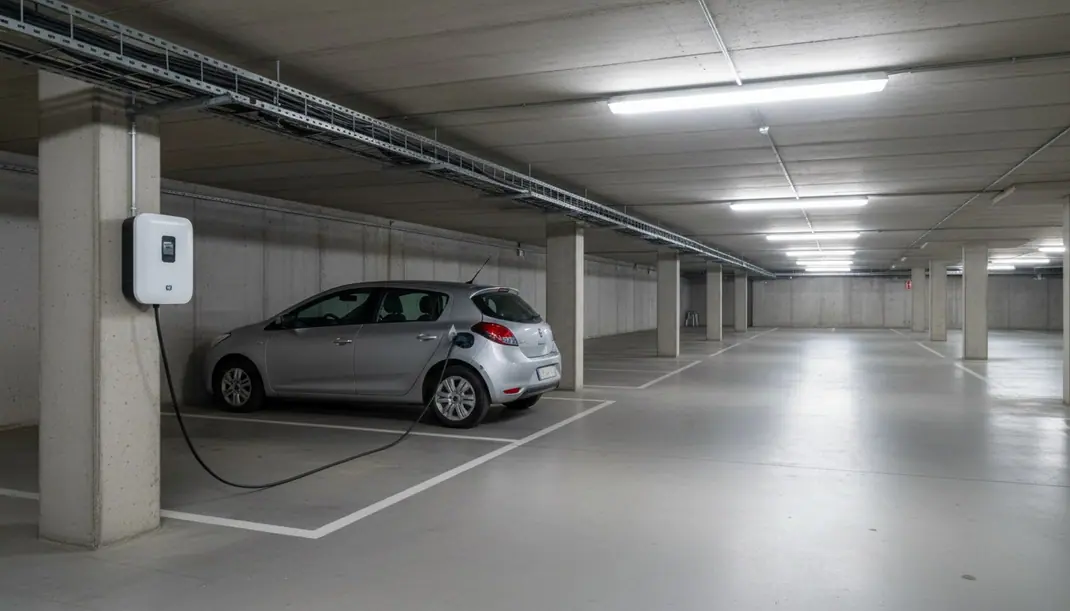
Note: the law does not oblige the condominium to upgrade the building's electrical installation. If the garage board lacks the power, that work has to be approved at the owners' meeting.
Fundo Ambiental support for a wallbox
In the 2025/2026 notice of the Fundo Ambiental, the charger category paid 80% of the price of the charging point, up to €800, and 80% of the electrical installation, up to €1,000. It was aimed at chargers in multi-family condominiums: one per owner and up to 10 per building.
The second phase took applications between 11 June and 27 July 2026 and has closed. Invoices issued from 1 January 2025 counted, with installation by a certified technician. If you plan to install now, keep every invoice and watch the Fundo Ambiental website for a new notice.
Charging in off-peak hours
Home charging pays off more on a two-rate (bi-horário) tariff. On the daily cycle, off-peak runs from 10 pm to 8 am. According to ERSE, the energy regulator, between July and December 2027 this period moves to 10:30 pm to 8:30 am, automatically through the smart meter.
Set the charger, or the car itself, to start after 10 pm. The cost of each charge, with examples, is worked out in our article on how much it costs to charge an electric car at home.
Do you really need a wallbox?
It depends on how much you drive. Someone doing 30 or 40 km a day puts that energy back in one night on a socket. A wall charger makes the difference with big batteries, high mileage or two EVs in the same home.
- Plug-in hybrids: small batteries that a socket fills overnight. There are 508 for sale on AUTO.MOTO.pt (median €29,200), see used plug-in hybrids;
- used EVs: 692 adverts on AUTO.MOTO.pt in October 2026, with a median price of €26,600 and 192 under €20,000. See the used electric cars for sale;
- buying your first EV? Compare the best used electric cars first and check each model's charging power.
Frequently asked questions about wallboxes
How much does a wallbox cost with installation?
Based on prices advertised in Portugal in 2026, roughly €800 to €1,600 in total for a 7.4 to 11 kW wallbox in a garage close to the fuse board. Long or three-phase installations cost more.
What is the advantage of having a wallbox?
It charges about three times faster than a socket, on a dedicated circuit with its own protection, and lets you schedule charging for off-peak hours.
What do I need to install a wallbox?
Your own parking space, a dedicated circuit from the fuse board, enough contracted power and a qualified electrician. In a block of flats, written notice to the administration 30 days in advance.
Is a certified electrician mandatory?
The installation must meet the technical rules for electrical installations and be done by a qualified technician. Without an invoice from a certified technician, you also lose access to Fundo Ambiental support.
What contracted power do I need for a wallbox?
There is no fixed figure. On 6.9 kVA, a 7.4 kW charger at full power can trip the supply. Either raise the power or choose a model with dynamic load management that reduces the charge.
How much electricity does a wallbox use?
The charger uses the energy that goes into the battery plus a small loss. Charging a 60 kWh battery from 10% to 80% takes about 42 kWh, whether from a socket or a wallbox.