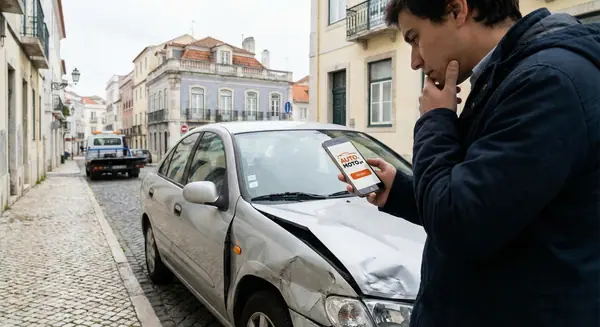
If you miss the payment deadline (data de vencimento), your policy is immediately canceled. You are no longer insured. You absolutely cannot drive. If police catch you, you face a direct fine of 500 to 2,500 euros. You lose 2 driving points. Authorities will initiate the immediate seizure (apreensão) of your vehicle. If you cause a crash, the FGA pays the victims, but they will legally pursue you to recover every single cent. Do not try to pay the old Multibanco reference. It is dead. You must contact a broker to issue a brand-new policy immediately. Check your payment status today.
Driving without insurance
Portuguese insurance contract law operates on a rigid foundational principle regarding financial consideration. Car insurance premiums are payable strictly in advance. The legal term is prémio prévio. The insurance carrier assumes the financial risk of potential future collisions only after receiving the agreed monetary premium. The immediate consequence of non-payment involves absolute contract termination. Third-party liability coverage ceases at exactly midnight on the specific deadline date. The legal requirement for every motorized road automobile to carry minimum liability protection means the vehicle legally loses its right to circulate on public roads at that exact moment. Driving exposes you to the 2,500 euro maximum fine.
How many days can I drive without insurance?
Zero days. A persistent myth circulates among drivers regarding a mythical post-deadline grace period (período de carência). Portuguese insurance law does not mandate any period where the carrier pays accident claims after the absolute payment deadline passes unpaid. The insurance sector utilizes a highly predictable chronological communication schedule before terminating any contract. Thirty days before expiration, the insurance company initiates the cycle by dispatching an official notification document known as the Aviso de Pagamento. It lists the 9-digit Multibanco reference number and the absolute payment deadline. If the clock strikes midnight on that exact date and the financial institution registers zero payment allocation, the carrier considers the contract broken. You hold full financial liability.
Insurance direct debit rejected
Automated bank debits (débito direto) fail frequently. Common technical issues include account balance shortfalls precisely when the mandate triggers. Bank transfer rejections occur if the account holder switches banks and forgets to update the IBAN on the insurance client portal. Credit card credential changes after a card is reported lost block the automated billing cycle instantly. The contract terminates instantly by operation of law. Resolving a bounced bank debit requires simple administrative action. Do not attempt to force the old direct debit mandate manually. Log into your insurer's digital smartphone application. Navigate to the billing section. Obtain a newly generated, active Multibanco reference. Pay that specific reference at an ATM.
Expired insurance: what to do
When a driver realizes their payment deadline has passed, they must initiate a specific recovery sequence. Paying the expired Multibanco reference printed on the original notice does not automatically reactivate a terminated policy. The banking system will either reject the expired reference entirely, or the insurer will receive the funds but place them in an unallocated holding account. The policy remains dead. You must request a new insurance quote or instruct your mediator to issue a fresh contract with the same insurance carrier. They calculate the premium based on current rates. Existing claims history and accumulated no-claims bonuses remain fully protected during this transition if action is taken within 90 days. Establishing a new policy takes minimal effort, even for older used cars. Sign the digital proposal. Pay the initial installment.
Automobile accident guarantee fund
The Portuguese insurance framework integrates a specialized safety net designed explicitly to protect innocent victims in road incidents. The FGA (Fundo de Garantia Automóvel) operates as a state-backed financial reserve. The fund intervenes when collisions involve uninsured or unidentified vehicles. If a driver with an unpaid, canceled policy strikes a parked car or causes bodily injury in an intersection, the victim does not face financial ruin. The fund steps in to cover the victim's medical expenses and property damage repair costs directly. After compensating the innocent third party, the fund contacts the responsible uninsured driver. They establish structured reimbursement plans to recover the payout, utilizing the courts to garnish wages if the driver refuses to cooperate. Expect a devastating lawsuit.
A parked car needs insurance
Portuguese drivers frequently face dilemmas regarding vehicles parked indefinitely on private property. Owners often assume they can simply stop paying insurance premiums if the vehicle never touches a public road. Current European and national jurisprudence establishes strict liability rules. Based on interpretations of Decreto-Lei 291/2007, even a non-running or parked vehicle must carry basic third-party liability insurance unless its registration is officially canceled with the transport authority. The legal reasoning focuses on latent risk. A parked car can suffer a mechanical short circuit and trigger a fire that damages a neighbor's property. Contact your broker to arrange a low-cost, basic third-party liability plan. If the vehicle is permanently inoperable, file paperwork to officially deregister the license plates. Pay the 10 euro cancellation fee.
Monitoring via the ASF and Digital Tolls
The Portuguese state monitors the national insurance ecosystem through a centralized digital architecture. The ASF (Autoridade de Supervisão de Seguros e Fundos de Pensões) operates as the primary regulatory body overseeing all active policies. When a policy terminates due to an unpaid premium, the insurance carrier transmits this cancellation data directly to the central database within days of the missed deadline. Electronic toll systems operating on Via Verdehighway corridors scan license plates continuously. They cross-reference the plates against the central database without requiring physical paper decals to be displayed on the windshield. If the cameras flag your plate as uninsured, the authorities intercept the vehicle at the next toll plaza.
Finding Affordable Solutions and Replacement Vehicles
Temporary suspension represents an optional, highly useful administrative tool that drivers can request voluntarily when actively selling a vehicle. Suspending the policy freezes the remaining months of financial credit. You apply that exact financial credit toward a future vehicle purchase. This strategic financial maneuver proves incredibly beneficial when researching where to buy used cars in Portugal and planning the budget for your next acquisition on platforms like AUTO.MOTO.pt. Using suspended credits reduces the upfront capital required to insure your new daily driver. Contact certified insurance mediators to issue an immediate provisional certificate or an updated Carta Verde the moment you process the new payment. Download it to your smartphone.
Frequently Asked Questions About Unpaid Vehicle Insurance
Can an insurer accept late payment without canceling the policy? No, contracts terminate automatically by operation of law at midnight on the deadline. The system does not permit manual overrides.
Does missing a payment affect my no-claims bonus? No-claims discounts are generally protected and fully transferable if you open a new contract within 90 days.
How quickly is coverage active after taking out a new policy? Coverage starts on the exact date and minute specified on the provisional certificate.
Will I receive a refund if I overpaid on a canceled policy? If a policy is canceled mid-term due to a vehicle sale or total loss, insurers calculate the exact pro-rata premium based on the specific number of days covered. Check your bank account.