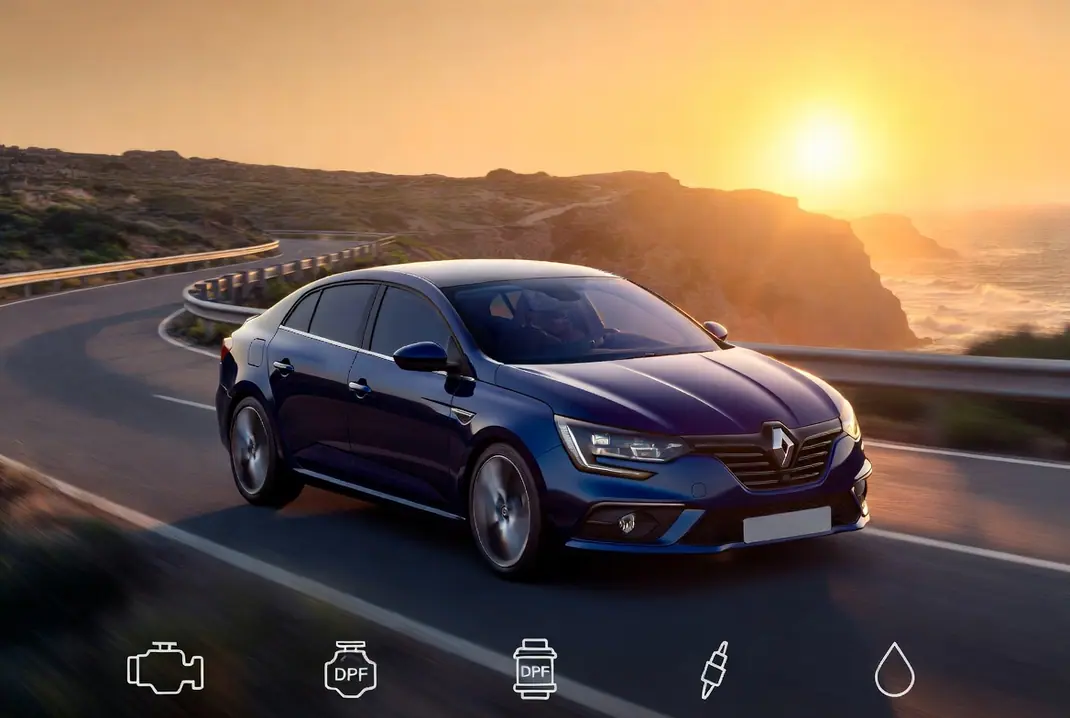
For nearly thirty years, the Renault Mégane has been a familiar sight on Portuguese roads. From the first generation launched in the mid-90s to the current electric version, this French compact has always tried to strike the right balance between interior space, comfort, and everyday running costs. In Portugal, where many drivers prioritise practicality and fuel economy, the Mégane has become a common choice both in showrooms and on the used car market.
This article is written for those who already own a Renault Mégane and for those still considering buying one. We’ll cover the engines that power the model, its dimensions, the oil capacity of the popular 1.5 dCi, when to replace the timing belt, how to perform particulate filter regeneration, the most common reasons why the car won’t start, and finally, the range of the electric version. The goal is to provide clear, practical information without unnecessary technical jargon.
What Engines Does the Renault Mégane Have?
The Mégane’s engine lineup has evolved from generation to generation. In the third generation (2008–2016) and the fourth (from 2016 onwards), the most common petrol options in Portugal were the 1.2 TCe and later the 1.3 TCe, with power outputs ranging from 100 to 160 hp. These small-displacement turbo engines offered a reasonable compromise between performance and consumption, although some owners reported higher oil usage in certain versions.
Nevertheless, the engine that truly dominated Portuguese roads was the 1.5 dCi, known internally as the K9K. Available in 90, 110, and 115 hp versions, this four-cylinder, eight-valve diesel earned a reputation for excellent economy. On the highway, with a well-maintained car, many drivers achieve averages below 5 litres per 100 km. The generous low-end torque makes it pleasant to drive both in daily traffic and on longer journeys.
More recent versions of the fourth generation also introduced the 1.6 dCi and plug-in hybrid solutions. The Mégane E-Tech, presented as a dedicated 100% electric model, completely abandoned combustion engines. In this version, we find a 160 kW (around 220 hp) electric motor with 300 Nm of torque and front-wheel drive.
The choice of engine depends heavily on how the car is used. Those who cover many highway miles still find the 1.5 dCi a solid and economical solution. Meanwhile, drivers who mainly use the car in the city and have the ability to charge at home are increasingly turning to the electric version, especially after the 2026 update.
What Is the Length of the Renault Mégane?
The dimensions of the Renault Mégane vary depending on the generation and body style. The fourth-generation hatchback measures approximately 4.36 metres in length (values between 4,359 and 4,364 mm, depending on the version and facelift). The Grandtour estate version increases to around 4.63 metres, making it more practical for those who need extra luggage space. The saloon sits in a similar range to the estate.
The Renault Mégane E-Tech electric is slightly shorter, at around 4.20 metres. This difference comes from the dedicated platform developed for the electric model. In terms of width, the conventional hatchback is about 1.81 metres (excluding mirrors), while the height is close to 1.45 metres.
These measurements place the Renault Mégane in a comfortable position within the compact segment. It is agile enough for city driving and parking, yet offers generous interior space for five adults. The conventional hatchback’s boot capacity ranges from 380 to 430 litres depending on the version, while the electric version offers 440 litres. With the rear seats folded, these figures increase significantly, making the car useful for weekend trips or small moves.
How Many Litres of Oil Does the Renault Mégane 1.5 dCi Take?
In the 1.5 dCi engine, the oil capacity is normally between 4.5 and 5.0 litres, including the filter change. According to the technical specifications for the K9K engine, the exact capacity is around 4.5–4.9 litres with the filter. Consult the manual or Renault technical data for your exact version. In most 110 hp versions, the most common figure is close to 4.5 to 4.9 litres. It is always advisable to check the dipstick after an oil change, as small differences can exist depending on the year and specific version.
The recommended oil type is a 5W-30 that meets the Renault RN0720 standard or equivalent ACEA C4, which is especially important in versions equipped with a particulate filter. Using the wrong oil can accelerate FAP clogging and cause premature wear on internal components, particularly the crankshaft bearings — a known issue in some 1.5 dCi engines with neglected maintenance.
Change intervals vary. Under normal conditions, many manuals suggest 15,000 to 30,000 km or annually, whichever comes first. However, those who mainly do short urban trips or use the car in severe conditions should consider shorter intervals, ideally every 10,000 to 15,000 km. Regularly checking the oil level (with the engine cold and the car on level ground) is a simple habit that prevents many problems.
When to Change the Timing Belt on the Renault Mégane 1.5 dCi 110 hp
The timing belt on the 1.5 dCi 110 hp is one of the most important maintenance points on this engine. The official interval varies depending on the year of manufacture. On older versions, the usual recommendation is 120,000 km or 5 years, whichever comes first. On engines produced after 2006/2010, the interval often increases to 160,000 km or 6 years. According to official Renault recommendations and specialist workshop data, the timing belt replacement interval on the 1.5 dCi varies between 120,000 and 160,000 km or 5–6 years, depending on the engine year.
Even if the car has low mileage, time is a decisive factor. The rubber belt ages, loses elasticity, and can crack even with low usage. Most professionals recommend replacing the water pump, tensioners, and auxiliary belt at the same time. Replacing only the belt and leaving the old water pump is a risky economy, because if the pump fails shortly afterwards, everything has to be disassembled again.
If the belt breaks on this engine, it causes serious damage to the valves and pistons, with repair costs that can easily exceed a thousand euros. Therefore, if you bought a used car without a clear record of this operation, the most prudent approach is to replace it preventively. Warning signs include unusual noises from the timing area, vibrations, or loss of power, although the belt often breaks without prior warning.
How to Perform Particulate Filter Regeneration on the Renault Mégane
The particulate filter (FAP or DPF) on the 1.5 dCi requires periodic regeneration to burn off accumulated particles. Under normal conditions, the process is automatic: when the system detects saturation, it raises the exhaust gas temperature through additional diesel injections. To complete regeneration successfully, the engine must be kept above 2,000 rpm for 10 to 20 minutes, preferably on the road or motorway at a steady speed.
If the particulate filter warning light comes on the instrument panel, continue driving without letting the revs drop too low and avoid prolonged stops. The ideal is to maintain a speed above 60–70 km/h for at least fifteen minutes. In many cases, the light goes out on its own when the process is complete.
When automatic regeneration cannot complete (which often happens with used cars used mainly in the city), a forced regeneration at a workshop with diagnostic equipment is required. This procedure raises the filter temperature in a controlled manner and cleans the accumulated particles. In more serious situations, chemical cleaning or, as a last resort, filter replacement may be necessary.
To prevent problems, it is recommended to make at least one longer trip (about 20 minutes at steady speed) every 200 km, especially if daily use is mainly urban. Avoiding turning off the engine during an ongoing regeneration and always using the correct oil also help extend the life of the system.
Renault Mégane 1.5 dCi Won’t Start: What to Do
When the 1.5 dCi refuses to start, the most common causes are relatively simple to diagnose but require a systematic approach. The first step is to check the battery and connections. Low voltage (below 12.4 V with the engine off) is one of the most common reasons, especially in cold winters or on cars that sit idle for many days.
The glow plugs also fail quite regularly and make cold starts difficult. Other points to check include the crankshaft position sensor (TDC), a clogged fuel filter, problems with the injectors or high-pressure pump, and issues related to the EGR system or a saturated particulate filter. In some cases, the car may start and then immediately go into limp mode due to lack of pressure in the common rail.
The practical procedure begins by trying to read the fault codes with a diagnostic tool. Often the solution involves cleaning sensors, replacing glow plugs, or performing a forced FAP regeneration. If the problem persists, it is best to take the car to a workshop experienced with these K9K engines, as some diagnoses require specific equipment and knowledge of the injection system’s peculiarities.
Avoiding driving with an almost empty tank and using quality fuel also reduces the likelihood of long-term starting problems.
What Is the Range of the Renault Mégane Electric?
The electric version, the Renault Mégane E-Tech, received a significant update in 2026. With the new 67 kWh usable LFP battery, the homologated range in the WLTP cycle reaches 500 km. According to official Renault data after the 2026 facelift, the Mégane E-Tech with the 67 kWh battery achieves up to 500 km WLTP. More information on the official Renault website. Before this update, with the 60 kWh battery, figures ranged between 450 and 470 km depending on the version and equipment.
In real-world use, range depends heavily on driving style, outside temperature, and route type. On motorways at high speeds (120–130 km/h), it is normal to see figures closer to 300–350 km. In the city with efficient driving and energy regeneration, it is possible to approach the official numbers. In winter, with low temperatures and intensive use of heating, range can drop by 15 to 25 percent.
Fast-charging capability has also improved: it is now possible to go from 15% to 80% in about 24 minutes at DC fast-charging stations up to 165 kW. At home, with a 7.4 or 11 kW wallbox, a full charge takes several hours, which is perfectly manageable for most daily uses.
Final Considerations and the Used Car Market
The Renault Mégane continues to offer an interesting combination of space, comfort, and controlled running costs, especially in well-maintained 1.5 dCi versions. Those looking for a balanced everyday car will find a solid solution in this model, provided they respect maintenance intervals and pay attention to critical points such as the timing belt and particulate filter.
On the used cars market, the Mégane offers good availability and relatively affordable prices compared to some German rivals. If you are considering buy Renault Mégane, it is worth checking the maintenance history, especially the date of the last timing belt change and the condition of the emissions system. Used Renault Mégane cars with the 1.5 dCi engine continue to be a popular choice for those who cover many miles and value low consumption.
Regardless of whether you choose a combustion model or the electric version, the important thing is to understand the particularities of each powertrain. With regular maintenance and attentive driving that meets the needs of the particulate filter (in the case of diesels), the Mégane can provide many years of use without major surprises. Before any purchase, a thorough inspection at a trusted workshop remains the best investment you can make.