Yamaha is one of the most recognised brands in the motorcycle world. Anyone who rides or simply enjoys mechanics has heard of it. The name appears everywhere: from urban scooters to competition superbikes. But behind the name there is an interesting history, a symbol with its own meaning, and a classic rivalry with Honda that never stops generating discussion.
In this article we will answer clearly and directly the questions that are most often asked: what the Yamaha symbol means, which country the brand is from, which is better between Honda and Yamaha, what is the most powerful Yamaha motorcycle, and which engine tends to last longer. All based on facts and without unnecessary complications.
What Does the Yamaha Symbol Mean
The Yamaha logo is one of the simplest and, at the same time, one of the most recognisable in the industry. It consists of three interlocking tuning forks inside a circle (or extending beyond the circle, depending on the version).
Its origin lies in the company’s history. Yamaha began as a manufacturer of musical instruments. In 1897, Torakusu Yamaha founded Nippon Gakki (later Yamaha Corporation) and, the following year, adopted the tuning fork as its symbol. The tuning fork is the tool used to tune pianos, organs and other instruments. It represents precision, harmony and sound quality.
When the motorcycle division was born in 1955, it kept the same symbol but with an adapted interpretation. Officially, the three tuning forks represent three fundamental pillars:
- Technology
- Production
- Sales
There is also a more musical reading: melody, harmony and rhythm. In the specific case of Yamaha Motor, the tuning forks are arranged in a way that recalls the wheel of a motorcycle. More recently, the company has also associated them with the concepts of Customer, Society and Individual, linking the symbol to its management philosophy.
One curiosity that many people do not know: there are two slightly different versions of the logo. At Yamaha Corporation (musical instruments and audio) the tuning forks remain contained within the circle. At Yamaha Motor (motorcycles, marine engines, ATVs) the tips of the tuning forks extend outside the circle, giving a sense of movement and energy. It is a subtle but intentional difference.
The symbol was updated in 2025 to a flatter, two-dimensional version designed to work better on digital screens without losing its identity.
In short: the Yamaha logo is not just a nice design. It is the bridge between the brand’s musical origins and its journey in the world of two wheels. You can consult the official history of the Yamaha logo for more details.
Which Country Is Yamaha From?
The answer is simple and direct: Yamaha is a Japanese brand.
The story begins in 1887, when Torakusu Yamaha built his first reed organ in Hamamatsu, Japan. In 1897 he formalised the company as Nippon Gakki. For decades it focused almost exclusively on musical instruments.
The entry into the motorcycle world happened in 1955. Genichi Kawakami, then president of Nippon Gakki, decided to make use of idle industrial capacity (machines that had previously been used to produce aircraft propellers during the war) and launch a motorcycle. On 1 July 1955, Yamaha Motor Co., Ltd. was officially founded, with its headquarters in Iwata, Shizuoka Prefecture. The founding of Yamaha Motor is well documented by the company itself.
The first motorcycle was the YA-1, a 125 cc two-stroke that became known as the “Akatombo” (red dragonfly). In its very first year the brand began competing and winning, creating the performance reputation it still holds today.
Today Yamaha Motor remains a Japanese company, headquartered in Iwata and present in more than 180 countries. It produces motorcycles, outboard motors, all-terrain vehicles, scooters and even industrial equipment. Despite its global scale, the Japanese identity remains strong: precise engineering, attention to detail and a culture of continuous improvement.
Which Is Better: Honda or Yamaha?
This is the question that has divided motorcyclists for decades. There is no absolute answer. It depends on what each person values.
Honda and Yamaha are the two largest Japanese motorcycle brands and, in many ways, complementary.
Honda’s strengths
- Refinement and smoothness of operation
- Very well-documented long-term reliability
- Generally wider dealer network in many markets
- Excellent reputation in daily-use and touring models
- Engines that often “give no trouble” for hundreds of thousands of kilometres
Yamaha’s strengths
- More distinctive character and riding personality
- Engine technology (especially the crossplane crankshaft of the R1 and MT-09)
- Better performance in many sport and naked models
- More aggressive and distinctive design
- In several recent reliability studies, Yamaha shows a slightly lower failure rate than Honda in the first four years
In terms of numbers, owner survey data (including studies similar to those of Consumer Reports) show very close failure rates: around 11 % for Yamaha and 12 % for Honda in the first four years. Both are well below the industry average.
In practice:
- Anyone who wants a motorcycle for daily use, long trips or maximum peace of mind tends to lean towards Honda.
- Anyone looking for fun, quick engine response and a more involving ride tends to prefer Yamaha.
Some say Honda is the brand that “always works” and Yamaha is the one that “makes you smile”. Both statements contain truth. The ideal choice depends on the type of use, riding style and, often, the subjective preference for the sound and behaviour of the engine.
In the used motorcycles market, the choice between the two brands remains very balanced. Both Yamaha and Honda maintain good demand and value retention, especially when they have a complete maintenance history and reasonable mileage.
What Is the Most Powerful Yamaha Motorcycle?
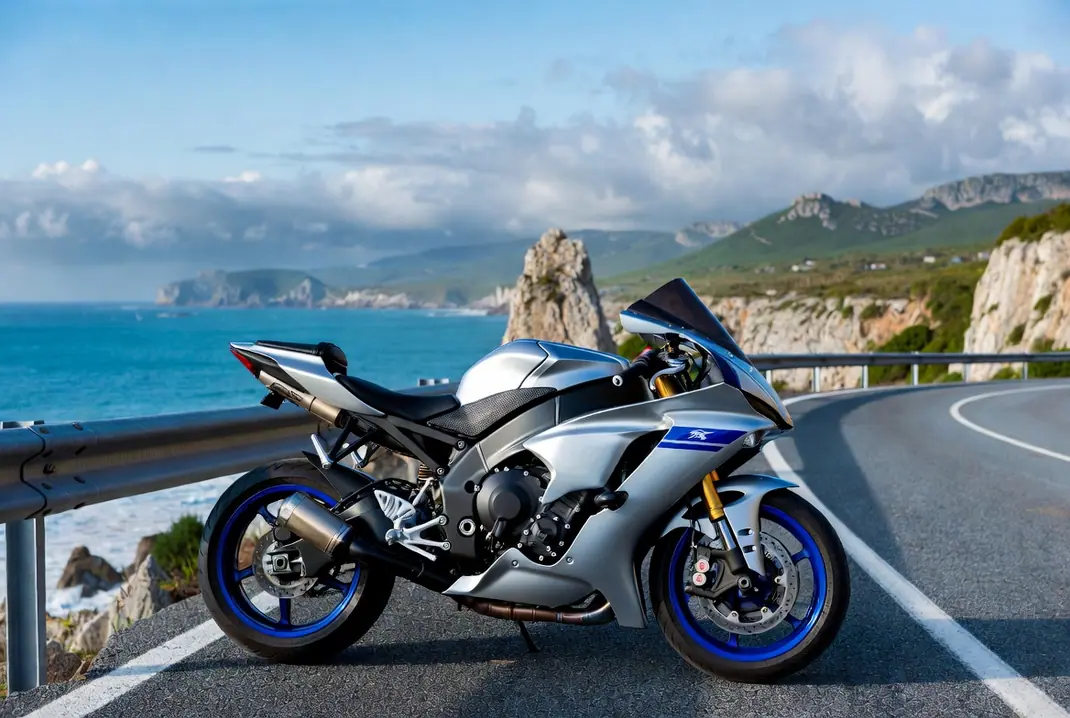
Currently, the most powerful production motorcycle from Yamaha is the YZF-R1.
The 998 cc inline-four engine with crossplane crankshaft delivers around 198 hp (approximately 200 PS) at 13,500 rpm. Maximum torque is 113 Nm at 11,500 rpm. These figures have remained stable in recent versions, including the 2026 model. These values can be confirmed in the official specifications of the YZF-R1.
The R1 is not just about raw power. The crossplane engine, inherited from Yamaha’s experience in MotoGP, produces more linear torque and a characteristic sound that clearly differentiates it from conventional four-cylinder rivals. The electronics package is complete: lean-sensitive traction control, power modes, launch control, bidirectional quickshifter and engine brake management system.
There is also the R1M version, more track-oriented, with Öhlins electronic suspension, carbon bodywork and a telemetry system, but the engine power is the same.
In other segments Yamaha has powerful models (the MT-10 with around 165 hp, for example), but none exceeds the R1 in maximum production power. In competition the brand uses even more developed engines, but here we are talking about production motorcycles available to the public.
Which Engine Lasts Longer: Honda or Yamaha?
Another classic question without an absolute answer. Both manufacturers produce extremely durable engines when they are properly maintained.
Honda has built over decades an almost mythical reputation for “eternal” engines. Models such as the CB500, Africa Twin or CBR600F accumulate hundreds of thousands of kilometres without major interventions. Honda’s philosophy prioritises robustness and safety margins.
Yamaha, especially with the CP2 platforms (MT-07, Ténéré 700) and CP3 (MT-09, Tracer 9, XSR900), also has an excellent track record. Many owners easily report 100,000 or 150,000 km with normal maintenance. The crossplane design reduces vibration and, in theory, internal stress on some components.
Medium-term reliability studies place the two brands side by side, with Yamaha sometimes showing a slight statistical advantage in the early years. In the long term (above 150,000–200,000 km) Honda continues to have a slightly stronger image among many mechanics and intensive users.
The determining factor is not so much the brand, but the maintenance:
- Oil and filter changes within the recommended intervals (or earlier in severe use)
- Use of quality oil of the correct viscosity
- Regular checks of the chain, valves and cooling system
- Avoiding extreme high-rpm regimes for long periods on new engines
A well-cared-for Yamaha engine lasts as long as a well-cared-for Honda engine. An engine from either brand that is neglected will develop problems sooner. The real difference lies in the owner’s riding style and care, not in an absolute “winner” between the two factories.
That’s why anyone looking for used bikes from these two brands often finds examples with high mileage that are still in excellent working condition, as long as the maintenance has been done regularly and documented.
Conclusion
Yamaha is a Japanese brand with roots in music and a strong identity in the world of two wheels. Its three-tuning-fork logo neatly sums up that story: precision, harmony and teamwork between technology, production and the market.
In the comparison with Honda there is no clear winner. Honda tends to win in refinement and daily-use peace of mind. Yamaha stands out for character, performance and, in many cases, riding pleasure. In terms of power, the YZF-R1 remains the brand’s flagship. And when it comes to engine longevity, both brands deliver excellent results as long as the owner does their part.
In the end, choosing Yamaha (or Honda) is less a question of “which is the better brand” and more a question of “which of these engineering philosophies better matches my style”. Both make high-quality motorcycles. The difference lies in what each one prioritises.