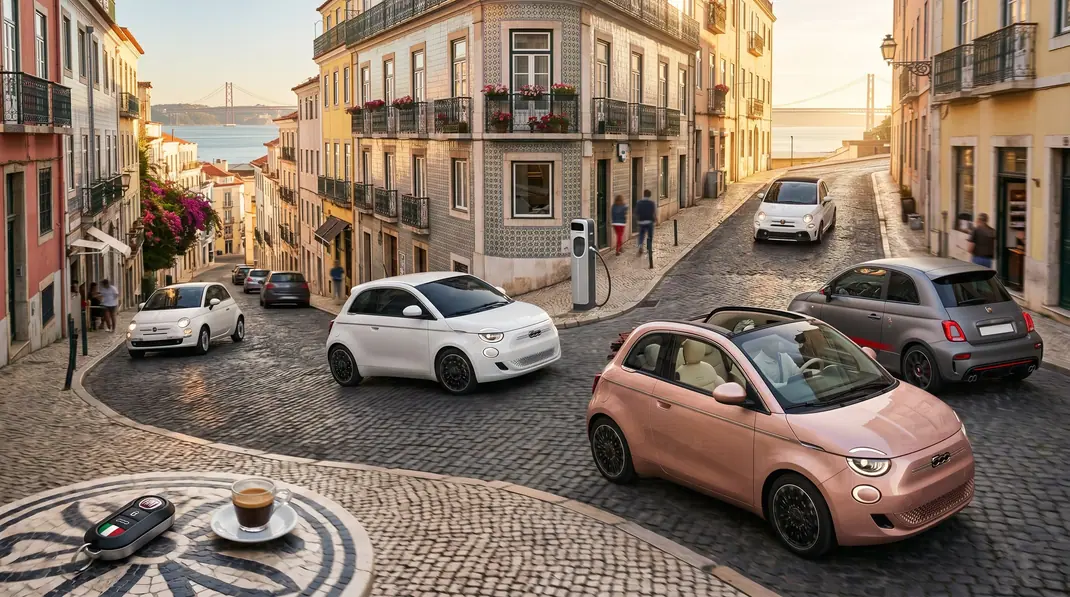
Chaos. Absolute gridlock. 8:15 AM on the IC19 highway. Brake lights stretching out forever toward Lisbon. You're sweating. Your fuel gauge drops. And then some city emission warden slaps you with a penalty ticket for driving an old diesel crossover. A total nightmare. The fix? A 1957 design icon that somehow prints money in 2026. A Fiat 500 cuts through the tight streets of Chiado like a scalpel. Pure agility. You want status? You buy Italian.
The heritage here—Dante Giacosa's original masterpiece—isn't just a fashion play. It's a financial fortress. They don't depreciate. They don't break. You dodge the heavy taxes. 1066 kg of pure curb weight. What's the catch? There isn't one. Just raw, unfiltered smart mobility. Think about the feeling of sliding into a 3.57-meter gap outside that tiny espresso spot in Bairro Alto. While the guy in the massive German SUV circles the block for the fourth time, you're already drinking your coffee. Hilarious.
I broker high-end cars. I deal with wealthy clients who want the smartest parking asset in the city. The psychology of a buyer today? Pure defense. Protect your cash. Don't lose €10,000 on a heavy crossover the second you sign the papers. The Portuguese market punishes heavy cars. High municipal taxes. Insane parking fees. Wardens hunting you down. But this? This little machine is a ghost. It slips right through the system. You'll drive down the Segunda Circular, sip your coffee, and laugh at the gas station prices. Roberto Giolito designed the 2007 revival. A genius. He captured lightning in a bottle. And you're buying that lightning.
The local driving lifestyle demands a specific type of weapon. You deal with steep, cobblestone hills in Porto. You deal with narrow, ancient streets in Braga. You deal with aggressive taxi drivers in Lisbon. A wide, heavy car is a liability. You'll scrape your alloys on high curbs. You'll fold your mirrors in every time a public bus passes. Stop suffering! Buy the short wheelbase. Buy the narrow track width. Drive like an absolute local.
How much does a Fiat 500 actually cost?
Pricing. It's an asset class of its own. Really. The European residual value metrics prove it. The market for used cars in Portugal operates on fear. Fear of depreciation. But not here. A baseline Lounge model from 2018? Dealers still demand €9,900. Why? Because you can't kill them. used Fiat 500 cars hold value better than gold bars in a Lisbon vault. You want to negotiate? Good luck. The demand is ferocious. Dealers don't drop prices because there's a line of buyers waiting outside.
I'll teach you how to negotiate on the local lots. Walk in. Look at the tires. Check the brake wear. Don't show emotion. If you see a base Pop trim with 50,000 km, offer €8,500. They'll say no. You walk away. They call you back. But for the rare specs? Don't play games. Pay the ticket price.
Want a specific color? The Fiat 500 rose gold price completely ignores normal market logic. Buyers gladly pay a solid €1,500 premium just for that pearlescent shine. Or is that crazy? No. You buy the rose gold, drive it for three years down the Marginal road to Cascais, and sell it for exactly what you paid. Free car. Essentially. It's the tightest, smartest money move you can make in the automotive sector today. You'll never lose sleep over residual drops.
Then there's the urban dream: the used automatic Fiat 500. The Dualogic robotized gearbox. Stop-and-go traffic on the VCI in Porto? You won't care. It takes the pain away. Your left leg rests. You listen to music. The car shifts. You pay maybe a €1,200 premium on the used lot for the automatic. But think of the ROI. Return on sanity! Hundreds of hours in heavy traffic completely neutralized. If you find one, buy it instantly. Someone else will if you don't. That's the brutal reality of the 2026 market. Fast decisions win.
I see clients hesitate. They overthink a €500 price difference. Don't. You're buying a highly liquid asset. You list it online tomorrow, your phone rings in five minutes. That's power. That's financial security.
Fiat 500 Hybrid: how does it work?
Pure mechanical genius. You get a 12V BSG (Belt-integrated Starter Generator) setup. Forget heavy plug-in cables. Forget fighting for a charging spot in Ribeira. The 1.0-liter FireFly 3-cylinder engine pairs with a tiny lithium-ion battery. 11 Ah. 0.13 kWh. It's nothing. But it changes everything.
Below 30 km/h? Pop it in neutral. The engine dies. Silence. You coast down Avenida da Liberdade. The BSG motor harvests the kinetic energy. Recharging! You don't plug it in. Ever. The system does the math for you. You save fuel. You cheat the tax man. The European Union emissions standards are brutally strict now. But this mild-hybrid setup passes them effortlessly. 12V architecture. No dead weight. 1330 kg for a full EV? No, this hybrid weighs barely 1066 kg. Lightness is speed. Lightness is efficiency. You'll feel the 3.6 kW electric torque boost at the traffic light. Boom. You're gone.
The psychological relief! You aren't dragging around a massive battery you don't need. You're using the exact amount of tech required to optimize city driving. The internal combustion engine completely shuts off while you coast to a red light. The battery keeps your air conditioning ice cold. It keeps your Beats audio bumping. The light turns green. You press the clutch. Instant restart. No grinding starter motor noise. Just a fast spark.
Dealers will try to upsell you on heavy hybrids. They'll show you massive SUVs with complex dual drivetrains. Run away. Those systems cost a fortune to fix out of warranty. The BSG is basically a supercharged alternator. It's simple. Simple doesn't break. Simple keeps your mechanic away from your wallet.
What engine does the Fiat 500 have?
Iron. Pure iron. You look at the Fiat 500 cars listings and see options. The 1.2 Fire engine. 69 horsepower. 8 valves. Port injection. It's ancient! And that's why it's perfect. No complex high-pressure fuel rails to snap. No fragile twin-scroll turbos to explode. It's bulletproof. Just use standard 5W-30 Selenia oil. You'll drive it to the moon and back. This engine survived decades of Italian driving habits. It won't flinch at your daily commute from Sintra.
Then there's the modern option. The 1.0 FireFly. 70 horsepower. Miller combustion cycle. 12:1 compression ratio. Sounds like a mini tractor at idle. Raspy. Aggressive. Love it. It wants to rev. The pistons are long-stroke, designed specifically for low-end punch. It punches way above its weight class.
Need more power? Want to terrorize the highway? Find a Fiat 500 abarth 1.4 T-Jet. 145 to 180 horsepower. Heavy-breathing Garrett turbochargers. Record Monza exhaust valves. It barks. It spits flames. A complete maniac. The suspension is stiffer than a rock. Your spine will hate you. Your face will smile. It's a supercar trapped in a city car's body. The throttle response is violent. You'll hunt down expensive sports cars and embarrass them in the corners. Sabelt carbon fiber seats grip your ribs. Koni shocks with FSD technology bounce you around the cabin. Automotive adrenaline.
Need ground clearance for the dirt tracks near the southern beaches? The Fiat 500 X offers that chunky SUV stance. You sit higher. You see the traffic ahead. You get the 1.3 turbo blocks. Heavy-duty passing power. But you keep the iconic face.
Every single block listed here runs on heavily validated, globally standardized oil specs. Check the API motor oil directory if you don't believe me. Parts are everywhere. You won't wait six weeks for a sensor from Germany.
Fiat 500 timing belt: when to change it?
100,000 kilometers. Five years. Don't push it. Seriously.
If you buy the 1.2 Fire block, you change the belt. It's a rubber band keeping metal from smashing into metal. If it snaps? Piston meets valve. Game over. Engine ruined. Your €10,000 asset turns into a €2,000 salvage project in one second.
But here's the massive sales hook. The parts cost nothing. Go to a neighborhood shop in Braga or Faro. €150. Done. New belt, new tensioner, new water pump, fresh coolant. A Continental belt kit costs maybe €45 online. A SKF water pump runs €35. Three liters of premium coolant? €25. Labor? Two hours max. Automotive aftermarket reports show it's literally one of the cheapest maintenance bills in Europe. It's an absolute joke how cheap it is. You drop off the car at 9 AM, you pick it up at lunchtime. Zero stress. A German car needs the front bumper removed for a belt change! The Fiat? The hood opens and everything is right there. A mechanic's dream.
And if you buy the 1.0 winter-tested FireFly Mild Hybrid? You don't have a timing belt. You have a timing chain. Double-row steel chain. Lifetime component. You don't change it. Ever. You eliminate the biggest scheduled maintenance cost entirely.
Just change the oil! The hydraulic tensioners inside the engine rely on clean, pressurized oil to keep that chain tight. Sludge kills the chain. Sludge is your enemy. Buy the premium synthetic oil. 0W-20 fully synthetic. ACEA C5 spec. Don't cheap out. Spend the extra €20 at the service interval. You're protecting a masterpiece. If the chain rattles on a cold start, walk away from the deal. But if it's quiet? You buy it. You maintain it. It outlasts you.
What is the range of the electric Fiat 500?
Range anxiety? A complete myth created by people who don't understand their own driving habits. The electric 500e is a sniper rifle for the urban jungle.
You check the electric Fiat 500 price Portugal and choke a bit. Yes. It's expensive upfront. But wait. Do the math! Zero annual road tax. Zero vehicle registration tax. Free or discounted parking in Lisbon. If you own a company, you deduct the VAT entirely! It pays for itself in two years! You're buying elite, top-tier hardware. Samsung SDI prismatic battery cells.
The 42 kWh pack gives you 320 kilometers WLTP. But in the city? In heavy traffic on the 25 de Abril bridge? Engage the "Sherpa" driving mode. One-pedal driving. The regenerative braking captures every single joule of energy. 400 kilometers! Easy. You don't brake; you harvest power. It's addictive. You'll catch yourself trying to beat your own efficiency scores.
Need a fast charge? 85 kW DC capability. 35 minutes gets you to 80%. Drink an espresso at a fast charger. Read your emails. You're ready to go. The national electric mobility network in Portugal is massive now. Chargers are everywhere. You won't get stranded.
Lithium cells hate extreme heat and extreme cold. But the local climate? Perfection. 20 degrees Celsius is the sweet spot for the chemical reaction. Your battery degrades slower here than in Northern Europe. You keep your capacity for years.
Don't need 400 km? Buy the 23.8 kWh version. 190 km range. It's lighter. It's cheaper. It darts around corners like a terrified rabbit. Instant electric torque. No gears. No turbo lag. Just a brutal, silent shove into the back of your seat every time you touch the pedal. You'll leave big, loud sports cars choking on your dust at every traffic light. That alone is worth the price of admission.
What is the engine displacement of the Fiat 500?
Displacement taxes in Portugal are a crime. The state steals your money every year based on a number on a registration document. 2.0-liter engines? Financial suicide. The government treats you like an ATM.
You have to fight back. You have to be smart.
The 1.2 Fire is exactly 1242cc. Cheap. Very cheap. You sit in a low tax bracket. But the 1.0 Hybrid? 999cc. Absolute genius. It sneaks right under the critical 1000cc threshold. You pay pennies in annual tax. Pennies! The tax man gets nothing.
But you don't sacrifice speed. It's a 3-cylinder block. The bore and stroke are optimized for massive low-end punch. It feels bigger. It pulls harder. The 12:1 compression ratio extracts every ounce of explosive power from the fuel. You're cheating the system. You get the thrust of a 1.4-liter engine, but you pay the tax of a moped.
Even the Abarth models! They run a 1368cc displacement. Think about that. You get 180 horsepower. You get supercar noise. You get massive Brembo brakes. But on paper? It's a tiny 1.3-liter hatchback. Your annual tax bill is a joke. You keep your cash. You invest it elsewhere. You don't hand it to the government.
Engine displacement isn't just a technical spec. It's a financial strategy. And this platform is the ultimate tax loophole. Buyers don't realize this until they get their first bill. They expect a €250 charge and get a €100 invoice. It's a beautiful moment.
Which has a bigger trunk: Citroën C3 or Fiat 500?
185 liters. That's the Fiat. The C3 has 300.
The C3 wins, right? Wrong. Dead wrong.
The C3 is a bloated, heavy whale. You get 300 liters of empty air. And you pay for it constantly. You pay in fuel. You pay in handling. You pay in pure stress when you can't fit into a parking spot in Alfama. The extra volume comes with a bulky, heavy body that turns city driving into a stressful chore.
The 185-liter VDA trunk in the Italian icon is a perfect square. No weird plastic bulges. No wasted corners. Two standard hard cabin bags fit like Tetris pieces. You still have room for a designer duffel. A laptop. Gym gear. Done. Need more? Fold the rear seats. Boom. Massive cargo space. You don't carry air for 360 days a year just in case you buy a big TV on Black Friday. You carry what you need. Agility. Speed. Style.
The C3 makes you look like a rental car fleet manager on vacation. The 500 makes you look like a boss who knows exactly what they want. You're engineered for sleek, smart professionalism. You pack light. You move fast. You don't compromise your daily driving experience for trunk space you won't use.
This isn't a family hauler. It's a precision instrument. A tool for the city. When you drop money on a car, you aren't buying a moving van. You're buying a lifestyle. You're buying the ability to slide into a parking space that is literally physically impossible for 90% of the cars on the road.
That 115-liter difference? That's the difference between a car that controls you, and a car that you control. Choose the agility. Choose the icon. Hit the marketplace right now and secure your asset. Don't wait. The good ones disappear fast.