Driving a passenger automobile along the unlit rural stretches of the N2 highway at midnight exposes the absolute biological limits of human optical processing. Standard low-beam projectors cast a sharply defined, horizontal cutoff pattern precisely forty meters ahead of the front bumper. Engineers design this sharp cutoff specifically to avoid blinding oncoming traffic in the opposite lane. Beyond that specific forty-meter line, the asphalt plunges into total, impenetrable darkness. The driver relies entirely on the mechanical engagement of the main-beam headlights to reveal wandering livestock, unreflective organic debris, and sharp topographical shifts. Pull the steering column stalk toward your chest. A copper relay clicks loudly behind the dashboard firewall. High beams activate. The physical physics of forward illumination take over. The choice of light color, beam focus, and electrical output dictates whether the driver sees a hazard at 150 meters or drives blindly into a concrete barrier.
The legal reality in Portugal operates under strict optical and administrative parameters. Under the regulations of the Portuguese Highway Code, main-beam headlights (luzes de estrada or máximos) can legally emit only white or selective yellow light. Any other color spectrum violates traffic safety codes. Emitting blue, green, or deep purple light triggers immediate administrative enforcement during mandatory vehicular roadworthiness testing or routine roadside police inspections. Ignorance of photometric regulations does not protect a driver from financial penalties. Modifying primary safety equipment carries heavy fines. A roadside officer will issue a citation. Confiscation of the vehicle registration documents follows.
What Color Can the High Beams of a Vehicle Be?
The definitive legal answer is strictly white or selective yellow. The Portuguese Highway Code regulates the exact operational capacity of the main-beam headlights. The law dictates that high beams must possess the photometric intensity to illuminate the road surface for a continuous distance of at least 100 meters ahead of the automobile. This legal threshold applies uniformly across all passenger classifications, regardless of whether the physical light emitted is pure white or selective yellow.
If a police inspector checks the beam throw on a dark highway and determines the headlight reflectors fail to project usable light to the mandatory 100-meter minimum, the vehicle is deemed legally unfit for public circulation. The light color must remain pure and unfiltered. The installation of colored vinyl film overlays, tinted aftermarket lens covers, or multi-color application-controlled LED bulbs instantly invalidates the road legality of the automobile. Traffic authorities impound registration documents until the vehicle passes a rigid technical re-inspection at an approved testing facility. Modifying the spectrum profile outside the white or yellow parameter constitutes a severe safety infraction. The fine is 250 euros.
The Physics of Forward Illumination: Understanding Lumen Output and Wavelength
Cutting through atmospheric interference demands high raw lumen output concentrated through highly specific optical architecture. High-beam projection relies entirely on parabolic reflectors or advanced glass projector lenses to gather the raw spherical light produced by the bulb filament or semiconductor diode. The housing focuses this raw light into an aggressive, tight pattern. Unlike low beams, the high-beam projector mechanism bypasses the cutoff shield completely. In bi-xenon or bi-LED systems, an electromagnetic solenoid physically pulls the metal cutoff shield down flat. It projects light upward and outward simultaneously. The entire reflector bowl fills with light.
The wavelength of the light wave dictates exactly how it interacts with the physical environment. Shorter wavelengths carry higher energy but scatter violently upon striking particulate matter in the air. Longer wavelengths carry less raw energy but penetrate airborne moisture with superior efficiency. The engineered geometry of the internal reflector bowl determines the precise angle of deflection. An oxidized, cloudy reflector bowl scatters the lumens randomly into the surrounding trees. It reduces forward throw massively. The mandatory 100-meter target drops to fifty meters. Light bends. The driver sees nothing.
White Light High Beams: The Modern Industry Standard
The global automotive manufacturing industry has shifted almost entirely toward bright white light output. The color temperature of modern factory setups typically rests between 4300K and 6000K on the Kelvin scale. Original Equipment Manufacturer (OEM) setups prioritize daylight-mimicking white light because human biology responds favorably to it. The human retina processes high-intensity white light with less muscular strain. Eye fatigue drops dramatically during extended nighttime driving sessions.
Modern retroreflective road signs, highway lane markers, and painted asphalt lines utilize microscopic glass beads designed to bounce raw white light directly back to the source point. The high-intensity white beam interacts perfectly with these retroreflective materials. It triggers intense visual contrast that alerts the driver to speed limit changes or sharp curves hundreds of meters away. The stark white contrast keeps the driver's cognitive processing sharp and reactive. Reaction times improve by milliseconds. The braking distance shortens.
Yellow High Beams: Historical Context and Fog Deflection Mechanics
Selective yellow light holds a deep historical and practical legacy in European automotive manufacturing. Burning around 3000K on the Kelvin scale, this light provides specific mechanical advantages. The preference for yellow main beams relies heavily on the optical principle of Rayleigh scattering. Yellow light features a significantly longer wavelength than pure white or blue light. This longer wavelength reduces the glaring backscatter effect when the light beam strikes airborne moisture, driving rain, or thick winter fog. Instead of reflecting violently back into the driver's retinas as a blinding white wall, the yellow light penetrates the moisture layers smoothly. It reveals the asphalt.
Classic rally drivers and owners of vintage vehicles actively prefer yellow main beams for navigating brutal weather conditions in steep mountain passes. The yellow tint physically filters out the shorter blue wavelengths that cause the most severe optical glare. Buyers evaluating classic imported used cars from the 1980s or early 1990s often encounter factory-fitted yellow headlight lenses or internal yellow glass bulb capsules. The French domestic market mandated yellow headlights by law for several decades. Finding these original yellow glass lenses intact adds verifiable historical value to the vehicle. Original parts command premium prices.
Technological Evolution: From Halogen to Matrix LED and Laser Lights
The raw hardware driving vehicle illumination has undergone radical, high-speed evolution. Standard tungsten-halogen bulbs dominated vehicle production for fifty years. A halogen bulb passes electrical current through a thin tungsten filament enclosed in a pressurized quartz glass capsule filled with inert halogen gas. The filament burns white-hot at around 3200K, casting a distinct yellowish-white glow. These legacy bulbs convert only a tiny fraction of their consumed electrical power into visible light. The vast majority of the consumed wattage burns off purely as wasted thermal radiation. Halogen capsules blister human skin upon contact.
Modern automotive engineering abandons burning metal filaments for solid-state semiconductors. Matrix LED technology revolutionizes the operational concept of the high beam. An onboard forward-facing camera module continuously scans the dark road ahead. When the optical sensor detects the headlights of an oncoming vehicle or the red taillights of a leading vehicle, the central processing unit calculates the exact spatial coordinates of the surrounding traffic. The Matrix LED system then selectively powers down individual light-emitting diodes within the primary headlight cluster. This rapid electronic action creates dynamic, moving shadow boxes entirely around the oncoming traffic. The driver keeps the high beams active continuously. Maximum forward visibility remains intact, yet the oncoming driver experiences zero glare. Laser headlight assemblies push this technology further. Phosphor-converted laser diodes project a microscopic, hyper-focused beam. The laser technology easily doubles the throw distance of standard LEDs. The beam strikes highway reflectors 600 meters away.
Kelvin Color Temperature Scale: Why Blue High Beams Are Illegal and Dangerous
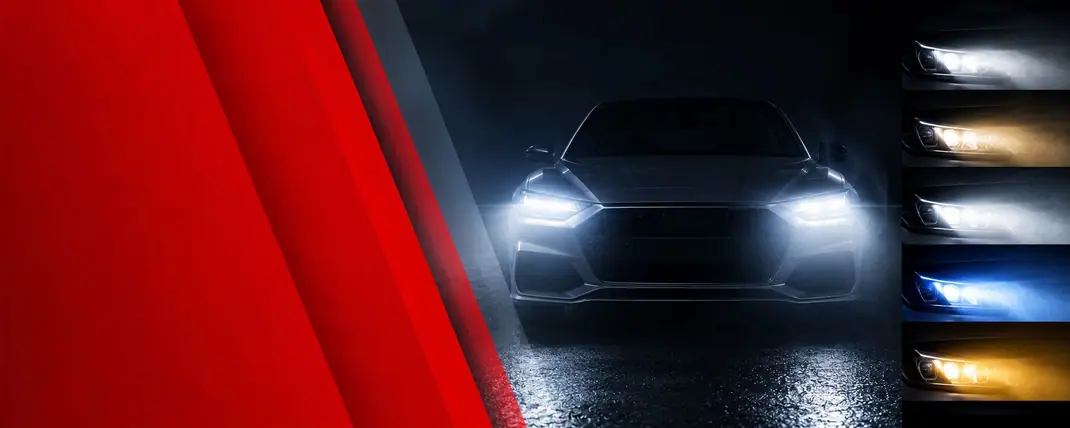
The Kelvin color temperature scale measures the exact visual hue of the light emitted by the source. The physical danger of aftermarket modifications revolves entirely around ignoring this scale. Legal, factory-approved lighting operates strictly in the 4300K to 6000K range. This range produces a clean, crisp white hue that mimics high-noon sunlight. Many vehicle owners purchase illegal aftermarket bulbs rated between 8000K and 12000K. These cheap bulbs emit heavily tinted blue or deep violet light. This creates an immediate optical disaster.
Blue light scatters violently inside the human eye. This specific physiological phenomenon, known as chromatic aberration, forces the driver's eyes to constantly struggle to focus the scattered blue wavelengths accurately on the retina. The driver experiences severe muscular eye strain, headaches, and blurred peripheral vision. The blue spectrum light scatters immediately upon hitting fog or rain, effectively blinding the driver with a wall of blue static. Vision drops to zero. Do not do this. Traffic police conduct targeted nighttime roadside police inspections specifically to catch and fine drivers using excessively blue high-beam bulbs. Officers confiscate the vehicle documentation on the spot. Tow trucks remove the vehicle.
Modifications and Aftermarket Retrofitting: Assessing the Risks of Conversion Kits
Retrofitting modern semiconductor lighting technology into older headlight housings causes severe mechanical and optical failures. Halogen reflector bowls are precisely, geometrically calculated to capture light from a specific, tiny tungsten filament positioned at an exact millimeter depth. When a vehicle owner forces an aftermarket Xenon High-Intensity Discharge (HID) arc capsule or a cheap LED bulb into a halogen reflector housing, the focal point of the light source misaligns completely. The glowing arc chamber of the Xenon bulb or the surface-mounted diodes of the LED sit several millimeters away from the original engineered focal point.
This misalignment destroys the beam pattern instantly. The parabolic reflector catches the light incorrectly and scatters intense, unfocused light upward into the trees and directly into the eyes of oncoming drivers. The glare is blinding and highly dangerous. Ironically, while the oncoming traffic suffers, the actual usable light thrown 100 meters down the road drops significantly. The raw lumen output measured at the bulb is high, but the optical forward projection is utterly ruined. The driver sees less of the road. Potholes remain hidden.
Aftermarket LEDs present massive thermal management issues for automotive electricians. LEDs generate intense, concentrated heat at the base of the diode board. If this thermal energy is not dissipated instantly, the diode melts its own soldering and fails. Cheap conversion kits utilize bulky integrated cooling fans or massive braided copper passive heat sinks attached to the rear of the bulb. These bulky heat sinks rarely fit correctly inside tight, enclosed engine bays. The factory rubber moisture dust covers on the back of the headlight housing cannot be reinstalled. Moisture from rain enters the housing freely. The internal reflective chrome bowl oxidizes and flakes away. Before purchasing any older used cars, a diligent buyer must pull the rubber dust caps off the rear of the headlight housings to inspect for spliced wiring and improperly mounted LED heat sinks. A butchered wiring harness requires total replacement. A new harness costs 150 euros.
How Electrical Demand from High Beams Affects the Alternator and the Battery
Engaging the high beams places a massive, instantaneous electrical load on the charging system. Standard halogen high beams draw 55 to 65 watts of power per bulb. When an owner upgrades to illegal 100-watt off-road rally bulbs in an attempt to increase visibility, the current draw spikes violently. The thin factory copper wiring heats up like a toaster element. The voltage drop across the deteriorated wiring harness increases exponentially. The plastic H7 or H4 bulb connectors melt directly onto the metal bulb prongs, creating a severe electrical fire hazard inside the tight engine bay.
This sudden, heavy electrical draw heavily impacts the alternator diode pack and the lead-acid storage cells. The alternator must instantly increase its magnetic field output to match the 200-watt continuous load of dual rally bulbs. If the vehicle is idling or moving slowly in heavy traffic, the alternator rotor RPM is far too low to meet this amperage demand. The vehicle's electrical system begins pulling raw voltage directly from the primary battery to keep the lights burning. Repeated deep discharges degrade the lead plates inside the battery cells through rapid sulfation. The internal resistance spikes. The battery fails prematurely. Owners must understand the technical limits of their vehicle's power storage architecture. Reviewing the Complete Car Battery Guide: How to Charge, Choose, How Much It Costs, How Long It Lasts, and What to Do When It Dies provides the exact diagnostic steps required to verify if the alternator can actually handle heavy electrical lighting loads without destroying the primary storage cells. Operating high-wattage lighting systems on a weak alternator guarantees an eventual mechanical breakdown. The vehicle loses all electrical power. The engine stalls.
Conclusion
Optimizing nighttime driving capability demands a strict adherence to optical physics and established legal parameters. The Portuguese Highway Code explicitly mandates white or selective yellow main beams for profound physiological and safety reasons. The color temperature dictates exactly how light cuts through atmospheric interference, how it reflects off modern road signage, and how the human eye processes contrast at high speeds. Ignoring these scientific principles by installing heavily tinted blue conversion kits actively degrades forward visibility while creating severe glare hazards for oncoming traffic.
True forward illumination relies entirely on the pristine condition of the physical hardware, not just the raw electrical wattage of the bulb. Polycarbonate headlight lenses degrade under intense ultraviolet radiation from the Iberian sun. The clear plastic turns opaque, cloudy, and heavily yellowed. This plastic oxidation physically blocks up to forty percent of the light output from ever leaving the housing. No LED bulb upgrade can overcome clouded plastic lenses. Sanding away the oxidized layer with 800-grit abrasive paper, applying a fresh UV-resistant clear coat, and using a professional optical alignment machine to set the high-beam projection angle to zero degrees of vertical deflection restores the factory 100-meter throw completely.