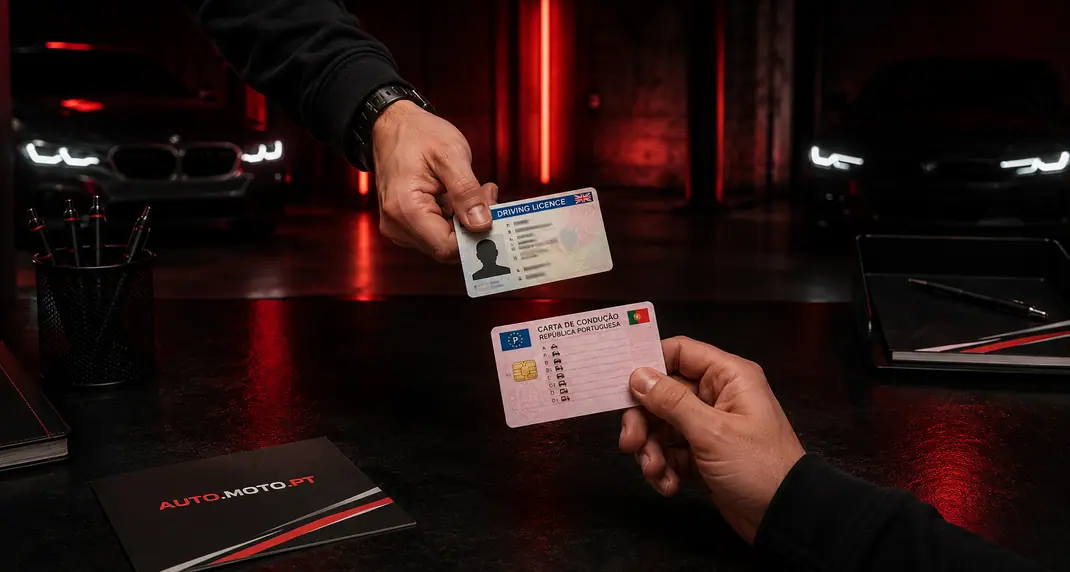
Moving to Portugal comes with a surprisingly long list of things to sort out. Your address, NIF, bank account, documents, car and, sooner or later, your driving licence. If your licence was issued in another country, one question usually comes up pretty quickly: can you keep using it in Portugal, or do you need to exchange it for a Portuguese licence?
There isn't one simple answer. It depends on where the licence was issued, what kind of licence it is and, very importantly, whether you are actually resident in Portugal.
The rules can be quite different for someone with a licence from the European Union, a country covered by the OECD/CPLP regime, a country with a bilateral agreement with Portugal or a country that isn't covered by the relevant international road traffic conventions.
So before doing anything, it makes sense to find out which rules apply to you. Some people can keep driving with their foreign licence, while others have a very specific deadline to exchange it.
And there is one deadline in particular that is easy to miss.
Do I have to exchange my foreign driving licence for a Portuguese one?
Not every foreigner living in Portugal has to do the same thing.
If your licence was issued in an EU country or in the European Economic Area, things are generally quite straightforward. Portugal recognises the licence while it remains valid. Once you become resident here, though, you have to register your Portuguese address with the IMT within the required period. There is no fee for this registration.
The situation is different for many licences issued outside the EU and EEA.
Portugal has different rules depending on whether the issuing country has a bilateral agreement with Portugal, is covered by an international road traffic convention or falls under the specific OECD/CPLP regime.
That distinction is important because the deadlines for exchanging the licence — and even the right to continue driving with it — can be completely different.
What happens during the first 90 days after getting residency?
This is probably the most important point for anyone moving to Portugal with a foreign driving licence.
For licences covered by the relevant bilateral agreements or international road traffic conventions, the rules are not simply "you have two years to exchange your licence". If you want to know more about renewing a Portuguese driving licence, we also have a complete guide explaining the process, deadlines and requirements. Once you establish residency in Portugal, the clock starts running.
For the first 90 days after obtaining your residence authorisation, you can continue driving in Portugal with your foreign licence, but you should already submit the exchange application to the IMT. IMT rules for foreign driving licences. After those first 90 days, the situation changes.
From 90 days up to two years after obtaining residency, you can still submit the exchange application, and the exchange can still be completed without the practical driving test that applies after the two-year period.
However, you are no longer allowed to drive in Portugal with the foreign licence during this period.
And after two years, the rules become stricter again. If you still want to exchange the foreign licence for a Portuguese one, you will have to take and pass a practical driving test.
So there are really three different stages:
- Up to 90 days: you can drive with the foreign licence, but you should submit the exchange request.
- From 90 days to 2 years: you can still exchange the licence without the practical exam, but you cannot drive with the foreign licence.
- After 2 years: the exchange is still possible in the applicable cases, but a practical driving test is required.
This is one of those details that can easily be missed when people read that they "have two years to exchange their licence".
The two-year period is not the same thing as having two years to continue driving with the foreign licence.
What if the licence is from an EU country?
If your licence was issued by Portugal, Spain, France, Germany or another EU country, you don't normally arrive in Portugal and immediately hand it over for a Portuguese one.
The licence remains valid until its expiry date.
Once you become resident in Portugal, however, you need to register your address with the IMT within 60 days of starting your residency. This is particularly important for people coming from another European country because it is quite easy to assume that becoming a Portuguese resident automatically means getting a Portuguese driving licence.
It doesn't.
Your EU or EEA licence can normally continue to be used in Portugal while it remains valid, subject to the applicable rules.
There is another situation involving foreign licences that don't have an expiry date. Depending on the document and your residency status, you may have to exchange one of these licences for a Portuguese document within the applicable deadline.
What about licences from OECD and CPLP countries?
This is one of the biggest differences compared with the standard exchange rules.
Portugal has a specific regime for certain countries belonging to the OECD and CPLP. Under the applicable conditions, these licences can be accepted for driving in Portugal even after the holder becomes a Portuguese resident.
That means that, for some people, becoming a resident does not automatically mean that they have to stop driving with their foreign licence after 90 days. The conditions matter, though.
According to the IMT, the foreign licence generally needs to:
- be valid;
- have been issued or last renewed less than 15 years ago;
- belong to someone under 60 years old;
- correspond to categories for which the driver meets the minimum Portuguese age requirements;
- not be suspended, seized, expired or revoked.
The issuing country must also meet the relevant convention or bilateral-agreement conditions.
The countries covered by the current OECD/CPLP regime include countries such as Brazil, Angola, Cabo Verde, Mozambique, São Tomé and Príncipe, Canada, Chile, South Korea, the United States, Iceland, Israel, Japan, New Zealand, the United Kingdom, Switzerland and Turkey, subject to the conditions established by the IMT. IMT — OECD and CPLP driving licences,
This is why simply saying that "foreign residents have 90 days to exchange their licence" can be misleading.
The country that issued the licence matters a lot. If your licence falls under the OECD/CPLP regime and you meet all the conditions, you may be allowed to continue driving in Portugal even after becoming a resident.
You can still choose to exchange the licence for a Portuguese one if you want to.
What if my country has a bilateral agreement or is covered by an international convention?
This is the group where the 90-day rule becomes especially important.
If your licence comes from a country covered by a bilateral agreement with Portugal or by the relevant international road traffic conventions, you can normally drive in Portugal for up to 185 days after entering the country, provided you are not yet resident and meet the applicable conditions.
Once you establish residency, the rules change.
You have the first 90 days to continue driving with the foreign licence while submitting the exchange request.
After that, you may still exchange the licence until the two-year mark, but you are no longer allowed to drive using the foreign licence.
After two years, the exchange becomes subject to a practical driving test.
This is why the date on your residence authorisation is so important.
It is not simply a case of looking at the date you first arrived in Portugal and adding two years.
What if my country doesn't have an agreement?
Here, the rules can be very different.
Licences issued by countries that are not covered by the relevant international road traffic conventions are not considered valid for driving in Portugal.
If you want to drive legally in Portugal, you need to deal with the exchange process and take the required driving examination.
The important thing is that this does not necessarily mean starting the whole process from zero through a driving school.
In the cases covered by the exchange procedure, you can apply directly for the examination.
The requirements can also depend on the categories you want to exchange. A separate examination may be required for each category.
So before assuming that your foreign licence can simply be converted into a Portuguese one, check exactly which rules apply to the country that issued it.
For countries outside the relevant agreements and conventions, this is one situation where you should pay particular attention to the examination requirements rather than simply booking driving lessons.
Check your country before starting the process
This is probably the easiest way to avoid unnecessary bureaucracy.
Before submitting anything, check:
- where your licence was issued;
- whether the licence is still valid;
- when it was issued or last renewed;
- whether you already have residency in Portugal;
- the date your residency started;
- whether your country is covered by an OECD/CPLP regime;
- whether Portugal has a bilateral agreement with your country;
- whether your country is covered by the relevant international road traffic conventions.
The IMT publishes the relevant country lists, so it is worth checking the official information before starting the exchange.
IMT — foreign driving licences and country rules
How to exchange a foreign driving licence
A good part of the process can now be started online, which saves at least one unnecessary trip to an IMT office.
The application is submitted through the IMTonline portal. You fill in the form, upload the required documents and then receive information about the payment and, when necessary, the collection of biometric details such as your photograph and signature.
So you don't necessarily have to start by spending half a day sitting at an IMT counter.
The usual approach is to submit the application, provide the documents and wait for the instructions.
If you need to appear in person at some point, the IMT will tell you what you need to do.
For someone who has only recently moved to Portugal, the process can look intimidating at first.
In practice, the tricky part is often not the application itself. It's figuring out which documents and deadlines apply to your particular situation.
What documents do I need?
In general, exchanging a foreign licence requires you to be resident in Portugal and meet the legal requirements for driving.
The usual documents include your identification document, proof of residence, NIF and your valid foreign driving licence.
You may also need an electronic medical certificate, which is sent directly to the IMT by the doctor.
Certain professional driving categories and heavy vehicle licences may require an additional psychological assessment certificate.
There is another requirement that can come up depending on the country where your licence was issued.
The Portuguese authorities may ask for a declaration from the issuing authority, or from a diplomatic or consular authority, confirming that the licence is genuine.
It may also need to confirm the date it was issued, its validity, the categories covered and that the licence was obtained after passing a driving test.
And if the information on the licence isn't written in Portuguese, French, English or Spanish, you may need an officially certified translation.
How much does it cost to exchange a driving licence in Portugal?
The standard fee for exchanging a foreign driving licence for a Portuguese one is €30.
There can be other expenses depending on your situation, particularly if an examination, translation or additional documents are required.
There is also a 10% discount associated with requests submitted through IMTonline for eligible services, so it is worth checking the amount shown when you submit the exchange request online.
In other words, don't assume that the final cost will always be exactly €30.
If your case requires an examination, for example, the exam has its own fee.
How long does it take to get the Portuguese licence?
For anyone who uses their car every day, this is probably one of the first things they want to know.
The average delivery time given for a Portuguese driving licence is around 60 days.
If you have to take a practical test, the timeframe can be different.
While the application is being processed, a temporary document can be issued allowing you to drive where this is provided for under the exchange procedure.
So handing over your foreign licence doesn't automatically mean that you have to leave your car parked for the next two months.
Still, keep every document you receive during the process.
More importantly, make sure you know exactly which temporary document you have and what it allows you to do.
What happens after I receive the Portuguese licence?
Once the exchange is finished, you have a Portuguese driving licence.
Its validity period may not be exactly the same as the remaining validity of the foreign licence you handed in.
From then on, you're under the normal rules that apply to Portuguese driving licences.
So when the next renewal eventually comes around, you're dealing with a Portuguese licence rather than going back through the rules for your original foreign document.
If you want to know what happens at that stage, we also have a complete guide to renewing your driving licence in Portugal, including renewal deadlines, documents, age requirements and the different ways to do it.
What if I lost my foreign licence?
Losing your foreign driving licence in Portugal doesn't necessarily mean that the whole process stops there.
If the licence was lost or stolen, you may still be able to exchange it for a Portuguese one.
In that situation, you need to obtain a certificate confirming that the original licence was lost from the relevant authority in the country that issued it.
That certificate can then be used as part of the exchange process instead of the original licence.
For someone who has already been living in Portugal for a while, this can save a particularly annoying trip back to their home country just to sort out a replacement document.
What if my foreign licence has expired?
This is one of those situations where it's better not to guess.
An expired foreign licence cannot simply be treated as though it were still valid.
The rules depend on the country that issued it, the type of licence and the circumstances involved.
The same applies if the licence has been suspended, seized or revoked.
So if your foreign licence has already expired, don't assume that the process is simply a matter of paying the exchange fee and submitting a request.
Check with the IMT first and find out exactly what applies to your case.
Do I have to take a driving test to exchange my licence?
Usually, no.
Where there is a recognition agreement or another applicable arrangement, exchanging the licence does not mean going through the process of getting a driving licence from scratch.
There are exceptions, though.
If the licence comes from a country that isn't covered by the relevant international road traffic conventions, an examination may be required.
There is also an important time limit for licences covered by the bilateral-agreement and convention regime.
If more than two years have passed since residency was established, exchanging the licence can require a practical driving test.
That's why it is better not to wait until the end of the two-year period.
Can I keep driving while my exchange is being processed?
This is another area where there isn't a single answer for everyone.
It depends on the country that issued your licence, the type of regime that applies and your residency status.
For the bilateral-agreement and convention group, the first 90 days after establishing residency are particularly important: during this period you can continue driving with the foreign licence, but the exchange request should already have been submitted.
After those 90 days, the exchange can still be requested until two years have passed, but the foreign licence can no longer be used for driving in Portugal.
For certain OECD/CPLP licences, however, the situation can be different.
If all the conditions of that regime are met, the foreign licence can remain valid for driving in Portugal even after the holder becomes resident.
So don't rely on the common idea that every foreigner can simply drive for six months.
The 185-day period that you often see mentioned applies to certain foreign licences when the holder is not yet resident in Portugal.
Once residency begins, different deadlines and obligations can apply. And this is where people often get caught out. Is it worth exchanging the licence if I don't have to?
Not necessarily. There are situations where your foreign licence can continue to be used in Portugal, as long as you stay within the conditions and deadlines that apply to it.
This is particularly relevant to some OECD/CPLP licences, where the holder may be able to continue driving after becoming a resident.
Still, some people prefer to have a Portuguese licence anyway.
For day-to-day bureaucracy, having a Portuguese document can make certain things simpler.
It can also save you from having to explain the details of a foreign licence every time driving documents come up.
But if your foreign licence is valid and Portugal recognises it, there's usually no reason to rush into an exchange simply because you've moved here.
The main thing is knowing which regime applies to you and keeping an eye on the deadlines.
In the end, it depends a lot on where you got your licence
"Foreign driving licence" sounds like one category, but it really isn't.
A Spanish licence doesn't follow exactly the same rules as a Brazilian one.
A Swiss licence is treated differently again, and the rules can be different for someone from a country that isn't covered by the international conventions.
Your status matters too.
A tourist and a person who has already become a Portuguese resident are not necessarily allowed to drive under the same conditions.
That's why going straight to the IMT shouldn't necessarily be your first move.
First, find out where your licence was issued, whether it is still valid, whether you already have residency in Portugal and which rules apply to that country.
Then check whether your licence falls under the EU/EEA, OECD/CPLP, bilateral-agreement or international-convention regime.
Once you know those four things, the rest becomes much easier to understand.
For some people, the whole exchange will come down to sending the documents, paying the fee and waiting for the new licence.
Others may need an additional declaration, a translation or an examination.
Either way, don't leave it until the last minute.
If you've recently moved to Portugal and rely on your car every day, knowing the rules early can save you a lot of unnecessary paperwork — and, more importantly, a lot of headaches on the road.
And if you're planning to buy a used cars, it's worth checking that your driving licence, paperwork and all the other legal requirements are in order before you sign the deal.