Some cars are impressive when they are new and almost forgettable a few years later. Others become more interesting as they get older, simply because there is more evidence to judge them by.
The Tesla Model 3 belongs to the second category.
When the Model 3 arrived in 2017, buying an electric car still felt like making a bet. Would the battery last? Would the range be enough? Would charging become a nightmare? Could an EV really replace a normal petrol or diesel car?
Nearly a decade later, those questions are much easier to answer.
There are Model 3s with serious mileage on them, thousands of cars have spent years on European roads, and the used market now contains almost every possible combination of age, battery, drivetrain and equipment.
That changes the way we should look at this Tesla.
We are no longer judging a promising new electric car. We are looking at a car with a history.
And sometimes, history tells you more than a specification sheet ever could.
Why does the Model 3 still matter?
The obvious answers are familiar: efficiency, range, technology and relatively easy everyday use.
But there is another reason.
The Model 3 arrived at exactly the right moment. Electric cars were becoming interesting, but most manufacturers were still treating them as something of a side project. Tesla, on the other hand, built a car around the idea that an EV could simply be… a car.
That sounds obvious now.
It wasn't in 2017.
Today, a Model 3 can quite comfortably be the only car in a household. It can commute during the week, spend a weekend on the motorway and make a long European road trip without turning the owner into a full-time charging planner.
Tesla currently quotes up to 534 km of WLTP range for the rear-wheel-drive Model 3, with newer Long Range versions going beyond that. Official efficiency figures can also be impressively low, depending on the exact specification.
But there is a small trap here.
WLTP is useful for comparing cars. It is not a promise.
Put the same Model 3 on a motorway at 130 km/h in winter, add rain and a strong headwind, and the number on the screen will tell a very different story.
And yet the car's efficiency remains one of its biggest strengths.
It does not need to carry an enormous battery around just to achieve respectable range.
That is an important distinction.
A lighter, more efficient car can sometimes be more useful than a much heavier EV with a giant battery.
Which Model 3 makes the most sense?
Searching for a used Model 3 can become confusing surprisingly quickly.
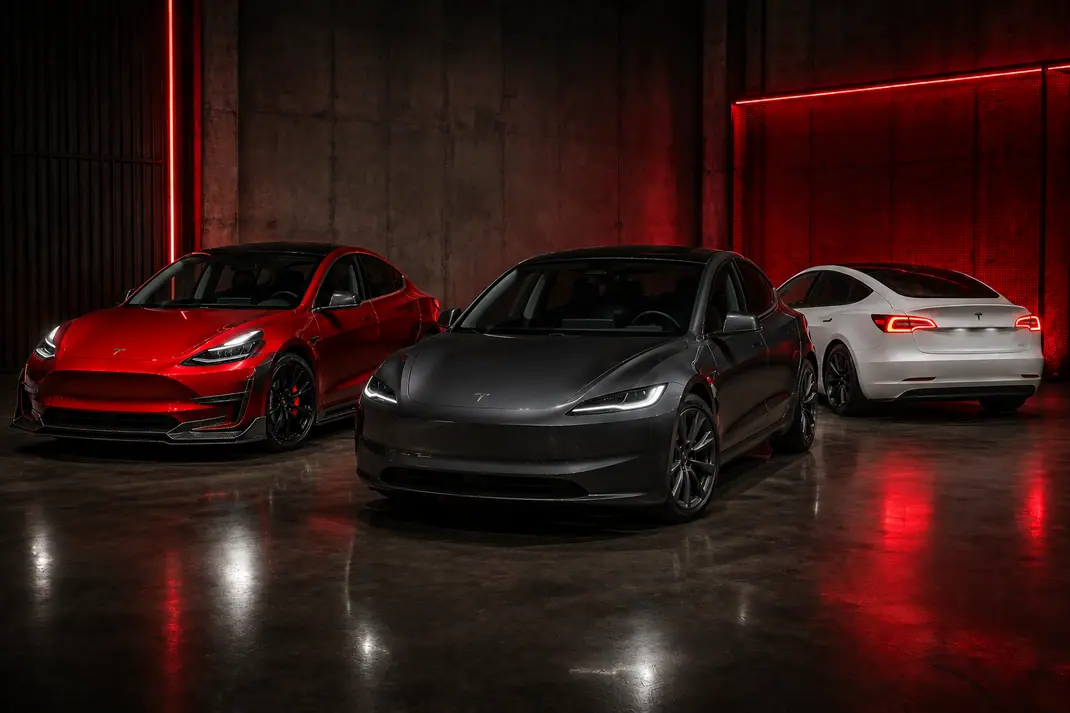
There are rear-wheel-drive versions, Standard variants, Long Range cars, Dual Motor models and Performance versions. Some differences are obvious. Others only become relevant after you have spent a few months with the car.
The Standard or rear-wheel-drive version is probably the easiest one to understand.
It is the sensible choice.
You get the basic Model 3 formula without paying for equipment or performance you may never use. For commuting, urban driving and normal motorway journeys, it is already a very capable car.
Then there is the Long Range. This is the version that starts making more sense when your annual mileage goes up. More battery capacity means fewer charging stops, and some versions add dual-motor all-wheel drive into the equation. For long-distance drivers, that combination is difficult to ignore.
The Dual Motor versions also bring another quality that is easy to underestimate until you experience it: traction. Electric torque arriving instantly at both axles can make the car feel remarkably composed when the road is wet, particularly when accelerating out of slower corners.
And then there is the Performance.
This is where the sensible family saloon starts behaving like something considerably more serious.
The current Performance can reach 100 km/h in 3.1 seconds, has all-wheel drive and is rated for up to 571 km of WLTP range, with 20-inch wheels.
Tesla Model 3 — official specifications and configurator The strange thing is that it remains usable every day.
That dual personality is perhaps one of the Model 3's least obvious strengths: it can be calm and efficient on Monday morning and absurdly quick on an empty road on Sunday.
Highland changed more than the appearance
The word "Highland" has become almost unavoidable when looking at newer used Model 3s.
And it is worth paying attention to.
Tesla's 2023 update was not simply a new bumper and a different set of headlights. The company changed a considerable amount of the car, including the exterior, cabin, acoustic insulation and suspension.
The result is a Model 3 that feels more mature.
The earlier cars can have a distinctly firm character. They are not necessarily uncomfortable, but the suspension can remind you that Tesla was still learning how to make a conventional-feeling car. The Highland feels less interested in proving that it is different.
It is quieter. It feels better isolated from the road. The cabin is more polished.
And that is actually quite important when buying used.
A 2022 Model 3 and a 2024 Highland may look related in an online advert, but they are not necessarily the same experience.
If two cars have a similar price, knowing which generation you are actually buying can be more valuable than obsessing over a small difference in mileage.
Forget the range number for a moment
"How many kilometres does it do?"
It is probably the first question people ask about any electric car.
The problem is that the answer changes with almost everything.
A Long Range Model 3 travelling gently through mild weather can cover a very impressive distance. The same car at motorway speeds, in cold weather, with heating running and a headwind can lose a considerable part of that theoretical range.
Independent EV data shows just how much the conditions can change the result.
EV Database publishes estimates based on different temperatures and driving conditions, and the difference between motorway driving and more favourable conditions is particularly useful to understand.
There is actually a useful lesson here for anyone buying their first EV.
Don't ask only:
"How many kilometres does it do?"
Ask instead:
"How many kilometres will it do on the journey I actually make?" That is a much better question.
If your normal route is 90% motorway, your useful range is different from somebody who spends most of the week driving through town. And because the Model 3 is efficient, it tends to remain competitive even after you apply a realistic real-world margin to the official figure.
Should you be worried about the battery?
This is probably the most important part of buying an older Model 3.
Not because Tesla batteries suddenly become useless after a certain number of years. They don't.
The battery is simply one of the most expensive components in the car, so it deserves more attention than a buyer might normally give to a petrol engine. Tesla currently offers an eight-year warranty for the battery and drive unit, although the mileage limit depends on the particular version. There will still be some degradation over time. That is normal.
The more useful question is whether the particular car you are looking at has been treated reasonably and whether its current range makes sense for its age and mileage.
A long-term What Car? test of a 2019 Model 3 Performance followed a car with more than 40,000 miles and monitored its real-world range during ownership. It is a useful example of why battery condition should be considered as part of the whole car rather than treated as a simple yes-or-no question.
In other words, don't buy a used Model 3 based only on the odometer.
The battery deserves a place on your checklist.
What should you check before buying a used Model 3?
This is where the Model 3 becomes much more like any other used car.
Start with the things that touch the road.
Tyres are important because the instant torque can be addictive. A previous owner who enjoyed that torque a little too often may have gone through tyres considerably faster than someone who drove gently.
Look closely at the wheels too. Kerb damage is not unusual, particularly on cars equipped with larger wheels.
Then move around the car. Check the paintwork, panels, glass, seats, screens and all the electrical equipment. Test everything rather than assuming that a car with a clean exterior must be fine underneath.
Charging equipment and cables deserve attention as well.
The vehicle's history matters.
What Car? also points buyers towards checking electrical equipment, wheels, bodywork, charging cables and known recalls affecting particular cars.
It takes considerably less time to check those things before buying than it does to deal with a problem afterwards.
Safety is another part of the Model 3 story
The Model 3 also built a strong reputation through its safety results.
Euro NCAP tested the car in 2019 and awarded it 96% for adult occupant protection, 86% for child occupant protection, 74% for vulnerable road users and 94% for its safety-assistance systems.
See the Tesla Model 3 Euro NCAP test.
Those numbers remain impressive.
But there is one distinction worth making.
A long list of driver-assistance functions does not turn the Model 3 into an autonomous car.
The driver is still the driver.
That sounds obvious, but it is an important point whenever technology becomes part of the sales pitch.
The part nobody notices until they own one
One of the Model 3's biggest advantages is actually rather boring.
There are fewer traditional mechanical components to maintain.
No engine oil.
No spark plugs.
No conventional clutch.
No exhaust system.
And no combustion engine sitting under the bonnet generating heat, vibration and thousands of moving parts. That does not mean the Model 3 is maintenance-free. It still has suspension components, steering parts, tyres, brakes, cooling systems and a large amount of electronics. But the mechanical architecture is simpler. Regenerative braking also changes how the car behaves. Lift off the accelerator and the electric motors can slow the car while sending energy back towards the battery. With the right driving style, you can spend a surprising amount of time driving without using the brake pedal in the conventional way.
That is good for efficiency and can also reduce wear on the friction brakes.
For owners who can charge at home, the financial side can become even more attractive.
If you are still trying to understand whether an EV actually fits your life, our guide to buying an electric car in Portugalcovers the practical side of electric-car ownership, including costs and the main things worth considering before buying one.
Has the competition caught up?
Absolutely.
And that is probably the biggest compliment you can give the Model 3.
When it arrived, Tesla had far fewer direct competitors. Today you can choose between electric models from Hyundai, Kia, BMW, Mercedes, Volkswagen, BYD, Renault and plenty of other manufacturers.
Some are better built. Some have more conventional interiors. Some are more comfortable. Some offer better rear-seat space. Some are simply easier to understand for someone moving from a petrol car.
So why does the Model 3 still make sense?
Because Tesla has had years to refine the basic idea.
The Supercharger network remains a major advantage for long-distance driving. The car's navigation can plan charging into a route, software updates arrive remotely and the entire system is designed around the assumption that the car is connected.
That makes the Model 3 feel less like a car with an electric powertrain and more like a computer that happens to have four wheels.
Whether that is a good thing depends on the driver.
The minimalist interior will be loved by some and hated by others. Almost everything goes through the central display, and people who prefer physical buttons may find themselves missing them.
And if you want the commanding seating position of an SUV, the Model 3 will never provide it.
It is a saloon.
A very quick, very efficient electric saloon, but a saloon nonetheless.
So, should you buy a Tesla Model 3?
This is where the Model 3's age becomes its greatest advantage. There is no longer much mystery surrounding the basic concept.
We know how it drives.
We know what happens to the batteries with age.
We know which versions exist.
We know what the earlier cars are like and how much the Highland changed the formula.
And, perhaps most importantly, there are enough used examples on the market to compare them properly. An older rear-wheel-drive Model 3 can be an affordable entry into EV ownership. A Long Range can make much more sense for someone who spends most of their time travelling.
A Highland brings a more polished version of the same formula. And the Performance remains the answer for anyone who thinks "electric" and "fun" should not appear in the same sentence.
The trick is not to buy the cheapest Model 3 you can find. And it is certainly not to buy the most expensive one simply because it has the biggest battery.
Look at the battery condition. Check the history. Inspect the wheels and tyres. Test the equipment. Find out exactly which version you are looking at. Then compare the price with other cars of the same generation and specification.
That is how you find the good cars. The Tesla Model 3 does not need another argument proving that an electric car can replace a conventional car.
It has already spent years doing exactly that.
And perhaps that is what makes it so interesting today. The Model 3 is no longer a promise about the future of electric cars. It is one of the cars that helped create that future — and now the used market gives us the chance to see how well the idea actually aged.