If you feel sleepy at the wheel, the only thing that works is to stop somewhere safe and rest. Coffee, an open window and loud music only delay the problem briefly. The 45-minute break after 4 hours 30 of driving is mandatory for professional drivers; for private car drivers the law sets no fixed time, but requires that you do not put safety at risk.
This guide explains the signs of tiredness, what a microsleep is, the break rules, what the law says and how to prepare a long trip in Portugal without falling asleep at the wheel.
Signs that you are too tired to drive
Tiredness rarely strikes suddenly. It usually gives warnings, and the most common mistake is to ignore them to «just get there». Stop and rest if you notice several of these signs:
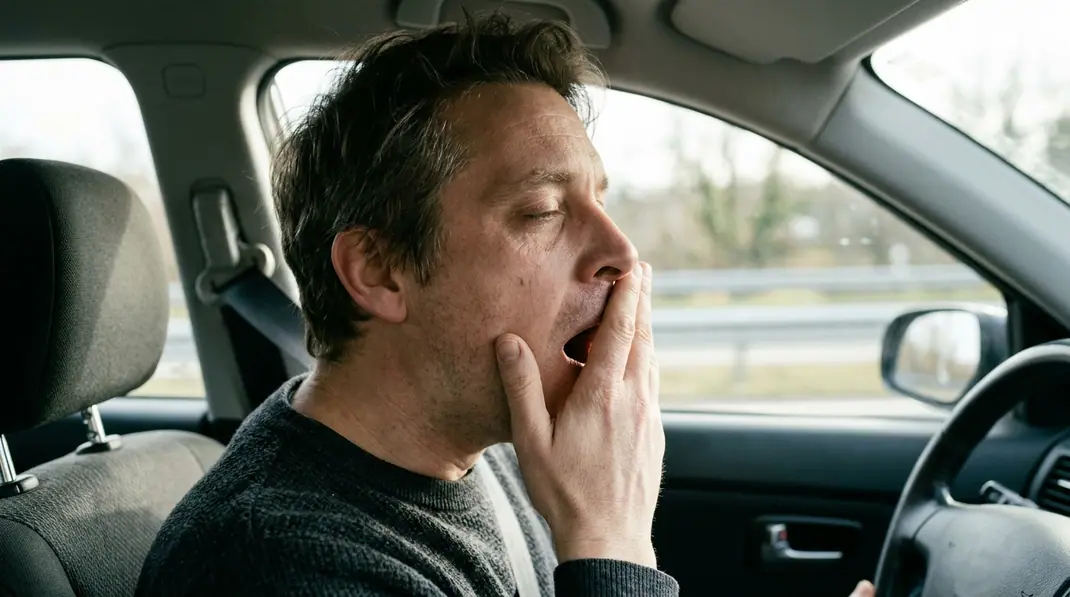
- Repeated yawning and eyes that sting or close.
- Trouble keeping your head up or focusing on the road.
- Not remembering the last few kilometres, as if they passed «by themselves».
- Drifting within the lane, touching the line or correcting the wheel at the last moment.
- Missing an exit or a road sign you should have seen.
- Irritation, wandering thoughts and slower reactions.
What a microsleep is and why it is so dangerous
A microsleep is an episode of involuntary sleep lasting only a few seconds. The driver may have their eyes open and not even notice. Nobody chooses when it happens.
The sum is simple: at 120 km/h the car covers about 33 metres per second. Three seconds of microsleep is about 100 metres with nobody driving. That is why a safe following distance is never enough to make up for a driver who falls asleep.
What does not fix sleepiness at the wheel
Some tricks seem to work and do not. Opening the window, turning up the radio, or drinking a coffee or an energy drink only mask sleepiness for a short time. The body still needs sleep and a microsleep can appear at any moment.
It does not help to «hold out until the next toll» either. The right decision is made at the first sign, not the fifth.
What to do when sleep hits
Follow these steps, in order:
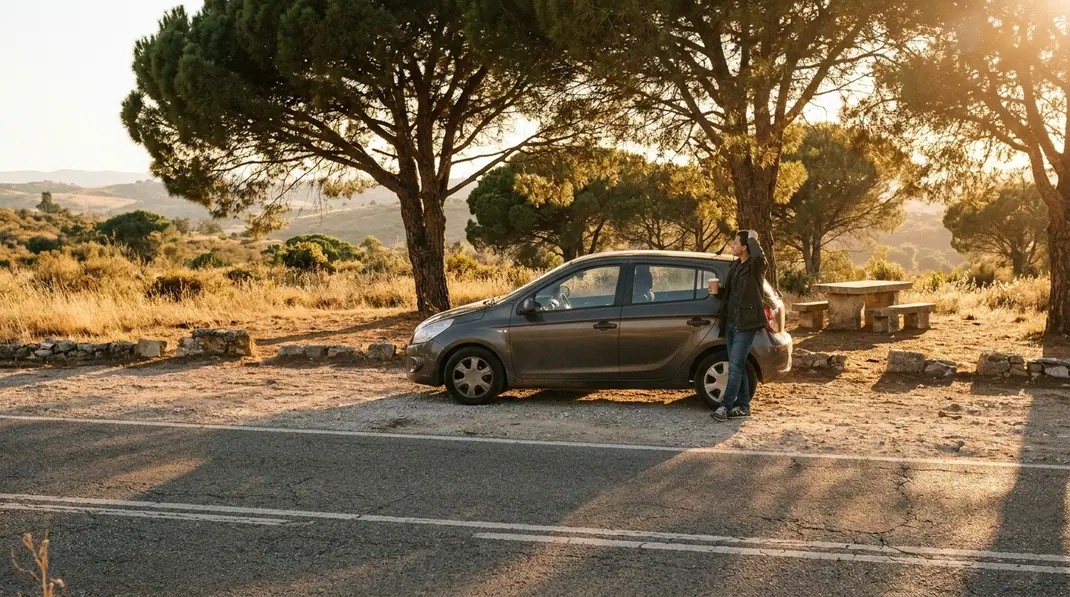
- Exit calmly: signal and look for the next service area, rest area or other safe place. Avoid stopping on the hard shoulder.
- Get out of the car: move, stretch and get some fresh air.
- Take a short nap: this is what road safety experts recommend, together with the rule of stopping at the first sign of fatigue.
- Only then carry on: a coffee after the nap can help, but if sleep returns, stop again.
- Consider sleeping over: if you are very tired, a night of accommodation is cheaper than a crash.
How long can I drive without stopping?
It depends on who is driving. The driving and break times in Regulation (EC) No 561/2006 apply to goods transport in vehicles over 3.5 tonnes and to passenger transport in vehicles with more than nine seats, driver included, as the official EUR-Lex summary explains. For those drivers the rules are:
- An uninterrupted break of at least 45 minutes after 4 hours 30 of driving, unless a rest period begins.
- No more than 9 hours of driving a day, which can rise to 10 hours up to twice a week.
- No more than 56 hours a week and 90 hours over two consecutive weeks.
According to the Your Europe portal, the 45 minutes can be split into two breaks, one of 15 and one of 30 minutes, and the daily rest is at least 11 hours, which can be reduced to 9 hours in certain conditions. The tachograph records everything.
For the driver of a private car there is no such stopwatch. But a good habit is to stop regularly and before you feel sleepy, not after.
What the law says about driving tired
The Código da Estrada (the Portuguese Highway Code) tells people to refrain from acts that compromise the safety of road users (article 3, paragraph 2). Driving while sleepy is exactly that. The same law provides, in article 135, that those who demand an effort unsuited to safe driving, or a schedule incompatible with rest, are also liable for offences caused by the driver’s fatigue.
In this guide we did not find a specific fine for «driving tired». What is penalised are the offences that tiredness causes: leaving the lane, ignoring a sign, not keeping distance. Each has its own fine and, where applicable, penalty points on the licence. And tiredness that distracts as much as a phone at the wheel is no excuse after a crash.
Medicines, alcohol and other causes of sleepiness
Not all sleepiness comes from a bad night. The SNS 24 (the national health line) reminds drivers that some medicines can cause drowsiness and affect driving, and lists fatigue, drowsiness, tiredness and confusion as warning signs. Read the leaflet: if it warns that it may affect alertness or coordination, do not drive.
Alcohol makes sleepiness worse. See the limits and consequences in our guide to the blood alcohol limit.
New cars already warn the driver
According to the European Commission, since 7 July 2024 every new car sold in the EU must carry driver-assistance systems, including a drowsiness and attention warning, which had already been required for new vehicle types since July 2022. The system warns the driver when it detects signs of drowsiness.
It is an aid, not a guarantee. If the car beeps, stop; if it does not, that does not mean you are awake. Older models may not have it at all.
How to prepare a long trip in Portugal
A good trip starts the day before. These practical rules reduce the risk:
- Sleep well the night before and do not start the trip already tired from work.
- Mark your stops on the route, at service areas, instead of waiting for your body to ask.
- If you can, share the driving with someone.
- Avoid hours when your body normally sleeps, and heavy meals before setting off.
- Do not drink alcohol and check your medication.
- Allow extra time, and for the tolls: people in a hurry drive worse.
If you make many long trips, you can check the driver-assistance equipment of each model among the used cars for sale and compare it before you decide.
Frequently asked questions
How long can I drive without stopping?
For a private car the law sets no fixed time, but the Highway Code requires that you do not compromise safety. For professional drivers the break is 45 minutes after 4 hours 30 of driving.
Is it mandatory to take breaks at the wheel?
It is mandatory for drivers of lorries over 3.5 tonnes and of vehicles with more than nine seats. For other drivers it is good practice: stop before you feel sleepy.
Is there a fine for driving tired?
In this guide we did not find a specific fine for driving tired. The offences that tiredness causes, such as leaving the lane or ignoring a sign, are penalised, each with its own fine.
Does coffee fix sleepiness at the wheel?
It only masks it for a short time. The solution is to stop somewhere safe and rest, preferably with a short nap.
What is a microsleep?
An episode of involuntary sleep lasting a few seconds. At 120 km/h, three seconds is about 100 metres travelled without the driver in control.
Do new cars warn when the driver falls asleep?
Since 7 July 2024 every new car sold in the EU has a drowsiness and attention warning. It is an aid and does not replace rest.
Information per the Highway Code and official sources at the date of publication; always check the version in force.