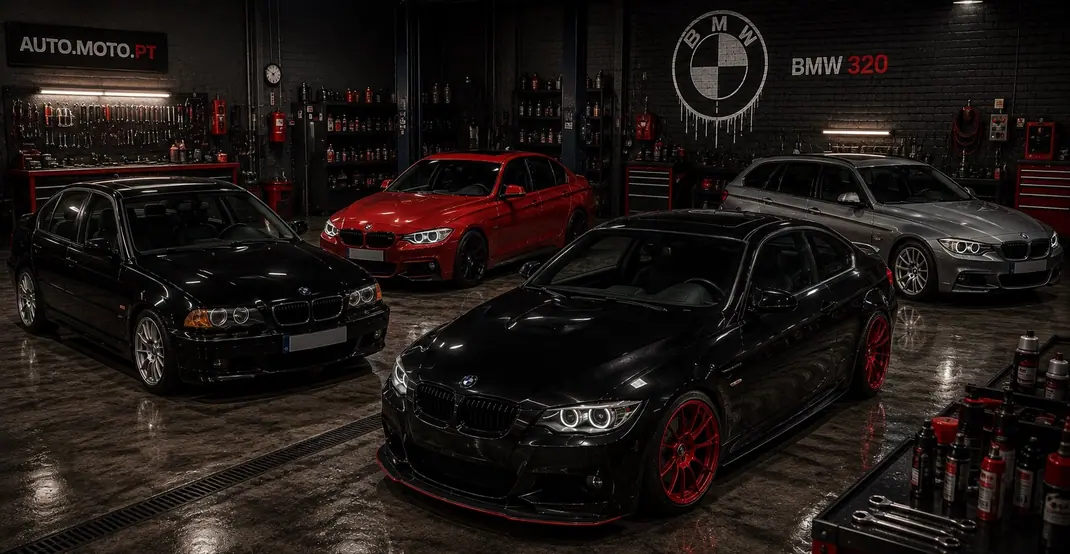
The BMW 320 continues to have a very strong presence in the Portuguese market and is one of the 3 Series versions most easily found in advertisements. It's a model known for its comfort, good driving dynamics, and premium image, although maintenance can be higher than what we find in a mainstream car. Among used cars, there's a bit of everything: older cars with many kilometers, but also more recent versions with diesel, gasoline, and plug-in hybrid engines.
Before buying, the questions end up being quite similar. How much does a BMW 320 cost in Portugal? Which engine makes the most sense? Is fuel consumption high? And would it be better to choose a sedan, a Touring, or a Coupé? There's no single answer to all these questions, because the year, the engine, and the car's usage make a big difference.
How much does a BMW 320 cost in Portugal?
In the Portuguese market, the prices of a used BMW 320 can vary considerably. Among the listings, we find 2006 models for around €8,500, 2013 examples in the €12,000–€14,000 range, and 2017 cars close to €20,000. For 2019 models, it's common to find prices above €25,000, while some newer plug-in hybrid versions reach €30,000 or even exceed that value.
The selection available on AUTO.MOTO.pt helps to understand this price difference. Currently, there are over 100 listings for BMW 320s, including sedans, Touring, and Coupés. Older options are below €10,000, while more recent examples can approach €30,000.
BMW 320d: Engine, Fuel Consumption, and Reliability
The BMW 320d is sought primarily for its balance between performance and fuel consumption. The 2.0-liter diesel engine has been present in several generations of the 3 Series and has received various updates over the years, both in terms of power and the technology used.
In the most recent versions, the 320d uses a BMW TwinPower Turbo four-cylinder engine with 1,995 cm³. In the current 3 Series, it delivers 190 hp and 400 Nm of torque, with an eight-speed automatic transmission and the option of rear-wheel drive and xDrive. Depending on the configuration, the combined WLTP fuel consumption announced by BMW ranges from 4.9 to 5.2 l/100 km in the rear-wheel drive version.
This is also where a pre-purchase inspection makes all the difference. It is advisable to check the engine's cold start operation, transmission, intake system, turbocharger, particulate filter, suspension, and any leaks. In a diesel car with high mileage, neglected maintenance can quickly turn a seemingly inexpensive purchase into a significant expense.
The BMW 320d continues to make sense for those who drive many kilometers, mainly on highways and roads. For predominantly urban use and short trips, a gasoline engine or a hybrid version may be a better choice. For those comparing this model with other options on the used car market, our guide on the best used cars to buy can help understand where the BMW 3 Series stands in relation to more economical models.
BMW 320 Touring: space, fuel consumption and price
The BMW 320d Touring is an interesting solution for those who like the 3 Series but need more space for everyday use. The station wagon body maintains the sedan's character and offers a more practical trunk, which can make a difference for families or those who travel frequently.
In the G21 generation, for example, the BMW 320d Touring has 190 hp, 400 Nm of torque, and an eight-speed automatic transmission. The trunk has a capacity of 500 liters and can reach 1,510 liters with the rear seats folded down.
Prices for BMW 320 Touring models vary considerably depending on the generation and condition of the car. Older examples appear in the €12,000–16,000 range, while newer units with automatic transmission, M Pack, and fewer kilometers can approach or exceed €25,000.
The Touring can also be an interesting choice for those who want a single car for daily use, travel, and family. The additional space doesn't transform the BMW 320 into a large station wagon, but it makes it much more versatile without losing the typical image and handling of the 3 Series.
BMW 320 Coupе: Is it worth buying?
The BMW 320 Coupе is a different proposition. Here, practicality takes a backseat, and the main selling point is style. The BMW 320 Coupé follows a different logic than other versions. It has fewer practical advantages, but it excels in design and a more sporty character. This is precisely what continues to attract buyers to the older Coupé versions, which allow for a 3 Series with a more aggressive image without reaching the price points of the M models.
The Coupе makes more sense for those who don't need five doors and prefer a more emotional experience. For family use, the Touring is clearly more practical; for those who want аs a premium everyday car, the sedan remains the most balanced compromise.
Is it worth buying a BMW 320?
Yes, but the choice should be made based on the condition of the vehicle and not just the price or the BMW logo on the hood. A BMW 320 with a well-documented maintenance history, consistent mileage, and a mechanical inspection before purchase can be a very interesting choice in the Portuguese market. The car's actual condition ultimately matters more than a difference of a few thousand euros in the advertised price.
In the Portuguese market, BMW 320d Coupé models from previous generations are also still appearing. For example, there are 2007 and 2008 units equipped with the 2.0 diesel engine with 177 hp. The asking prices vary greatly depending on the condition, mileage, and equipment. It is possible to find examples in the €12,000–14,000 range, while a well-maintained Coupé with a good configuration may justify a higher price.
For those who drive many kilometers, the 320d remains one of the most interesting versions. The Touring is more suitable for those who need space and versatility, while the Coupé is primarily a style choice. In more recent generations, the 320e plug-in hybrid added yet another possibility to the range and clearly demonstrates the evolution of the 3 Series.
There is no BMW 320 that is the right choice for everyone. Before deciding, it's worth looking at the generation, the engine, and how the car will be used daily. The maintenance history deserves attention, as do the mileage and mechanical condition. A cheap car can quickly cease to be so if you need several repairs soon after purchase.
For those looking for a premium used sedan with good dynamics, comfort, and a large supply in the Portuguese market, the BMW 320 still deserves attention. If you want to better understand how the value of a used car is calculated, you can also consult our guide How much is my used car worth?, where we explain the main factors that influence the price in the Portuguese market.
Regarding the BMW 320. If the budget is, say, €15,000, it might make more sense to look for a slightly cheaper unit and set aside some money for an initial service or minor repairs that may arise after the purchase.
What to check before buying a used BMW 320?
Buying a used BMW 320 deserves some attention, especially when we are talking about cars with several years and different owners. There are examples that remain in excellent condition even after many kilometers, but there are also cars that have not had the necessary maintenance over the years. Before closing the deal, there are some points that are really worth confirming.
A BMW 320 with many kilometers, but with regular servicing and a well-documented maintenance history, can be a safer purchase than one with fewer kilometers and practically no information about what has already been done. The number on the odometer, by itself, doesn't tell the whole story about the car's condition.
It's also advisable to test drive the car before making a decision. During the test drive, you can understand how the transmission works, how the engine responds, and if there are any unusual vibrations or noises. Brakes, steering, and suspension should also be evaluated. If anything seems strange, it's best to clarify the situation before proceeding. To learn about some of the signs you should watch out for, you can consult our guide on how to tell if your car has engine problems.
Tires are another detail that easily goes unnoticed when we are more concerned with the engine and equipment. A worn set doesn't necessarily mean the car is a bad purchase, but it's an expense that should be included in the budget. The same can happen with brakes, battery, or other components subject to wear and tear.
Therefore, it's also not advisable to spend all your available money just on buying a BMW 320. If your budget is, for example, €15,000, it might make more sense to look for a slightly cheaper unit and reserve some money for an initial service or for minor repairs that may arise after the purchase.
BMW 320 petrol or diesel: which one to choose?
The choice between gasoline and diesel depends mainly on usage. There's no one-size-fits-all answer for every driver.
The BMW 320d is a well-known option among those who drive many kilometers. For long trips, highway driving, and frequent out-of-town use, diesel can offer interesting fuel consumption and good range. This is also one of the reasons why there are so many 320ds on the Portuguese used cars market.
On the other hand, those who use the car mainly within the city may have other priorities. Very short routes and daily use in traffic are not necessarily the ideal scenario for a modern diesel. In these cases, a gasoline version may make more sense, depending on the vehicle.Depending on the purchase price and the mileage the owner intends to drive per year.
There are also those who seek a BMW 320 simply for the driving experience. In this case, the type of use, the transmission, and the equipment can be as important as the engine itself. A well-equipped unit in good condition may be more appealing to a particular buyer than another with a different configuration, even if it has a similar price.
It's also worth driving the car before making a decision. A few kilometers behind the wheel can reveal things that aren't obvious when you see the BMW 320 parked. The gearbox should shift gears without hesitation, the engine should respond normally, and there should be no vibrations, noises, or other strange behaviors. Steering, brakes, and suspension also deserve attention during the test. If something doesn't convince you, it's best to understand the reason before proceeding with the purchase. In our guide on how to tell if a car has engine problems, we explain some signs that can help identify potential issues.
Ultimately, the best BMW 320 isn't necessarily the one with the most powerful engine or the lowest advertised fuel consumption. It's the one that aligns with the mileage we drive and how we use the car.
How much does it cost to maintain a BMW 320?
The purchase price is only part of the bill. Those looking for a used BMW 320 should also consider what they will spend after buying the car. This is where a cheap unit can end up being much more expensive than it initially seemed.
A normal service, tires, brakes, or a battery are expenses that are relatively easy to predict. The problem arises when it's necessary to repair more expensive components, especially in a car with high mileage. Automatic transmission, cooling system, suspension, turbo, or other mechanical elements can represent significant costs depending on the generation and engine.
Therefore, it's not a good idea to spend your entire budget just on the purchase. If someone has, for example, €15,000 to buy a BMW 320, it might be wiser to look for a cheaper unit and save some money for maintenance and eventual repairs.
Equipment can also influence costs. A BMW 320 with larger wheels, more expensive tires, or certain equipment may require a greater investment over time. This doesn't mean it's a bad choice, but it's something to consider before buying.
Another important aspect is the car's age. An older BMW 320 may have a very attractive base price, but that doesn't necessarily mean it's cheaper to maintain. Over the years, some components naturally begin to need replacement. That's why the condition of the vehicle is so important when comparing used cars.
In the end, buying a used BMW 320 can be a good decision, provided the purchase is made calmly. Comparing prices, checking the history, test driving the car, and having an inspection done before paying are simple steps that can make a big difference.
And perhaps this is the main rule for this model: don't just buy the cheapest BMW 320 that appears in the advertisement. Between two similar units, it may be much more worthwhile to pay a little more for a well-maintained car than to save a few thousand dollars and then discover that several repairs are needed.