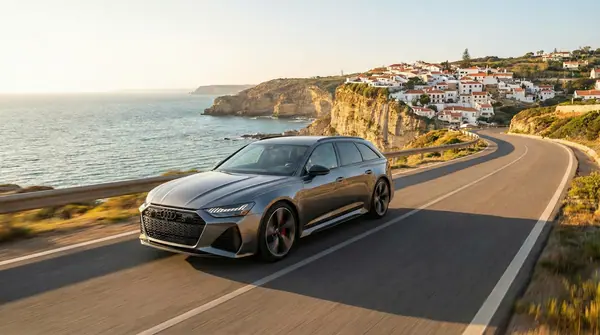
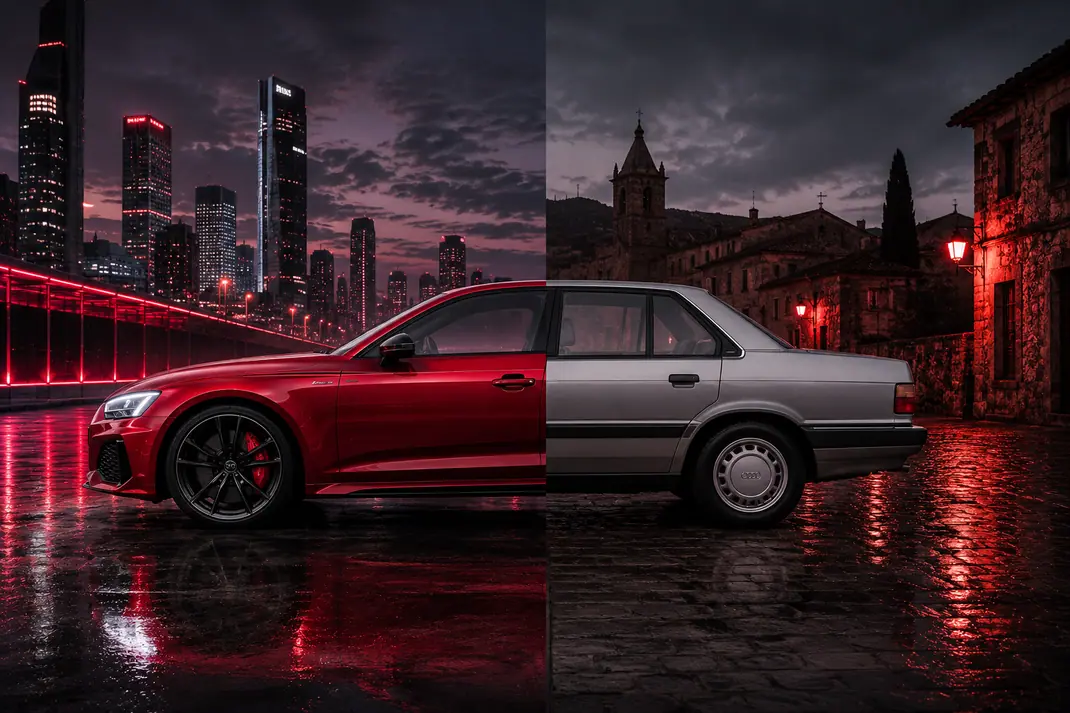
The A4 has been an important part of Audi's history for more than three decades. It arrived in 1994 and quickly established itself among the main premium models, competing with the BMW 3 Series and Mercedes-Benz C-Class. The story, however, starts a little earlier. The roots of the Audi A4 go back to the 1970s, when Audi introduced the Audi 80. That earlier model laid much of the groundwork for what eventually became the A4 and helps explain its strong presence on Portuguese roads and in the used-car market. The A4 did not remain the same car throughout its life. Audi went through five main generations — B5, B6, B7, B8 and B9 — changing the engines, technology and styling along the way. The family also became considerably wider, with saloon and Avant versions joined by quattro models, S line equipment and performance cars such as the S4 and RS4. The Allroad added another interpretation of the same basic formula.There was a major change at the end of this story. In 2024, Audi stopped using the A4 name for its combustion-engined models and moved this part of the range to the A5 name. The name change accompanied an important evolution of the car itself, which arrived with a more modern design and an approach closer to what Audi wanted for the premium segment.
The strategy worked. The A4 quickly became one of Audi's most important models and helped consolidate the brand in the premium segment.
The connection between the A4 and Audi 80 is more direct than it might seem. Audi introduced the 80 in 1972, and the model went on to become a key part of the company's range. It was not replaced after just a few years either. Four generations followed, known internally as B1, B2, B3 and B4, keeping the Audi 80 name in the mid-size class for more than two decades.
By the beginning of the 1990s, Audi was ready to move in a new direction. The company was changing the way its cars looked and was also reorganising the names used across the range. The Audi 80 would therefore not receive another generation under the same badge. Instead, its successor arrived in 1994 as the Audi A4 B5.
Audi A4 B5: The Beginning of the Story
Audi introduced the A4 B5 in 1994. Compared with the Audi 80, the difference was immediately visible. The new car had cleaner bodywork, more modern proportions and a stronger premium character. It was clear that Audi wanted the A4 to compete on equal terms with the established German rivals in this class.
Technically, this generation also brought some solutions that would accompany the A4 for many years. The longitudinally mounted engine and the four-link front suspension contributed to more balanced handling. In versions equipped with quattro, all-wheel drive added another dimension to driving and helped reinforce the brand's technological image. Another useful source for comparing the different generations and their production years is the ADAC catalog: ADAC – Audi A4 and generations. Initially, the A4 appeared as a sedan, but soon after came the Avant version, which quickly gained popularity among customers seeking more space without sacrificing the premium image.
The engine range was quite diverse. There were gasoline and diesel versions, including the well-known 1.9 TDI, which would become one of the engines most associated with the A4 image in the European market. Depending on the version and market, the power could vary considerably. The famous 1.9 TDI was even available with different power levels, including versions close to 130 hp.
The B5 also marked a time when Audi began to invest more and more in electronics, comfort, and automatic transmissions like the Tiptronic. For those looking for an A4 from that era today, the year is especially important. A 2002 Audi A4, for example, already belongs to the next generation, while a 1998 or 1999 model belongs to the B5. This is an important distinction when searching the used car market.
Audi A4 B6: the second generation
In the late 1990s, Audi began preparing a profound evolution of the model. The result came at the beginning of the following decade, with the A4 B6.
The new generation didn't break with what already worked, but practically every aspect of the car underwent some kind of evolution. The design gained a more elegant look, the cabin became more refined, and technology began to play a greater role in the onboard experience.
The B6 became associated with a huge variety of engines. Among the diesels, the 1.9 TDI continued to be one of the most popular choices, while the 2.0 TDI engines later began to gain importance in the lineup.
There were also gasoline engines of different displacements and more powerful versions, including the S4.
At this stage, the A4 also began to gain an even stronger presence as a company car. The combination of relatively low fuel consumption, comfort on long journeys, and a premium image made it a very popular choice among professionals and companies.
The Avant body style became especially important. In Portugal, as in other European markets, the A4 station wagon managed to combine sufficient space for family use with dimensions that are relatively easy to use daily.
Audi A4 B7: evolutionInstead of Revolution
In 2004, the A4 B7 arrived. Although often considered a new generation, the B7 had a very close technical relationship with the B6. Audi opted to evolve a formula that already worked
The design underwent significant changes, especially at the front, where the Singleframe grille appeared, becoming one of Audi's most recognizable visual features.
It was also an important generation for diesel engines. The 1.9 TDI continued to be sought after, but the 2.0 TDI gained more and more space in the lineup.
It is precisely in this generation that many of the Audi A4s that can still be found in the Portuguese used car market today appear. A 2005 Audi A4, for example, can come with different engines, trim levels, and body styles.
The B7 also opened up space for some of the most desired versions by enthusiasts. Among them were the S4 and the RS4, which took the same A4 base in a much more performance-oriented direction. The RS4, in particular, became known for managing to hide quite serious mechanics beneath a body that, at first glance, remained relatively discreet.
For those looking for a used car of this generation, it's not enough to just look at the price. Mileage, maintenance history, engine condition, gearbox, suspension, quattro system, and equipment should be analyzed individually.
Audi A4 B8: an important change
In 2007, one of the most important generations in the model's history arrived: the Audi A4 B8.
The new generation used a different architecture and brought a significant increase in external dimensions and interior space. The design became more modern, while the technology available in the cabin evolved considerably.
It was also in this generation that the A4 began to approach even closer to the positioning we know today.
The 2.0 TDI engines became extremely common, with various power versions. At the same time, the TFSI gasoline engines gained importance.
The quattro transmission continued to be one of the model's main features. For many buyers, the combination of a powerful engine and all-wheel drive was precisely what differentiated the A4 from its competitors.
The B8 was also the origin of the A4 Allroad, a version with a more robust appearance, greater ground clearance, and the ability to tackle less prepared roads than a conventional sedan or station wagon.
From that time on, equipment such as navigation systems, sensors, assistance systems, and different S line configurations began to have a much greater influence on the final price of the vehicle.
Older B8 examples are still relatively easy to come across on the Portuguese used-car market. Cars from 2008, 2010 and 2011 can have quite different specifications, even when they share the same basic engine. The 2.0 TDI was offered with different outputs and could be paired with either a manual or automatic gearbox. Some versions also came with quattro.
Audi A4 B9: the most modern generation
Audi introduced the B9 in 2015, giving the A4 a fifth generation and, as it turned out, the final one to use the name. By this point, the model had moved a long way from the original B5, with a greater focus on efficiency, digital technology and refinement.
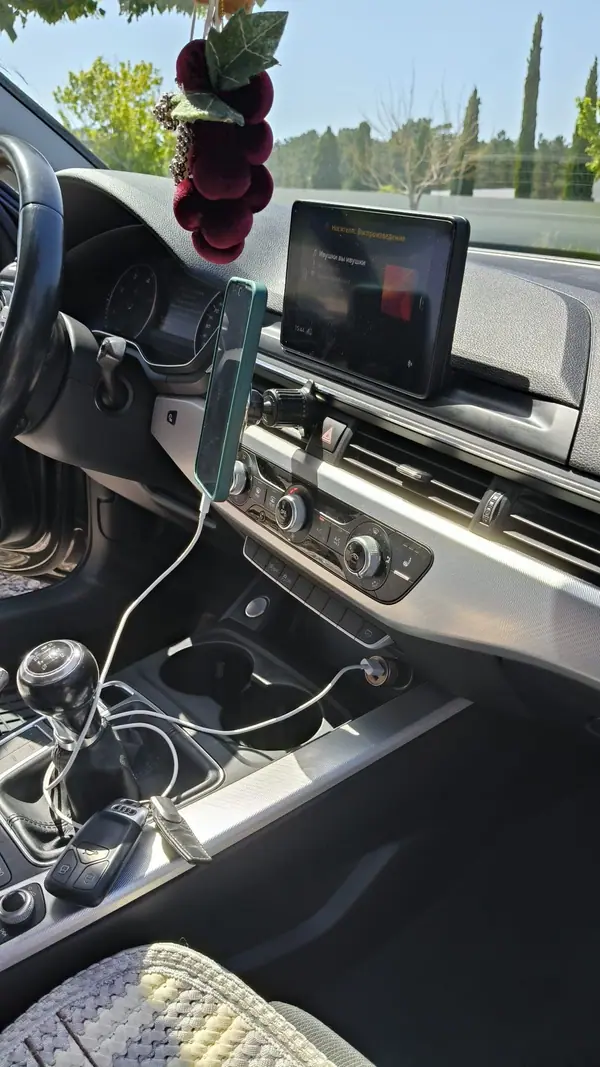
The latest versions also received mild electrification technologies, driver assistance systems, and a significant evolution of the infotainment system.
The A4 B9 was sold both as a sedan and as an Avant, maintaining the station wagon tradition that had accompanied the model since its early years. For many Portuguese customers, the Avant remained one of the most appealing versions thanks to its combination of space, comfort, and ease of use.
Image also gained importance. The S line versions became particularly sought after, mainly for their exterior appearance and sportier interior. Larger wheels, specific seats, a sports steering wheel, and other equipment could significantly transform the A4's appearance.
Quattro: an essential part of the A4's identity
Talking about the history of the Audi A4 without mentioning quattro would be impossible.
All-wheel drive has become one of Audi's main technological features and has helped create the image of safe, fast, and efficient cars in different road conditions.
Over the generations, the system has evolved technically. Depending on the engine and generation, different transmission and differential solutions have been used.
In the used car market, finding an A4 quattro can be particularly interesting for those who live in areas with greater exposure to rain, mountain roads, or less favorable grip conditions. However, it is important to remember that all-wheel drive also means more mechanical components and potentially higher maintenance costs.
From TDI to 2.0 engines
One of the reasons for the A4's popularity in Europe was the huge variety of engines The 1.9 TDI became practically synonymous with the early diesel A4s, especially the B5, B6, and B7 generations. Its reputation for economy and durability helped transform this engine into a benchmark among used car buyers.
Later, the 2.0 TDI became the star of the diesel lineup. We find this engine in several generations and with different power outputs, transmissions, and configurations.
These words are not just details from an advertisement. They can indicate quite significant differences between cars that, externally, look very similar.
Audi A4 Avant and Allroad
The history of the A4 is not limited to sedans.
The Avant version became one of the most important body styles in the family. In practice, it offered a solution for those who needed to carry more luggage or use the car as a family, but didn't want to switch to an SUV.
Later, Audi took this concept even further with the A4 Allroad.
The Allroad combined the Avant body with a more adventurous look, increased ground clearance, and all-wheel drive in certain configurations. The idea was to offer an alternative for those who needed greater versatility without sacrificing the handling and comfort of a premium car.
S line, S4 and RS4: when the A4 became sporty
Another important part of the model's history is related to its sporty versions.
The S line designation became primarily a level of equipment and appearance, and should not be confused with the S and RS models.
The S4, on the other hand, received significant mechanical changes and was developed to offer more performance.
At the top of the line was the RS4, created to transform the discreet A4 into a true performance machine. Throughout the generations, the RS4s received high-performance engines and became some of the most desired Audis by enthusiasts. It is precisely this variety that made the A4 so interesting: the same model could function as an economical car for many kilometers, a family station wagon, a company car, or a high-performance automobile.
The Audi A4 in the Portuguese Used Car Market
In Portugal, the A4's story continues long after production ended.
Today, it's possible to find listings for different generations, from the older B5 and B6 models to the more recent B9s. Prices vary enormously depending on the year, engine, mileage, equipment, and overall condition. For example, A4 B6s with a 1.9 TDI 130 hp engine still appear on the Portuguese market, while B8s are frequently found with a 2.0 TDI. In the B9s, the most recent versions feature very different technologies and equipment compared to the early A4s. Those researching used cars should avoid choosing solely based on price. A cheap A4 might require significant mechanical work, while a more expensive unit with a complete maintenance history could end up being a much more rational purchase.
It's also possible to use the general used cars search and filter by make, model, year, fuel, power, and price.
The end of the Audi A4 and the birth of a new era
In 2024, a change came that ended one of the longest chapters in Audi's recent history. After three decades with the A4 name, the brand reorganized its strategy and decided to distinguish electric models from models equipped with combustion engines through the nomenclature itself.
Thus, the B9 generation became the last to use the A4 designation for combustion engine versions. Audi began reserving even numbers for electric models and odd numbers for cars with combustion engines. In practice, the successor to this concept became known as the A5, signaling a new phase for the range.
The decision marked the end of an era, but it doesn't mean that the technical history of the A4 disappeared. On the contrary: many of the concepts developed throughout the five generations are still present in current Audi models.
For 30 years, the A4 accompanied a huge transformation in the automotive industry. From the early 1.9 TDI engines and simple interiors to modern turbocharged engines, sophisticated quattro systems, automatic transmissions, digital technology, driver assistance systems, and mild-hybrid versions.
Audi A4: 30 Years of Evolution
The history of the Audi A4 is, in reality, a story of constant evolution.
The B5 marked the transition from the Audi 80 to a new generation of models. The B6 brought more sophistication. The B7 perfected a formula that already worked. The B8 represented a significant technical change and elevated the model to a new level of comfort and technology. Finally, the B9 took the A4 into the digital and electrified era.
Along the way, millions of kilometers were driven by sedans and Avant station wagons, countless TDI engines, quattro versions, S line, S4, RS4, and Allroad.
That's also why, decades after the launch of the first A4, it's still easy to find the model on Portuguese roads. Whether it's an older B5 with a 1.9 TDI, a 2005 B7, or a BWhether it's a 2008 or 2010 2.0 TDI, or a more recent B9 with S line equipment, each generation represents a different phase in Audi's history.
And perhaps that's the biggest reason why the A4 remains so relevant in the used car market: more than just a model, it has become one of the car families that best represents the evolution of Audi itself.