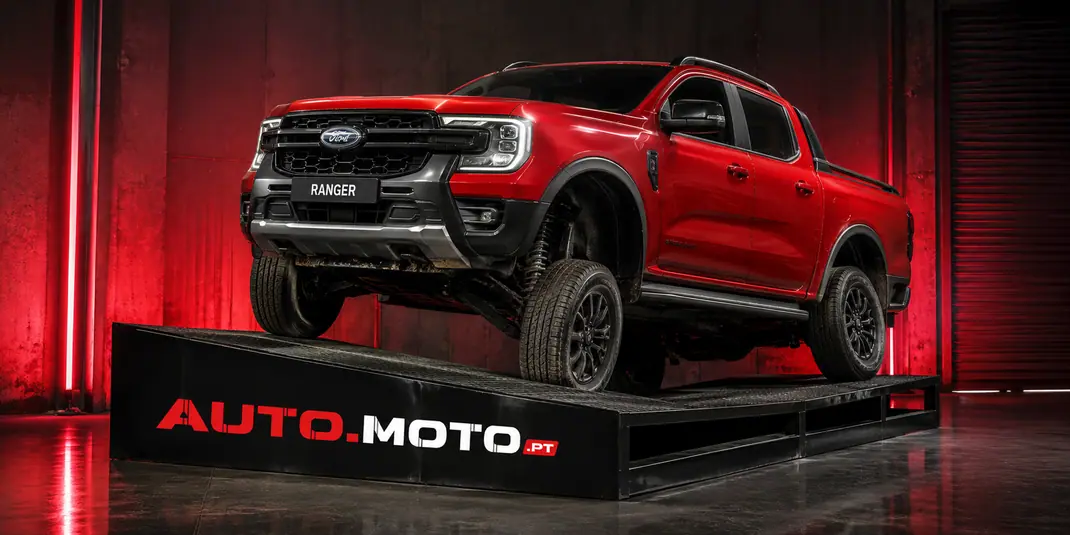
The Ford Ranger is no longer just a pickup truck designed for work. The current generation has managed to bring this type of vehicle closer to a family car, without abandoning its robust construction, four-wheel drive, and ability to tackle difficult terrain.
The arrival of the 3.0 V6 turbodiesel engine further changes this equation. With 240 hp, 600 Nm of torque, and a 10-speed automatic transmission, this version occupies an interesting position between the conventional Ranger and the Ranger Raptor.
For those seeking information about the Ford Ranger price in Portugal, this version also deserves attention, although the final price depends heavily on the equipment and configuration chosen.
A larger and more prepared Ranger
The current generation of the Ford Ranger was presented at the end of 2021 and brought an important evolution compared to the previous one. The base remains a ladder-frame chassis structure, a solution that makes sense in a pickup truck that needs to support loads, trailers, and off-road use.
The wheelbase has grown by 50 mm, reaching 3,270 mm. The double-cab body measures approximately 5.37 meters in length, meaning we are dealing with a very large vehicle for daily use in a Portuguese city.
This size has advantages. There is more space in the cabin, the cargo platform maintains its usefulness, and the body geometry helps when the road is no longer paved.
There were also changes to the chassis structure itself. Ford redesigned the front part of the structure to improve airflow to the cooling system and create additional space for certain equipment. For those who use the Ranger as a work tool, this may be more important than it seems.
Ford Ranger 3.0 V6: what changes in the engine
The big news in this version is under the hood.
The 3.0 EcoBlue V6 engine has a displacement of 2,993 cm³, uses common rail injection and a variable geometry turbocharger. The result is 240 hp and 600 Nm of torque, figures that clearly place this Ranger above the 2.0 diesel versions in terms of available power.
The comparison with the 2.0 Bi-Turbo is interesting. The two-liter engine can reach 205 hp and 500 Nm, so the power difference doesn't seem huge on paper. In real-world use, however, the V6's 600 Nm gives the pickup a more convincing response, especially when there is a load or a trailer behind.
The 0 to 100 km/h acceleration also improves. The 3.0 version can do it in about 8.7 seconds, while the 2.0 Bi-Turbo version is slower.
This is not, of course, the main reason to buy a V6 diesel pickup. The interest lies primarily in how the engine delivers power.
Combined with a large body and an all-wheel-drive system, the V6 becomes especially interesting for those who need to tow heavy loads, carry equipment, or simply prefer to have a large reserve of torque available.
Fuel Consumption: How much does the Ford Ranger 3.0 consume?
A V6 diesel engine in a pickup truck of this size cannot be considered economical in the traditional sense of the word.
Depending on the version and usage conditions, consumption can be around 10 liters per 100 km. The real value can increase significantly when the Ranger is used with a load, in the city, on difficult terrain, or with a trailer.
This is precisely where one of the main differences compared to the 2.0 diesel appears.
Those looking for a more affordable Ford Ranger and who don't need to carry heavy loads will probably find more sense in the two-liter versions. However, for those who will regularly explore towing capacity or use the pickup truck for more demanding work, the V6 may justify the additional investment.
The choice, therefore, depends less on the desire to have the larger engine and more on how the Ranger will actually be used.
10-speed automatic transmission
The V6 is paired with a 10-speed automatic transmission.
This may seem like an excessive number, but in a pickup truck of this type there are clear advantages. The shorter ratios help in situations where control and power are needed at low speeds, while the higher ratios allow the engine to remain at lower RPMs on the highway.
On long trips, this contributes to a smoother driving experience.
The transmission also suits the character of the V6 well. Instead of forcing the engine to constantly run at high RPMs, it manages to take advantage of the available torque and quickly choose an appropriate gear.
For daily use, it's a much more comfortable solution than a manual transmission, especially considering the size and weight of the Ranger.
Ford Ranger 4x4: how all-wheel drive works
Another strong point of this version is the all-wheel drive system.
In the higher-end versionsIn the Ranger's basic configuration, Ford uses a more traditional setup, while the V6 has a system that allows selecting different operating modes, including a 4A mode capable of automatically managing power distribution between the two axles.
This possibility is particularly interesting because it allows the use of all-wheel drive even in certain situations on asphalt.
On dry roads with good grip, the two-wheel drive mode remains a logical option. When the surface becomes wet, slippery, or uneven, all-wheel drive plays a much more important role.
This is one of the reasons why the question of Ford Ranger 4x4 price appears so often in searches by those looking for a pickup truck. In this type of vehicle, all-wheel drive is not just an image element. It can be a truly useful tool.
Ford Ranger Wildtrak: the version for those who want more
The Ford Ranger Wildtrak occupies a special position in the line.
It's not as radical as the Raptor, but it offers a fairly balanced combination of work capacity, comfort, and equipment. Depending on the configuration, it may include 18-inch wheels, dual-zone climate control, SYNC 4, seats with more sophisticated trim, keyless entry, adaptive cruise control, and driver assistance systems. (Ford Portugal)
It's probably one of the most interesting versions for those who intend to use the Ranger every day.
The interior is much closer to the environment of a modern SUV than the traditional idea of a work truck. The large central screen, the digital dashboard, and the various electronic systems make the experience very different from that offered by older generations.
Ford Ranger Raptor: a different philosophy
The demand for the Ford Ranger Raptor is enormous, but it's important to realize that we are dealing with a different proposition.
The Raptor was developed for much more extreme use. It has specific suspension, greater ground clearance, off-road tires, FOX shock absorbers, and driving modes designed for off-road use. Ford itself positions it as the most robust and sporty version of the Ranger. (Ford Portugal)
Therefore, the question of Ford Ranger Raptor price shouldn't be analyzed solely by comparing power or equipment.
If the priority is transporting cargo, towing, and driving kilometers on the road, the V6 diesel might be a more rational solution. If the goal is to drive fast off-road and fully exploit the chassis' capabilities, the Raptor is a different story.
And the Ford Ranger MS-RT?
There's also an alternative for those who primarily value style.
The Ford Ranger MS-RT aims to give the pickup a sportier and more distinctive look, visually resembling a road-ready vehicle. Ford Portugal itself currently includes the MS-RT in the Ranger range. (Ford Portugal)
It's a different choice from the Wildtrak and, especially, the Raptor.
While the Raptor clearly focuses on off-road use, the MS-RT is much more linked to design and visual presence. Therefore, those researching Ford Ranger MS-RT are usually looking for something quite specific within that range.
Ranger or Mitsubishi L200?
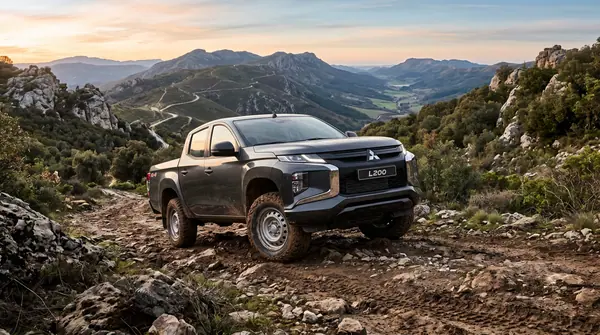
The Ranger isn't alone in this segment. One of the best-known alternatives is the Mitsubishi L200, which maintains a similar philosophy: robust construction, 4x4 traction, and suitability for professional and recreational use.
For those comparing the two, it's worth considering not only power but also dimensions, load capacity, intended use, and maintenance costs.
You can also check the Mitsubishi L200 on AUTO.MOTO.pt and compare the different versions available on the Portuguese market.
How much does a Ford Ranger cost in Portugal?
There isn't a single Ford Ranger price.
The range is extensive enough that the value varies considerably depending on the engine, body style, equipment, and version. A Ranger XLT shouldn't be directly compared to a Wildtrak or Raptor because the equipment level and purpose are different.
It's also important to distinguish between a new Ford Ranger and a used one. In the used car market, the condition of the chassis, maintenance history, mileage, and how the pickup truck was used can have a huge influence on its real value. A used Ranger that spent years towing heavy loads may show completely different wear and tear than one that mainly did highway trips.
Therefore, those researching Ford Ranger prices in Portugal should look beyond the number presented in the advertisement.
What to check in a used Ford Ranger?
Buying a used Ford Ranger requires special attention to certain components.
The first point is the maintenance history. A pickup truck may have been used as a professional tool for many years, and this should be reflected in its mechanical condition.
It is importantCheck the engine, automatic transmission, all-wheel drive system, suspension, and differentials. It's also worth carefully inspecting the chassis and underbody, especially on a unit that has spent a lot of time off-road.
The tires can also reveal a lot about previous use.
A professional inspection before purchase is a good idea. The same principle applies to any used vehicle, but in a pickup truck, the analysis of the chassis and transmission components becomes even more important.
For those looking for other used car options, you can also check out our used car market AUTO.MOTO.pt
Ford Ranger 3.0 V6: for whom does it make sense?
That's the big question.
The 3.0 V6 isn't necessarily the best Ranger for everyone. If the use is mainly urban, without heavy loads and with few annual kilometers, the smaller engine might make more sense.
On the other hand, for those who travel frequently, tow, transport equipment, or simply want a pickup truck with a stronger response, the V6's 600 Nm of torque is a hard argument to ignore.
The combination of a diesel engine, 10-speed automatic transmission, and all-wheel drive also makes the Ranger quite versatile.
To learn about the range and compare equipment directly, you can consult the [EXTERNAL LINK — Ford Ranger in Portugal] Ford Ranger — Ford Portugal. Ford currently offers several versions, including XLT, Limited, Wildtrak, Platinum, Raptor, and MS-RT. (Ford Portugal)
Is it worth buying the Ford Ranger 3.0 V6?
The answer depends mainly on the work expected of the vehicle.
The 3.0 V6 engine transforms the Ranger into a faster, stronger, and more comfortable pickup truck for situations involving cargo or towing. The 240 hp and 600 Nm put it at a clearly superior level to the 2.0 diesel versions, while the 10-speed automatic transmission helps to better utilize the engine's potential.
At the same time, there's no escaping the costs. Fuel consumption is higher than that of lower-displacement versions, and maintaining a pickup with a V6, all-wheel drive, and a complex transmission can be more demanding.The Ford Ranger Wildtrak emerges as one of the most balanced options for those who want to combine work and daily use. The Ford Ranger Raptor is more suitable for those seeking performance and off-road handling. The Ford Ranger MS-RT, on the other hand, follows a more style-focused direction.
Ultimately, it is precisely this variety that has made the Ranger one of the most interesting pickups on the market.
There isn't just one Ford Ranger for everyone. There's a version for every type of use — and the new V6 diesel is probably one of the most complete for those who really need power, traction, and work capacity.