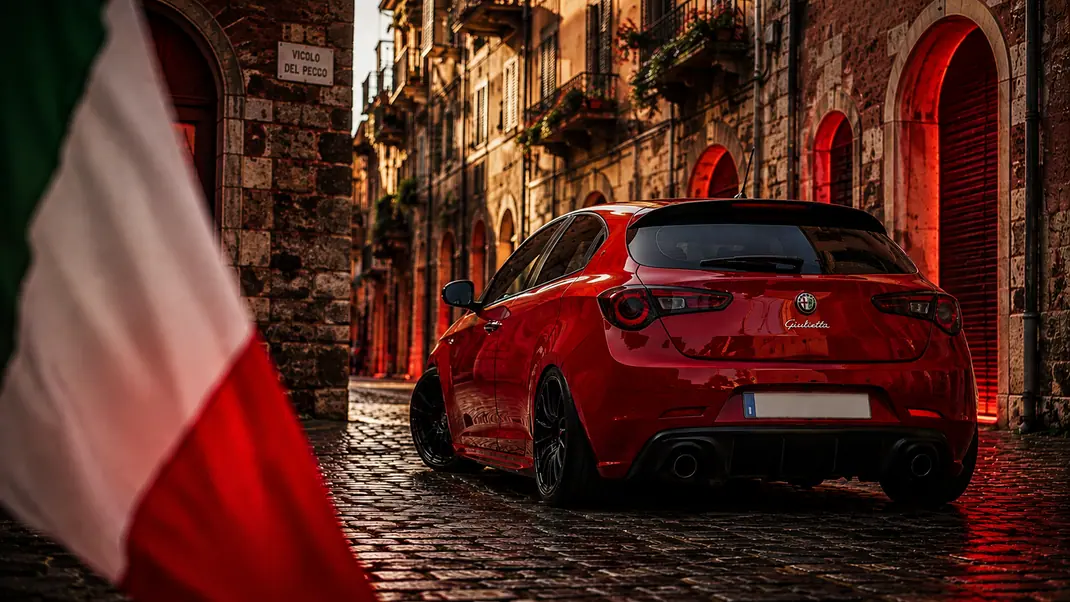
For those thinking about buying a used Giulietta in Portugal, understanding these differences is fundamental. And there's another interesting aspect: the model remains a good base for customization and tuning, especially in the more powerful versions. But before thinking about reprogramming, wheels, or suspension, it's essential to understand which version you've chosen and, above all, its condition.
Alfa Romeo Giulietta: a model that has aged well
The Giulietta arrived on the market in 2010 as the successor to the Alfa Romeo 147. The recipe was simple: a five-door body, modern engines, plenty of equipment, and a design capable of standing out in a segment dominated by German offerings. Over the years, the line has received aesthetic changes, new engines, gearboxes, and different equipment levels.
The variety of the line is one of the main characteristics of the Giulietta. The official Alfa Romeo technical documentation includes 1.4 Turbo engines with 120 hp, 1.4 MultiAir with 170 hp, 1750 TBi with 235 hp, 1.6 JTDM-2 with 105 hp and 2.0 JTDM-2 with 170 hp, among other configurations. Alfa Romeo Giulietta — technical specifications
This diversity is an advantage for those looking for a used car, but it also means that two Giuliettas with the same price can be completely different cars. The engine, gearbox, equipment, mileage and maintenance history should be analyzed together.
Buying a Used Alfa Romeo Giulietta: What Really Matters
Shopping for a second-hand Giulietta in Portugal can be a bit misleading at first. Open a few adverts and you will quickly notice that the prices are all over the place. One car looks like a bargain, another costs considerably more, and from the photos there may be very little to separate them.
The difference usually becomes clear once you start looking at what is underneath.
The Giulietta was offered with plenty of different engines, transmissions and trim levels, and most examples you will find today have already had a fair amount of life. Two cars with roughly the same mileage can have completely different stories behind them. One may have been serviced properly throughout its life, while the other may simply have been driven until something needed fixing.
That is why I would be careful with particularly cheap examples. Saving money on the purchase sounds great until you discover that the tyres are finished, the suspension needs attention, the clutch is near the end of its life or the previous owner skipped several services. A few relatively ordinary repairs can wipe out that initial saving surprisingly fast.
The service history is probably the first thing worth asking about. Receipts, inspection records and invoices for replaced parts give you a much better idea of what you are actually looking at. Mileage also needs a little common sense. A Giulietta with 180,000 km should not automatically be crossed off your list. If it has been maintained properly and the owner can show evidence of that maintenance, those kilometres may be far less concerning than a car showing 120,000 km with no convincing history at all.
There are other clues too. Look at the steering wheel, pedals, driver's seat and general wear inside the cabin. None of these things proves anything on its own, but together they can help you decide whether the condition of the car makes sense for the mileage shown on the dashboard.
Pay Attention to the Gearbox: It is easy to spend the whole inspection listening to the engine and forget about the transmission. That can be an expensive mistake.
If the Giulietta has a manual gearbox, try every gear rather than just checking that the car moves. Changes should not require unusual force, and there should be no worrying noises coming from the transmission. The clutch is worth feeling as well. A judder when pulling away or an engagement point that feels particularly strange deserves some attention.
The TCT version needs a slightly different approach. Don't just take it onto an open road, accelerate hard once and decide that everything feels fine. Spend some time driving slowly through traffic, pulling away from junctions and manoeuvring into a parking space. These situations put the gearbox through plenty of small gear changes and are often where an unhappy transmission makes itself known.
Ideally, the car should pull away without a big shudder and shift gears without obvious bangs or long moments where nothing seems to happen. If you can, drive it for long enough to get everything properly warm. Some faults are much harder to notice when the car has only been running for five minutes.
Which Engine Makes Sense for You?
The answer really comes down to what you are going to do with the car.
If your Giulietta is going to spend most of its time on motorways and covering long distances, the diesel versions make plenty of sense. The 1.6 JTDM is the more economical choice, while the 2.0 JTDM gives you noticeably more torque and feels stronger when overtaking or climbing long gradients.
Things look different if most of your driving happens around town or on shorter trips. In that case, one of the petrol engines may suit you better, especially if you enjoy having a little more character when you put your foot down. The 1.4 MultiAir versions are particularly interesting in that respect.
Fuel consumption figures alone should not make the decision for you. Think about how many kilometres you actually drive in a year, where those kilometres happen and what sort of driving you enjoy. A diesel that spends its entire life doing short urban journeys is not necessarily getting the treatment it was designed for. Put the same engine into the hands of someone doing several hundred kilometres every week and the picture changes completely.
So rather than asking which Giulietta engine is “the best”, ask which one fits your life. That usually leads to a much better answer.
Why the Giulietta Still Stands Out
There are newer and more practical hatchbacks out there, so why are people still looking for a Giulietta?
Quite simply, it has some character.
The shape still looks distinctive, the cabin has its own feel and the car is more interesting to drive than plenty of ordinary family hatchbacks from the same period. It is not trying to be the most sensible car in the parking lot, and that is exactly part of its appeal.
But there is a catch. With an older Alfa Romeo, the individual car matters enormously. You can find a Giulietta that feels tight, well looked after and genuinely enjoyable, or you can find one that has been neglected for years and is already asking for money.
That is why I would much rather buy a well-maintained car with a little more mileage than a suspiciously cheap example with an attractive number on the odometer.
Take your time, look at the paperwork, drive the car properly and inspect the things that are expensive to put right. If the history makes sense and the mechanical condition is good, the Giulietta can still be a very enjoyable used car to own.
Alfa Romeo Giulietta Engines
Among the gasoline engines, the 1.4 is probably the most common on the used car market. There are several versions, starting with the 105 hp and going through the 120 hp and 170 hp MultiAir. The difference between them is significant and should not be ignored simply because they all use a 1.4-liter engine.
The 1.4 105 hp version is more geared towards relaxed and economical use. The 120 hp version offers a more interesting compromise, while the 1.4 MultiAir 170 hp is probably one of the most balanced options for those who want a fast Giulietta, but still perfectly usable in everyday life.
At the top of the range we find the 1750 TBi, especially interesting in the Quadrifoglio Verde version with 235 hp. It's a much more performance-oriented option and also one of the most sought-after versions by enthusiasts. In the diesel range, the choice mainly comes down to the 1.6 JTDM and the 2.0 JTDM. The former prioritizes fuel economy and daily use, while the 2.0 offers significantly more torque and is particularly interesting for those who drive many kilometers on roads or highways. The range has also been updated over the years. In later versions, Alfa Romeo introduced, for example, the 1.4 MultiAir with 150 hp, the 1750 TBi with 240 hp, and different configurations of the 1.6 and 2.0 JTDM engines. Alfa Romeo Giulietta — versions and specifications
Alfa Romeo Giulietta 1.4: which one to choose?
If the goal is to find a used Giulietta with a good balance between price, performance, and operating costs, it's worth taking a close look at the 1.4 MultiAir with 170 hp. The engine offers a much more interesting response than the entry-level versions and still leaves room for small performance changes.
The 170 hp version had, according to official Alfa Romeo data, 1,368 cm³, 170 hp, and up to 340 Nm in Dynamic mode. Weighing approximately 1,290 kg, it could reach 100 km/h in 7.8 seconds and a top speed of 218 km/h. Official technical data for the Giulietta 1.4 MultiAir. However, it's not advisable to buy a MultiAir solely based on horsepower. The maintenance history is extremely important. The MultiAir system is a relatively sophisticated technology, and in a used unit, any sign of irregular operation should be investigated before purchase.
It's worthwhile to start the engine cold, check for malfunctions, abnormal noises, or warning lights, and confirm the oil change history. A well-maintained Giulietta MultiAir can be an excellent purchase; a neglected unit can quickly turn a good opportunity into an expensive repair. 1750 TBi and Quadrifoglio Verde For those seeking performance, the 1750 TBi is naturally the most interesting version. With 235 hp in the Quadrifoglio Verde configuration, the Giulietta reaches a completely different performance level compared to the 1.4 versions.
Official Alfa Romeo data indicates 1,742 cm³, 235 hp, 300 Nm in Normal mode and up to 320 Nm in Dynamic mode, with acceleration from 0 to 100 km/h in approximately 6.8 seconds. Official specifications of the 1750 TBi
This is also a version that should be chosen with more care. The purchase price tends to be higher, and maintenance costs can also increase. Therefore, it doesn't make sense to buy a 1750 TBi simply because it appears cheap in an advertisement.
In a car of this type, the maintenance history, the condition of the turbo, the clutch, the brakes, and the suspension are particularly important. An original and well-maintained unit will normally be a good choice.A much better base than a cheaper car that has already undergone several modifications.
1.6 JTDM or 2.0 JTDM?
In diesel engines, the choice depends mainly on usage. The 1.6 JTDM can be an interesting solution for those seeking low fuel consumption and using the Giulietta daily. The 2.0 JTDM, on the other hand, offers more torque and a stronger response, making it especially enjoyable on long journeys.
In the 170 hp versions, the 2.0 JTDM delivers 320 Nm in Normal mode and up to 350 Nm in Dynamic mode, according to Alfa Romeo's technical data. This is a significant difference compared to the 1.6 and explains why the 2.0 is particularly interesting for those who value acceleration. Official technical data for diesel engines
In a used diesel car, it is important to check components such as DPF, EGR, turbo, injectors, clutch, and dual-mass flywheel. The higher the mileage, the more important it is to know the car's history. It is also worthwhile to understand how the car was used. A diesel car that has spent most of its life in the city may exhibit very different wear and tear than another with the same mileage but used primarily on the highway.
Most Common Problems with the Giulietta
The Giulietta should not automatically be considered a problematic car. As with any used car over ten years old, the condition of each example depends heavily on maintenance and previous use.
Among the points that deserve attention are electrical components, sensors, multimedia system, Stop&Start, climate control, and some interior elements. It is also worth carefully observing the suspension. During the test drive, pay attention to noises when driving over degraded surfaces, harsh knocks, or strange steering behavior.
For gasoline engines, the maintenance history should be a priority. For diesel engines, it is equally important to understand whether the car has mainly been used for short trips or long journeys. And in a unit equipped with a TCT automatic transmission, the transmission's behavior should be analyzed with special attention. TCT Transmission Some versions are equipped with the TCT dual-clutch automatic transmission. It's an interesting solution for daily use, but it should be carefully tested before purchase.
The gearbox should start smoothly and perform gear changes without strong vibrations, knocks, or hesitations. It's also important to test low-speed maneuvers, where any problems may become more evident.
If there are any strange symptoms, it's best to have a diagnosis done before buying. A faulty automatic transmission can quickly turn a cheap Giulietta into a rather expensive purchase.
How much does a used Giulietta cost in Portugal?
Prices vary considerably because there are many different configurations. An entry-level 1.4 and a 1750 TBi Quadrifoglio Verde belong practically to two different worlds, even sharing the same body.
Therefore, it's not worth comparing only the advertised price. A more expensive Giulietta, but with a complete history, proven maintenance, recent tires, and suspension in good condition, may end up being a much more economical purchase than a cheap example that needs several repairs.
It's also important to confirm all the vehicle's characteristics, especially when dealing with an imported or modified unit. The gov.br website provides an official certificate of technical characteristics, which allows you to confirm data such as frame and engine numbers, tire sizes, fuel type, transmission, vehicle category, and tare weight.
This can be a very useful tool when there are doubts about the specifications of a used car or when the vehicle has already undergone modifications: Where And How To Buy A Used Car In Portugal
Alfa Romeo Giulietta and tuning: what's worth changing?
The Giulietta is also of interest to those seeking a tuning project, but it's not necessary to start with extreme modifications. The 1.4 MultiAir 170 hp engine is probably one of the most interesting bases for moderate tuning, especially through ECU reprogramming. A Stage 1 tuning can improve engine response, acceleration, and torque delivery. The most important thing, however, is to choose a calibration appropriate to the engine's condition and not simply seek the highest possible horsepower.
After the electronics, it makes more sense to look at tires, suspension, and brakes before moving on to more profound engine changes. A Giulietta with good tires, shock absorbers in good condition, and well-tuned geometry can be much more enjoyable to drive without any radical modifications.
Wheels, suspension, and appearance
Wheels are one of the simplest changes to completely alter the appearance of the Giulietta. However, a larger wheel is not automatically better. The weight, width, and tire used directly influence handling and comfort.
The same applies to the suspension. Lowering the car slightly can improve the appearance.Suspension and reduced body roll, but an overly aggressive setup can worsen comfort and make the car less pleasant on Portuguese roads.
There is also a legal issue that should not be ignored. gov.pt indicates that certain alterations to the vehicle's characteristics, including tire and wheel dimensions, must be registered on the vehicle registration certificate. Altering vehicle characteristics on the registration certificate
The IMT (Portuguese Institute for Mobility and Transport) further specifies that certain alterations to the structure, body, engine, systems, or components of a vehicle may be considered transformations and require prior authorization.
Therefore, before installing components that alter the homologated characteristics of the Giulietta, it is important to first confirm the applicable procedure.
What to check before buying
A careful inspection can prevent many problems. Start with the engine and perform a cold start. Check the idle speed, any noises, smoke, and warning lights. During the test drive, try all the gears, accelerate at different speeds, and observe if the power delivery is linear.
Also test the air conditioning, electric windows, multimedia system, sensors, lighting, and other equipment. Check the condition of the tires and rims and look for signs of repairs to the bodywork.
If it's a modified unit, try to understand exactly what has been changed. A Giulietta that has undergone aggressive modifications may have been used in a much more demanding way than a completely original example.
It is also important to confirm that the existing modifications are properly documented. A modification may seem interesting in the advertisement, but create problems later if it does not conform to the registered characteristics of the vehicle.
Conclusion
The Alfa Romeo Giulietta continues to be an interesting proposition in the Portuguese used car market. It's not necessarily the most rational choice for everyone, but it offers something many rivals can't: personality.
The variety of engines allows you to find an economical version, a balanced option, or a true sports version. And, for those who like to modify cars, there's still room to create a faster, lower, or simply more personalized Giulietta.
The most important thing is to start with the right example. First the car's condition, then the tuning. A well-maintained Giulietta can remain a very interesting car even after many years, while a cheap and neglected unit can quickly turn a seemingly excellent purchase into an expense that's difficult to justify.