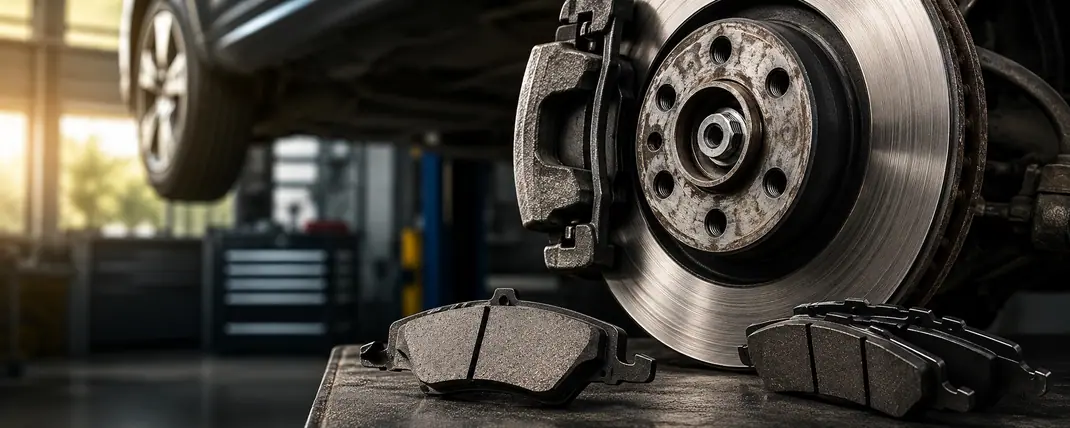
The Physics of Stopping a Two-Ton Mass
Forget pedal feel. Look at the raw, violent physics exploding inside your wheel arch right now. You are piloting a 2,000-kilogram metal missile at 120 kilometers per hour. You expect it to stop dead in four seconds. Utter violence. A brake setup is basically an engine running backward. Instead of turning fuel into motion, it kills motion by turning kinetic energy into brutal radiant heat. You stomp that pedal. A steel pushrod slams into the master cylinder bore. Hydraulic fluid shoots down braided stainless lines at over 1,800 psi. That hydraulic fist forces multi-piston calipers to smash composite friction blocks against a grey iron disc spinning at 1,500 rpm. The contact patch instantly spikes past 400 degrees Celsius under hard braking. Zero mercy for bargain-bin parts. Thermal shock hammers the iron. If those internal cooling vanes inside the vented rotor cannot dump heat into the air, that thermal spike bleeds straight through the steel pad backing plate. Your brake fluid cooks inside the caliper bore at 230 degrees Celsius. Hydraulic pressure dies. Your foot hits the floorboard. Zero braking happens at the wheels. Managing this thermal inferno while maintaining a predictable friction coefficient across thousands of kilometers falls entirely on the structural integrity of your consumable brake pads. Listen to the mechanics of your machine.Every advanced safety system on your vehicle—from multi-channel anti-lock braking modulation to dynamic electronic stability control—remains completely useless if that single square inch of friction material shears off the steel plate or melts under mechanical stress. This physical reality applies to showroom-fresh models and high-mileage used cars alike. Look through your wheel spokes right now. Those dust-covered backing plates represent the absolute boundary separating controlled stopping power from structural destruction against a concrete wall.
Defining the Component: Friction Compounds and Thermal Transfer
Answering what are brake pads means breaking down the component into raw chemical binders, metallurgy, and thermal engineering. Look past the simple backing plate. You are looking at a precision-stamped steel plate bonded to a proprietary friction compound using thermosetting phenolic resins cured under intense pressure and heat exceeding 200 degrees Celsius. Chemical engineers design three dominant friction formulations to survive specific thermal windows and iron disc hardness levels. Semi-metallic pads rule heavy-duty tow rigs and track cars. Why? They blend chopped steel wool, iron powder, copper fibers, and graphite into a heavy block that is 65 percent metal by weight. That metal content acts like a thermal sponge. It sucks heat out of the rotor face fast and dumps it into the caliper body. Massive initial bite. The trade-off is brutal. Expect heavy rotor scoring, nasty black iron dust on your wheels, and a screaming squeal on freezing mornings until the metallic fibers hit 100 degrees Celsius. Ceramic pads go the exact opposite route. Engineers ditch the iron wool for calcined clay, porcelain fibers, and copper flakes glued together by high-temp polymers. These compounds hold a flat, rock-steady 0.35 to 0.40 friction coefficient across massive temperature swings. Zero corrosive iron dust on your rims. Dead quiet. Low-metallic NAO (Non-Asbestos Organic) blends sit right between the two extremes, incorporating synthetic aramid fibers, glass particles, and a light 10 to 30 percent steel fiber addition to optimize cold-weather biting force while preserving soft iron discs. Look closely at the edges of any high-tier backing plate and you will spot a 30-degree chamfered edge cut directly into the friction block. Engineers slice those trailing and leading edges to prevent mechanical grab from triggering audible NVH (Noise, Vibration, and Harshness) frequencies during gentle city braking. A multi-layer stainless steel and vulcanized nitrile-rubber damping shim clipped to the back of the steel plate completes the system, trapping high-frequency piston vibrations before they echo through your suspension control arms.
Marketplace Realities: Inspecting Calipers on the Secondary Market
Shopping for used cars on an automotive marketplace requires ignoring shiny paint jobs and getting on your knees to inspect the iron hardware behind the rims. Smart buyers use braking wear as a brutal diagnostic tool to expose mechanical neglect, track abuse, and fake service records long before signing a purchase contract. Look at the rotor face with a high-lumen inspection torch. Healthy cast iron exhibits a uniform, dull grey appearance with a smooth swept path stretching from the inner hub radius to the outer perimeter. Bad news looks like deep, radial circumferential grooves gouged into the metal, proving the previous driver ran the friction material down to bare metal and ground the steel backing plate into the disc. Run your thumb radially outward across the rotor face toward the outer edge. If your fingernail catches a sharp, rusted lip exceeding 1.5 millimeters, that rotor has lost its structural mass through abrasive wear and must be scrapped immediately alongside the pads. Blue thermal burn marks—rainbow-colored heat rings baked into the steel—indicate severe brake fade, repeated mountain descent abuse, or a dragging caliper piston. Uneven pad wear uncovers a hidden mechanical disaster inside floating caliper assemblies. When an outer pad shows 6 millimeters of usable compound while the inner pad is scraped down to a razor-thin 2 millimeters, the caliper slide pins have seized solid inside their rubber boots. Corrosion locks the guide pins. Instead of centering the caliper over the rotor to squeeze both sides equally, the hydraulic piston forces the inner pad against the iron while the outer pad drags constantly against the outer face. Forget the seller's promises of fresh maintenance. A seized slide pin creates continuous parasitic drag, warps iron discs, cooks wheel bearings, and ruins fuel economy. Use these mechanical defects during price negotiations to chop the full replacement cost of a complete two-axle brake job right off the seller's asking price.
The Millimeter Limit: Reading Warning Signs and Friction Loss
Knowing when to change brake pads relies on hard millimeter measurements rather than vague mileage guesses or soft pedal feel. Brand-new passenger vehicle pads arrive from the factory with 10 to 12 millimeters of fresh friction material bonded to the steel plate. You must replace the component the exact millisecond the remaining friction block drops to the 3-millimeter safety threshold. Zero exceptions. Below 3 millimeters, the thin material loses its ability to insulate the hydraulic system, passing extreme thermal radiation directly into the caliper piston and boiling the fluid. Hydraulic failure occurs without warning. Brake engineers rivet acoustic wear indicators onto the steel backing plate—small spring-steel tabs engineered to scrape against the iron rotor when the compound wears down to 2.5 millimeters. That metal-on-metal friction creates a screeching 10,000-hertz acoustic shriek during low-speed stops that refuses to stop until you install fresh parts. European performance cars skip the mechanical screech tabs in favor of single-wire electronic wear sensors slotted into the friction material itself. When the iron disc grinds through the plastic sensor body and severs the internal copper wire loop, it breaks the circuit and triggers an amber warning light on your dashboard. Never ignore that light—especially when evaluating used cars where sellers frequently clear dashboard error codes without actually replacing the worn hardware. Physical mechanical warnings inside the cabin signal advanced structural failure across your wheel ends. A violent steering wheel shudder under heavy braking proves the iron rotor has suffered severe Disc Thickness Variation (DTV) or lateral runout exceeding 0.05 millimeters due to extreme heat warping. Excessive pedal travel—where your right foot sinks deep toward the carpet before feeling hydraulic pressure—means severely worn pads have forced the caliper pistons to extend far out of their bores. Piston hyperextension exposes delicate rubber dust boots to road debris, causing torn seals, fluid leaks, and sudden pressure loss. Look under the hood at your brake fluid reservoir. As your pads wear down, the fluid level drops from MAX toward MIN because fluid stays down in the extended caliper bores. Never top up that reservoir until you inspect all four corners for worn friction blocks.
The Rear Axle Challenge: Electronic Parking Brakes and Caliper Resetting
Front braking systems handle nearly 70 percent of a vehicle's stopping work during emergency stops because forward weight transfer violently compresses the front springs. Rear braking assemblies operate under totally different physics, serving to settle chassis pitch, prevent rear-wheel lockup, and keep the car tracking straight. Because modern vehicle safety suites rely on Electronic Stability Control to perform targeted rear-wheel braking during high-speed cornering, rear friction material often wears out faster than front pads. ESC micro-interventions constantly drag the rear pads. Preparing to change rear brake pads on a modern vehicle introduces a major electromechanical obstacle that simple hand tools will ruin: the Electronic Parking Brake (EPB). Old-school parking brakes used simple steel cables and mechanical hand levers to pull the rear pistons against the rotors. Modern EPB systems replace cables with a high-torque 12-volt electric motor and a planetary gear reduction box bolted straight onto the rear caliper body. That electric motor turns an internal threaded jack-screw shaft inside the hollow hydraulic piston, physically locking the piston against the pad backing plate when parked. Plug a bidirectional OBD2 scanner into the dash port. Boot up the ABS/EPB menu. Command the system into service mode to retract those electric parking actuators. Listen closely. You will hear the small electric motors whine for three seconds as they spin the threaded internal shafts out of the hydraulic pistons. Wait for the scanner confirmation. Once unlocked, grab a standard mechanical compression tool and push the hydraulic piston straight back into the bore. Never pull the 12-volt battery leads while rear calipers hang loose off their brackets. A random voltage spike will trick the EPB computer into running an auto-calibration sweep. It will fire the piston out of the caliper body, blow the rubber seal, and dump DOT 4 fluid all over your shop floor.
Choosing the Replacement: Engineering Standards and Metallurgy
Deciding what is the best brake pad brand requires looking past clever marketing hype and looking for the official ECE R90 approval mark stamped into the steel backing plate. ECE R90 is a strict European safety standard mandating that aftermarket replacement pads perform within a tight plus-or-minus 15 percent window of original equipment factory parts across cold bite, high-speed friction stability, and thermal fade recovery. Cheap, unbranded internet pads shave manufacturing costs by using cheap clay binders, removing copper thermal conductors, and skipping the high-temperature factory scorching process. Those bargain-basement pads glaze over during your first hard downhill descent, leaving you with zero stopping force against a red-hot rotor. World-class original equipment engineering firms—such as Brembo, Ferodo, Textar, ATE, and TRW—supply factory assembly lines for top automakers before packaging the exact same friction formulations for the retail aftermarket. Brembo dominates high-carbon rotor matching and intense heat management, whereas Textar and ATE tune their friction matrices to match European ABS hydraulic pulse frequencies. Ferodo builds bulletproof semi-metallic formulations engineered to handle heavy vehicle loads down mountain passes without suffering thermal decay. Look at the back of any certified pad plate for the two-letter DOT edge code, such as "FF" or "GG." The first letter represents the friction coefficient when cold; the second letter represents the friction coefficient at 300 degrees Celsius. An "FF" stamp means a stable friction coefficient between 0.35 and 0.45, providing ideal stopping balance for daily drivers and heavy crossovers. Upgrading your friction hardware forms just one half of total vehicle maintenance. Once you finish bleeding fresh DOT 4 hydraulic fluid through the lines—making sure its dry boiling point tops 230 degrees Celsius—and torquing caliper carrier bolts to factory specifications, you must address engine health. Understanding what is the best oil for a diesel engine protects your turbocharged powerplant with the exact same relentless engineering discipline you just applied to your braking system. Never compromise on critical mechanical components.
Final Garage Verdict
Bedding-in new friction hardware is an absolute mechanical necessity designed to transfer an even, microscopic film of friction material directly into the pores of the iron rotor surface. Skip this thermal transfer procedure and the fresh pad compound will spot-weld unevenly onto the cold iron disc during your first hard highway stop, creating violent pedal pulsation and permanently glazing the friction block. Drive your vehicle out to a clean, empty stretch of straight tarmac. Accelerate up to 80 kilometers per hour and apply firm, steady pedal pressure to decelerate the vehicle down to 20 kilometers per hour without coming to a complete stop. Slam that partial braking cycle six to eight times in a row. You need to bake the iron rotor core up to 300 degrees Celsius. Notice that sharp, chemical stink bleeding out of the wheel wells? That is the phenolic resin binder inside the pad off-gassing under intense heat. That smell proves thermal transfer is happening. Get back on the throttle immediately. Cruise at 80 kilometers per hour for five straight minutes without touching the brake pedal. Clean airflow will cool the iron rotors evenly across the swept face. Never come to a dead stop and clamp your foot on the brake pedal while the discs are smoking hot. Doing that bakes a localized pad imprint straight into the hot iron, causing permanent disc thickness variation and ruining your new brakes before you even get home.