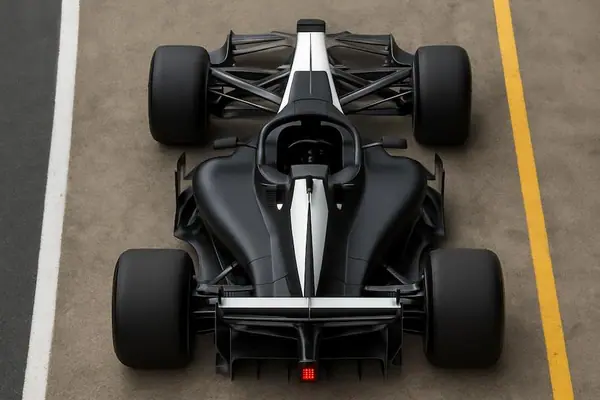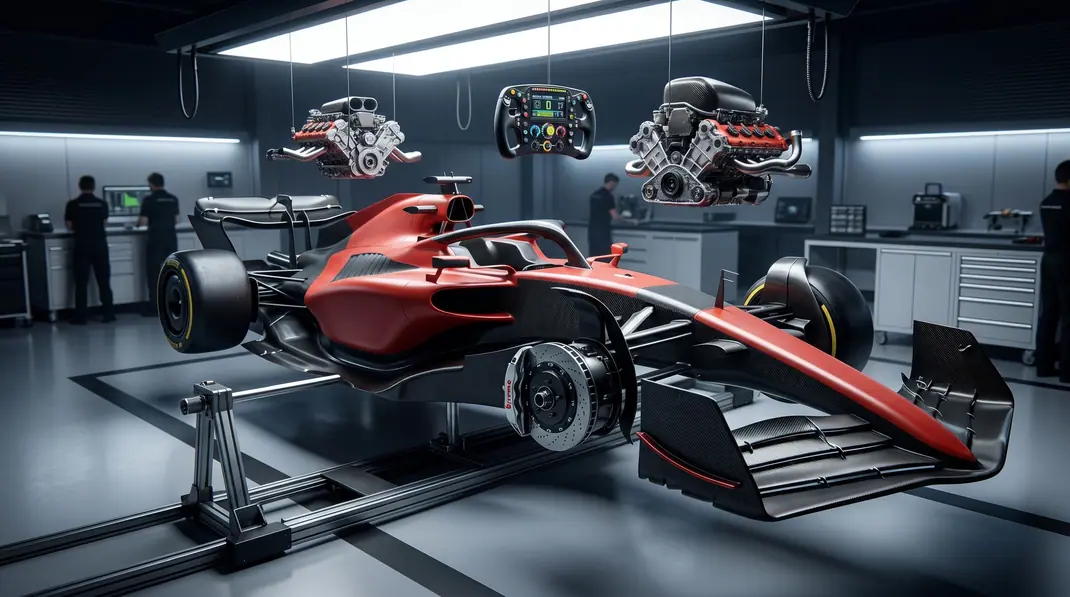
Let’s be completely honest for a minute. When you sit down on your couch on a Sunday afternoon, the TV volume cranked up, watching twenty of the absolute best drivers in the world line up on the starting grid for another Grand Prix, what runs through your mind? We see the raw tension in the drivers' eyes through their visors, we hear the muffled yet terrifyingly potent roar of the hybrid power units, and we stare at those aerodynamic machines that look far more like spaceships glued to the asphalt than actual cars. It is a visceral spectacle, a high-speed choreography of carbon fiber, burning rubber, and pure adrenaline.
But inevitably, the more pragmatic, curious side of our brain wakes up. When we watch a driver miss their braking point by a mere fraction of a second and completely shatter their front wing against the unforgiving barriers of a street circuit like Monaco or Baku, the question forces itself upon us almost aggressively: exactly how much does an F1 car cost?And how much money just vanished into thin air in that tiny lapse of concentration?
Answering this question is not like walking into a local dealership and reading the sticker price on the windshield of a family sedan. There is absolutely no official price list, nor is there a glossy catalog where a racing team can simply order "one single-seater in red, please, with black rims." The true cost of a Formula 1 car is one of the best-kept, most incredibly complex, and fascinating secrets in global sports.
In this article we are going to completely deconstruct a Formula 1 car, piece by piece, titanium bolt by titanium bolt. We are going to look far beyond the superficial glamour and dive deep into the financial madness that actively sustains the absolute pinnacle of motorsport.
1. The Illusion of the "Final Price"
Before we even start adding up imaginary invoices, we absolutely must understand a fundamental concept that separates Formula 1 from the traditional automotive world. An F1 car is never a finished, finalized product; it is a prototype in a constant, frantic state of evolution.
A car that wins the very first race of the long season in Bahrain in early March is, mechanically and aerodynamically, a completely different animal than the one that fiercely crosses the finish line in Abu Dhabi in late November. Teams (such as Ferrari, Mercedes, Red Bull, or McLaren) introduce brand new parts, redesigned floors, and heavily updated wings almost every single week.
Therefore, when we attempt to calculate the "cost," we are strictly referring to the material value of the physical parts that make up the car at one specific moment in time, entirely excluding the billions of dollars invested over decades in giant wind tunnels, massive Computational Fluid Dynamics (CFD) supercomputer simulations, and the hefty salaries of hundreds of brilliant aerospace engineers. If we want to be cold and calculating, just the physical cost of manufacturing and assembling the parts of a single modern F1 car averages around $12 to $15 million.
But how on earth do we reach this stratospheric value? Let’s pop the hood.
2. The Heart of the Monster: The Power Unit
Forget the simple word "engine." In modern Formula 1, strictly governed by the Fédération Internationale de l'Automobile (FIA), the correct term is "Power Unit." And it is, by a massive margin, the most complex and outrageously expensive element of the entire vehicle.
Since 2014, F1 has utilized highly advanced 1.6-liter V6 hybrid turbo engines. It might sound like a tiny displacement (many daily commuter cars have engines this size), but it is a true masterpiece of thermodynamic engineering, capable of violently unleashing over 1000 horsepower. The Power Unit is incredibly complex, composed of six distinct major elements:
- The Internal Combustion Engine (ICE): The traditional V6 heart.
- The Turbocharger (TC): To violently force massive amounts of air into the cylinders.
- MGU-K (Motor Generator Unit - Kinetic): A highly advanced electric motor that recovers the massive kinetic energy generated during brutal braking zones and instantly transforms it into electricity.
- MGU-H (Motor Generator Unit - Heat): A piece of absolute science-fiction technology bolted to the turbocharger that converts the extreme heat and energy of the exhaust gases into raw electricity.
- The Energy Store (ES): The ultra-lightweight, incredibly high-density battery packs.
- The Control Electronics (CE): The supercomputer brain that flawlessly manages the delicate dance between all these volatile components at thousands of revolutions per minute.
The estimated cost of a single complete Power Unit sits at roughly $10 million to $12 million. It is a value so utterly absurd that the FIA strictly caps the number of engines each driver is legally allowed to use per year (currently just four) to actively try and prevent wealthy teams with infinite budgets from completely ruining the smaller competitors.
The wonderful, beautiful irony of all this is that the brutal, tireless development of this hybrid technology to secure victory on Sunday is, slowly but inexorably, completely transforming the real world. Today, the highly efficient battery management software that was born under the immense pressure of F1 heavily influences the vehicles we drive daily, helping to massively improve everything from premium luxury sedans down to the humble used electric cars that families search for in the secondary market to try and save money on daily fuel costs.
3. The Skin and the Skeleton: The Chassis and the Halo
If the power unit is the beating heart, the carbon fiber chassis is the impenetrable skeleton that fiercely protects the driver. Officially called the monocoque, this vital survival cell is literally baked in giant ovens (autoclaves) under extreme temperatures and pressures. It is meticulously designed to be incredibly lightweight, yet capable of safely withstanding massive frontal and lateral impacts in the range of dozens of G-forces. The complex manufacturing of a single monocoque can easily cost around $600,000 to $700,000.
And sitting prominently right above the driver's head, we find the most polarizing, yet heroic element introduced in the modern racing era: the Halo. This thick titanium wishbone-shaped structure, which only weighs about 7 kilograms, is incredibly strong enough to support the massive weight of a classic double-decker London bus falling directly on top of it. It was designed to physically deflect giant flying debris or the heavy wheel of another car flying straight toward the driver's vulnerable helmet. Manufactured by highly certified external aerospace companies, the Halo itself costs roughly $15,000. It is an almost laughable price when we seriously think about the human lives it has unequivocally saved—just remember Romain Grosjean’s terrifying, fiery accident in Bahrain in 2020 or the scary collision where Verstappen's tire landed on Hamilton's head in Monza in 2021.
4. Sculpting the Wind: The Aerodynamics
Formula 1 is, at its absolute core, an invisible, high-speed war against the air. The air is thick, highly resistant, and totally unforgiving when you attempt to punch through it at 220 mph (350 km/h). Teams spend colossal slices of their budget designing intricate parts that efficiently slice the air, generating what is known as downforce—the invisible weight that literally crushes the car against the ground, allowing it to take corners at speeds that actively defy human logic and physics.
- The Front Wing: This is absolutely not just a simple piece of shaped carbon fiber. It is a highly complex, millimeter-perfect sculpture designed to deliberately redirect the "dirty" turbulent air around the massive front tires and seamlessly feed the crucial floor of the car. Composed of dozens of multiple movable elements (flaps), a brand new front wing costs about $150,000. When a driver gives a tiny "tap" in the chaotic first corner and is forced to pit to change the nose, they have just thrown the equivalent price of a nice suburban house straight into the garbage bin.
- The Rear Wing and DRS: The prominent rear wing, which houses the complex hydraulic mechanism of the DRS (Drag Reduction System) used to open a flap on the straights and facilitate overtaking, hovers around $80,000 to $100,000.
- The Floor: Since the massive reintroduction of "ground effect" aerodynamics in 2022, the hidden floor of the car has become the single most important and highly secret piece for generating massive grip. Its unbelievable three-dimensional complexity, filled with deep venturi tunnels and hidden air channels, means that a single floor easily costs more than $130,000.
5. The Command Center: The Steering Wheel
Think for a moment about the steering wheel inside your normal commuter car. It has a horn, maybe a couple of plastic buttons to turn up the radio volume or answer a Bluetooth phone call, and very little else. Now, look closely at a Formula 1 steering wheel. It is absolutely not a steering wheel; it is a highly advanced onboard supercomputer plastered with dozens of glowing buttons, rotary switches, bright LCD screens flashing real-time telemetry, carbon-fiber gear shift paddles, and sensitive clutch paddles on the back.
A driver, while suffering brutal G-forces on their neck that actively try to rip them out of the seat at 180 mph, desperately needs to use this specific wheel to alter the brake bias corner by corner, constantly adjust the energy delivery mapping of the hybrid engine, key the radio to talk with the pit wall, and carefully manage the fuel mixture to make it to the end of the race.
Every single steering wheel is painstakingly hand-molded to perfectly fit the exact gloves and the specific ergonomic demands of each driver (Lando Norris's wheel layout is completely different from Oscar Piastri's, for instance). The true cost of this marvel of electronic engineering? Somewhere between $50,000 and $90,000. To put things into a shocking perspective, the price of one single, tiny F1 steering wheel could easily buy you two or three brand new Dacia DusterSUVs, one of the most highly practical and accessible family vehicles on the real-world market. It is the brutal, fascinating contrast between engineering without limits and everyday mobility.
6. The Shoes and the Stoppers: A Million-Dollar Wear Rate
Formula 1 violently devours consumable parts at a highly alarming rate, and these consumables are decidedly not cheap.
Let’s start with the only part that actually touches the asphalt: the tires. The official supplier, Pirelli, develops incredibly exotic rubber compounds that only operate efficiently within very narrow, extreme temperature windows (usually well above 200 degrees Fahrenheit). These special tires are never actually bought by the teams; they are heavily restricted and leased from Pirelli for each specific race weekend. A single set of four tires (whether they are the softs, mediums, hards, or extreme wets) has an estimated production and logistical cost of roughly $2,500. In a single busy Grand Prix weekend, one driver can easily burn through 13 sets. Do the math, multiply that by 20 cars across 24 official races on the Formula 1calendar, and the financial value of burnt rubber becomes truly staggering.
And then, there is the extremely pressing need to actually stop the missile. Braking from 205 mph down to 50 mph in a mere 100 meters in just a few seconds demands a braking system from another dimension. The carbon-ceramic brake discs and giant Brembo calipers work glowing red-hot, at extreme temperatures that would literally melt common metals (frequently exceeding 1000 degrees Celsius). A complete set of high-performance brakes, which desperately needs to be constantly replaced for reasons of extreme safety, costs around $35,000.
7. The Hidden "Cost Cap": The War of the Accountants
For decades, Formula 1 was an incredibly reckless sport run on a blank check. Giant factory teams like Ferrari or Mercedes would frequently spend upwards of $400 million per season, desperately burning cash just to find one-tenth of a second per lap, completely obliterating the competition from smaller, struggling privateer teams like Sauber or Williams.
To actively try and save the sport from completely destroying itself and to guarantee much closer racing, the FIA and the commercial rights holders drastically changed the rules of the game and introduced the highly controversial Cost Cap. Currently, the base spending limit hovers around $135 to $140 million annually per team.
This completely and permanently changed how Formula 1 operates. The true, unsung heroes of a top-tier team are no longer just the crazy aerodynamicists dreaming up spectacular wings in the wind tunnel, but rather the stressed accountants and production managers who must meticulously ensure that the expensive manufacturing of a new chassis does not breach the strict legal limit.
The financial impact of crashes has turned into an absolute logistical nightmare. In the wild past, if a driver completely destroyed a car against the wall on a Friday free practice session, the mechanics simply pulled another immaculate spare chassis out of the truck without thinking twice about the bill. Today, a heavy crash (which can easily cause damages exceeding $2 million if it destroys the engine, chassis, gearbox, and wings) literally means the team will have vastly less money available to develop new upgrade parts at the crucial end of the season, severely limiting their ability to fiercely fight for the lucrative Constructors' World Championship, which is where the real prize money resides, as detailed by the expert journalists at Motorsport.com.
Conclusion: The Perspective of Reality
When we add the hybrid power unit, the carbon chassis, the incredibly complex seamless gearbox with millisecond shifts (about $500,000), the cutting-edge electronics, the hydraulics, and the complex fuel system, we arrive at the mythical, dizzying value of roughly $15 million for one single Formula 1 car. It is a stunning monument to human obsession with absolute perfection, blistering speed, and ultimate victory. It is a high-speed laboratory on wheels, driven by the elite athletes with the absolute best reaction times on planet Earth.
However, as much as we deeply love this furious, billionaire-funded spectacle on alternating Sundays, Monday morning always, inevitably arrives. The sun comes up, the loud alarm rings, and we need to hit the road. While we daydream about these hyper-expensive spaceships racing on the glamorous streets of Monaco, the highly practical and rational reality for most families involves actively seeking safety, solid reliability, and great financial deals on used cars for their daily commute to work, or to safely take the kids to school.