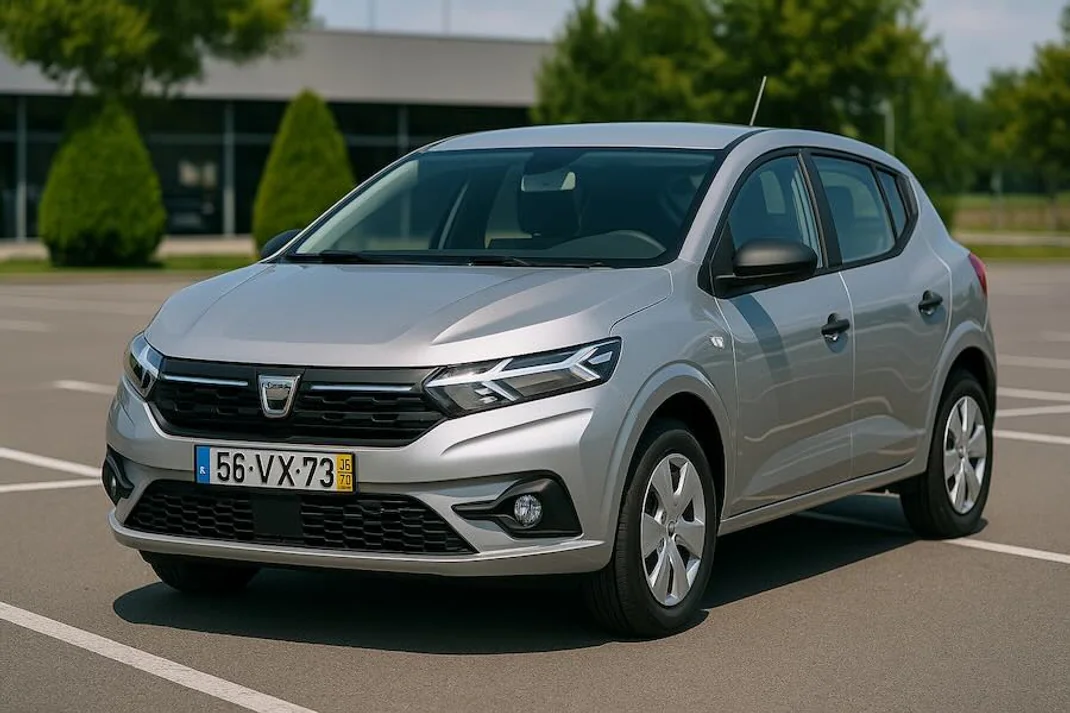
In March 2026, Portugal remains one of the most favorable European markets for those looking for a new car on a limited budget. Despite inflationary pressures on production costs, raw materials, semiconductors, and adaptations to environmental standards (such as the transition to standards equivalent to Euro 7), it is still possible to find entry-level models for under €16,000 in the base version. This affordability is largely due to Dacia's (Renault Group) strategy, which prioritizes simplicity, efficient production in factories in Romania and Morocco, and a focus on essentials without excess technology or design features. While in countries like Germany or France equivalent models often exceed €18,000–22,000, Portugal benefits from a well-developed LPG network, moderate incentives for combustion engines, and competitive prices that keep real options available for tight budgets.
The Dacia Sandero continues to be the cheapest new car on sale in Portugal. The Essential SCe 65 version — equipped with a naturally aspirated 3-cylinder 1.0-liter gasoline engine producing 65 hp — starts at €14,200 (recommended PVPR, including VAT and ISV, excluding administrative and transport fees). This price has remained stable since the 2026 update launch and is confirmed on the official Dacia Portugal website, as well as sources like Razão Automóvel and Caetano Retail (official importer). With active campaigns until March 31, 2026, the effective price can drop to around €14,507 (discounted PVP, including some fees).
Main features of the Essential version:
- SCe 65 engine: average WLTP consumption of 5.3–6.5 l/100 km (real-world mixed use: typically 6.0–6.8 l, according to owner reports).
- 5-speed manual gearbox, front-wheel drive.
- Standard equipment: electric power steering, ABS + EBD + emergency braking assistance, 6 airbags (front, side, and curtain), electronic stability control (ESP) with traction control, speed limiter and regulator, DAB radio with Bluetooth and steering wheel controls, electric front windows, remote central locking, 1/3-2/3 split-folding rear seat, rear parking assistance system.
- Interior space: 5 usable seats (suitable for average-height adults in the rear), 328-liter trunk (expandable to 1,108 liters with seats folded) — one of the most generous capacities in the A/B segment.
- Factory warranty: 3 years or 100,000 km, with the option to extend up to 7 years.
Dacia's philosophy is clear: “less is more.” No giant touchscreens in the base model, no advanced driving assistants (like lane keeping or adaptive cruise) that increase costs, and durable but simple materials. This results in low maintenance costs — Portuguese owners often report annual services between €250–450 (oil, filters, brake pads), low incidence of major breakdowns (according to DECO PROTeste and ADAC surveys), and proven robust mechanics over the years.
Other popular powertrains in the 2026 Sandero:
- TCe 100 (1.0 turbo, 100 hp): starting at around €16,150 in Expression or Journey versions. More dynamic on the road, with WLTP consumption of 5.5–6.0 l/100 km.
- Eco-G 120 (bi-fuel gasoline/LPG, equivalent to 100 hp on gasoline and about 120 hp on LPG): also starting at €16,150 (manual; automatic EDC around €19,050). 49.6-liter LPG tank + gasoline, combined range up to about 1,590 km. With LPG typically costing €0.85–0.95/liter (compared to €1.65–1.80 for gasoline in March 2026), the cost per kilometer drops to 3–4 cents — an unbeatable option for those driving over 15,000–20,000 km per year.
Official sources for 2026 Sandero prices (March 2026):
- Dacia Portugal website
- Razão Automóvel (launch details and prices)
- Caetano Retail
Competitive alternatives (€15,000–20,000 range)
- Dacia Sandero Stepway — starting at around €16,300 (TCe 110 or Eco-G 120). Crossover version with higher ground clearance (+4 cm), plastic protections, roof bars, and a more rugged look. Retains the regular Sandero's economy but gains versatility on uneven roads or light off-asphalt use.
- Fiat Grande Panda — starting at around €16,859 in base versions. Available in mild-hybrid or pure gasoline, with retro-modern design, 10-inch screen, wireless Apple CarPlay/Android Auto, and superior comfort. A strong alternative to the Sandero in urban environments.
- Citroën C3 — between €15,500–16,500 with campaigns. Stands out for its “Advanced Comfort” suspension (soft and absorbent), bold design, and good interior space, though base equipment is more limited.
- Leapmotor T03 (Chinese-origin electric) — starting at €18,985–19,600. WLTP range of 265–300 km, generous equipment (360° camera, adaptive cruise control, heated seats). Home charging cost around €2–3/100 km.
- Dacia Spring — starting at around €16,900 in the base version. Remains the most affordable new electric on the market: 45 hp motor, WLTP range of 225 km (realistic 180–210 km in city), slow charging (about 7 hours on a wallbox). With Environmental Fund incentives, the effective price can drop below €15,000 in promotions.
Total cost of ownership (TCO) — realistic examples for 3 years/45,000 km
Catalog price is just the starting point. Consider full TCO:
- Sandero SCe 65 (gasoline): fuel ~€1,800/year + maintenance ~€350 + insurance ~€300 (for driver +30 years) + road tax ~€30 + tires ~€150/year ≈ €7,800–8,500 total (excluding depreciation).
- Sandero Eco-G 120 (LPG): fuel savings of €800–1,200/year → TCO ~€6,000–7,000.
- Electrics like Spring or T03: home electricity ~€400–600/year + low maintenance (~€200) → lower TCO in the medium term, despite higher initial investment.
Incentives and campaigns: Dacia offers free maintenance for 2 years on some variants (until 31/03/2026), renting at €80–130/month (with down payment), Mobilize financing (TAEG ~10–11%). Residual value: Dacia loses about 35–40% in 3 years (better than the segment average).
Safety: Base versions include ESP, 6 airbags, and basic autonomous emergency braking (historical Euro NCAP 2–3 stars; current generation slightly improved). For more advanced ADAS (sign recognition, lane keeping), choose Expression or Journey.
Practical advice: Always do a test drive, compare offers from 3–4 dealerships (differences of €500–1,500 are common), check stock and limited promotions.
Evolution and context: why does the Sandero dominate?
Since 2012, the Sandero has been the sales leader in the affordable segment in Portugal. Prices have risen ~20–25% since 2020 (due to inflation and chip shortages), but remain competitive. In 2026, with electrics gaining ground (but still expensive for many), the Sandero and its LPG variants remain unbeatable for mixed daily use — urban, suburban, or long trips.
Conclusion
In March 2026, the Dacia Sandero Essential SCe 65 at €14,200 clearly answers the question of the cheapest new car in Portugal. It is simple, spacious, reliable, and economical — especially the Eco-G for high mileage. For emission-free urban driving, the Spring; for more style or comfort, the Fiat Grande Panda or Citroën C3. The Portuguese market still preserves good options for real budgets — something increasingly rare in Europe. Check official configurators, negotiate multiple offers, and take advantage of campaigns until the end of March.