1. Introduction: What Does "Powertrain" Actually Mean?
In the vast and complex world of automotive engineering, there are terms we use every day without fully understanding their profound depth. When flipping through catalogs, watching video reviews, or browsing the market for used cars, the term "powertrain" (often translated as grupo propulsor in Portuguese) constantly appears. But what, in its essence, is a powertrain?
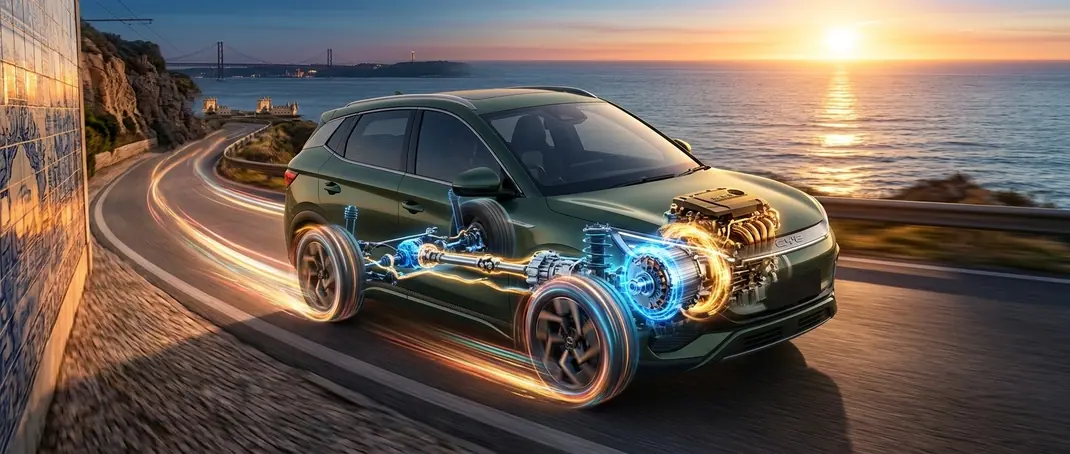
Many drivers mistakenly assume that the powertrain is just a fancy synonym for "engine." While the engine is undeniably the star of the show, the powertrain is actually the entire performance. According to the rigorous technical definition detailed in the Wikipedia article on Powertrains, the powertrain encompasses absolutely all mechanical and electronic components that generate power and physically transmit it to the road surface, causing the vehicle to move.
Think of your car as a living organism. If the chassis is the skeleton and the Electronic Control Unit (ECU) is the brain, the powertrain is the heart, the lungs, the circulatory system, and the musculature, all working in perfect unison. Without an efficient, well-maintained powertrain, even the most stunning automotive design is nothing more than an inert metal sculpture.
2. The Fundamental Difference: Powertrain vs. Drivetrain vs. Engine
To become true experts in vehicle evaluation, whether for daily driving or commercial purposes, we need to separate the concepts:
- The Engine: This is the power-generating unit. It converts fuel (gasoline, diesel, hydrogen) or electricity into mechanical force (rotation).
- The Drivetrain: This is the assembly of parts that carries the power from the engine to the wheels. It includes the gearbox, driveshaft, differential, and axles, but excludes the engine itself.
- The Powertrain: This is the complete package. It is the sum of the Engine + Drivetrain.
3. Deep Anatomy: The Internal Combustion Engine (ICE)
To understand the whole, we must dissect the parts. Let's start with the traditional heart: the thermal engine. Despite growing electrification, the vast majority of used cars on the roads of Portugal and Europe today still rely on internal combustion.
3.1. The Engine Block and Cylinders The block is the foundation. Inside it, we have the cylinders, where the magic (or rather, the chemistry) happens. In a common four-stroke engine, the cycle of Intake, Compression, Combustion, and Exhaust repeats thousands of times per minute. The efficiency of this process determines the car's power output and fuel economy.
3.2. The Crankshaft and Valve System The explosion pushes the piston downwards. This linear force must be converted into rotary motion to turn the wheels. The crankshaft does exactly that, similar to the pedals of a bicycle. Meanwhile, the intake and exhaust valves, controlled by the camshaft, open and close in milliseconds to let air in and exhaust gases out.
Strict standardization organizations, such as SAE International, set global tolerance standards for these parts, ensuring that modern engines can withstand extreme pressures over hundreds of thousands of kilometers.
4. The Gearbox: The Mechanical Brain of Power
A combustion engine has a very limited rev range where it produces efficient power (the "redline" on the tachometer). If we connected the engine directly to the wheels, the car would barely be able to accelerate from a standstill and would reach its top speed at around 30 km/h. This is where the gearbox comes in.
4.1. Manual Transmissions
The historical standard. They require the driver to press the clutch pedal to temporarily disconnect the engine from the gearbox, allowing the mechanical selection of different gears. They are praised for long-term reliability and direct control, being highly sought after by purists acquiring classic sports cars.
4.2. Automatic Transmissions (Torque Converter)
Instead of a dry clutch, they use fluid coupling. Technology has advanced so much that modern 8 or 9-speed automatics are faster and more fuel-efficient than the best human drivers with manual gearboxes.
4.3. Dual-Clutch Transmissions (DCT)
Think of this as two robotic manual gearboxes working together—one for the odd gears and one for the even gears. The result is gear shifts in a matter of milliseconds.
4.4. Continuously Variable Transmissions (CVT)
It has no fixed gears. It uses a system of pulleys and a metal belt to offer an infinite transition of ratios. It keeps the engine at the ideal RPM, making it the top choice for Asian hybrids as it maximizes fuel economy.
5. The Driveshaft and the Differential
The power has left the gearbox. Now what? If it's a front-engine, rear-wheel-drive vehicle, a long metal tube called the driveshaft runs underneath the car. At the end of this shaft lies the differential.
The differential is a masterpiece of engineering invented over a century ago. When a car turns a corner, the wheel on the outside of the curve must travel a substantially greater distance than the wheel on the inside. If both were locked to a solid axle, the car would drag its tires, losing grip and destroying the rubber. The differential allows the two wheels on the same axle to rotate at different speeds while maintaining an uninterrupted delivery of power.
6. Drivetrain Layouts: FWD, RWD, AWD, and 4WD
The powertrain's layout entirely defines the vehicle's dynamics. When evaluating a car, the drive configuration is a deciding factor.
6.1. Front-Wheel Drive (FWD)
The engine, gearbox, and differential are all packaged in a compact block at the front of the vehicle, transferring power directly to the front wheels.
- Pros: Cheaper to produce, offers more cabin space (no transmission tunnel), excellent traction in the rain due to the engine's weight resting over the drive wheels.
- Cons: Prone to understeer (the front of the car "pushes" wide in tight corners).
6.2. Rear-Wheel Drive (RWD)
The classic configuration for sports cars and luxury vehicles.
- Pros: Ideal weight distribution (often 50/50). The front wheels focus solely on steering, while the rear wheels handle propulsion, offering unmatched dynamic balance.
- Cons: Takes up more interior space and requires more careful driving in rain or snow.
6.3. All-Wheel Drive (AWD) and 4WD
AWD is either always active or automatically engages upon loss of traction via electronically managed multi-plate clutches. 4WD is traditionally manually engaged and is intended for pure off-roading (Jeeps and pickups). Organizations like the ACP - Automóvel Club de Portugal frequently recommend AWD models for drivers living in mountainous regions due to their superior stability in icy conditions.
7. The 21st Century Revolution: The Electrified Powertrain
We are living through the greatest disruption in automotive history. The MIT Technology Review has extensively documented how electrification is not just a fuel change, but a total reinvention of the powertrain.
7.1. The Hybrid Powertrain (HEV and PHEV)
Complexity taken to the extreme. A hybrid powertrain combines a combustion engine, one or more electric motors, a high-voltage battery, and a sophisticated planetary gearbox. They can run on electricity alone, gasoline alone, or with both systems joining forces for maximum power.
7.2. The 100% Electric Powertrain (BEV)
Paradoxically, the shift to electric has massively simplified the hardware. In a Tesla, for example, the powertrain consists of:
- The battery (energy storage).
- The inverter (converts direct current from the battery to alternating current for the motor).
- The electric motor (stator and rotor).
- A simple speed reducer (most EVs do not have multi-speed gearboxes, using a single fixed ratio). The result? Fewer moving parts, less vibration, less mechanical wear, and brutally instantaneous acceleration response.
8. How the Powertrain's Condition Dictates Market Value
If your goal is trading, pay close attention: the condition of the powertrain is the most critical factor in the financial valuation of a vehicle. When buying or selling used cars, the bodywork can be immaculate and the leather seats can smell like new, but if the powertrain is compromised, the vehicle is a financial liability.
Red Flags for Buyers:
- Fluid Leaks: Black oil (engine), reddish oil (transmission), or green/pink coolant under the car are signs of degraded gaskets and seals.
- Exhaust Smoke: Blue smoke indicates the engine is burning oil (worn piston rings). Thick, persistent white smoke indicates coolant in the combustion chamber (blown head gasket).
- Transmission Noises: Clicking sounds when reversing (worn CV joints) or hesitation and jerking when an automatic shifts gears signal repairs that could cost thousands of euros.
- Slipping Clutch: In a manual car, if the RPMs rise but the speed doesn't follow, the clutch (a vital part of the powertrain) has reached the end of its life.
9. Preventive Maintenance: Protecting Your Investment
The secret to a powertrain that surpasses the 300,000-kilometer mark without needing an engine rebuild lies in one word: lubrication. The metal surfaces inside an engine and a gearbox move with minuscule tolerances.
- Strict Oil Changes: Oil degrades with heat and hydrocarbon contamination. Following (or anticipating) the manufacturer's intervals is the best life insurance for the engine.
- Timing Belt Attention: The timing belt (or chain) synchronizes the upper and lower parts of the engine. If it snaps while driving, the pistons collide with the valves, destroying the engine instantly.
- Automatic Transmission Service: Many manufacturers claim that automatic gearbox oil is "lifetime." Experienced mechanics disagree and recommend changing it every 80,000 or 100,000 km to prevent valve body failure.
- Thermal Management: Excessive heat is the great destroyer of automatic transmissions and EV batteries. Keep radiators clean and fluid levels correct.
10. The Future of Powertrains
What can we expect for the next decade? With the rapid advancement toward a zero-carbon future, traditional combustion engines will give way to electric powertrains featuring solid-state batteries, which promise higher energy density, charging times in minutes instead of hours, and unmatched thermal safety. Furthermore, software will become as important as hardware, with Artificial Intelligence actively managing power delivery to maximize range every millisecond of driving.
11. Conclusion: Knowledge is Power (and Savings)
Deeply understanding what a powertrain is and how its architecture influences everything—from fuel consumption to maintenance costs—transforms you from a common driver into an insightful automotive expert. Whether you prefer the organic feel of a manual transmission and rear-wheel drive in a weekend classic, or the silent, technological efficiency of a hybrid model for city traffic, the powertrain is the foundation of the entire experience.
In the demanding and dynamic national market, arming yourself with this knowledge is your greatest protection against bad deals and your best tool for adding value to your own vehicle.
Is it time to put this knowledge to the test? If you are looking for the perfect vehicle that combines mechanical reliability and fair prices, or if you have a car with a flawless powertrain that you wish to sell, your place is on the largest and most transparent digital marketplace in Portugal.
Do not rely on shady middlemen. Join our platform and do business securely.